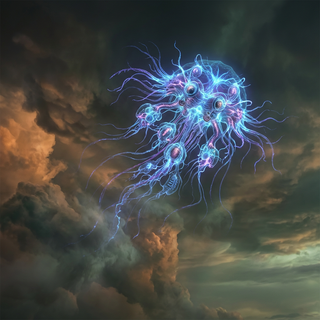
Nimboplasma gravitas
KNOWN INTEL
BIOLOGY
Nimboplasma gravitas is a colonial, plasma-like organism that exists within the dense, turbulent cloud decks of Aetherion V, a gas giant characterized by high gravity (2.53g) and a hydrogen-helium dominated atmosphere. Its cellular structure is not based on traditional lipid membranes but rather on self-contained electromagnetic fields that stabilize micro-pockets of ionized gas and metallic dust particles, primarily iron and nickel, suspended within the organism’s matrix. These “cells” utilize a form of magnetocaloric metabolism, extracting energy from the extreme temperature gradients within the cloud layers by cycling between magnetic heating and cooling phases. Methane (CH4) and ammonia (NH3) traces in the atmosphere act as catalysts for low-energy plasma reactions, providing supplementary energy through chemical ionization processes. This adaptation is critical in an environment with unknown equilibrium temperatures, allowing Nimboplasma gravitas to survive across a wide thermal range by dynamically adjusting its internal plasma state. Structurally, Nimboplasma gravitas resembles a sprawling, amorphous lattice of interconnected plasma filaments, extending up to 50 meters in diameter for a mature colony. Its body is not solid but a semi-fluidic network of charged particles that continuously shift and reform under the influence of internal magnetic fields. This structure is an evolutionary response to the high gravity of Aetherion V, as a rigid or dense body would collapse under such forces. Instead, the organism’s low-density, gas-like composition allows it to remain buoyant within the cloud decks, while the metallic dust within its matrix provides electromagnetic shielding against potential radiation from the G-type host star. The constant reformation of its structure also prevents catastrophic damage from the violent atmospheric storms prevalent on gas giants, as the organism can dissipate and reassemble after disruption.
SENSES
Nimboplasma gravitas perceives its environment through magnetoreception and pressure wave detection. It senses fluctuations in Aetherion V’s intense magnetic field, generated by the planet’s metallic hydrogen core, to navigate the cloud decks and detect nearby storm systems or density variations in the atmosphere. Additionally, it detects low-frequency pressure waves caused by turbulent gas flows, using these as a form of echolocation to map out its surroundings in three dimensions. This sensory system is entirely non-visual, as traditional optics would be useless in the opaque, dense atmosphere of a gas giant. Communication among colonies of Nimboplasma gravitas occurs through modulated electromagnetic pulses, which travel through the conductive atmosphere as bursts of low-energy plasma waves. These pulses encode information about environmental conditions, colony health, and reproductive readiness, allowing distant colonies to synchronize behaviors such as migration or resource sharing. This method of communication is highly efficient in the hydrogen-rich atmosphere, where electrical conductivity is high, ensuring signals can propagate over vast distances without significant loss.
LOCOMOTION
Nimboplasma gravitas moves through the cloud decks of Aetherion V by manipulating its internal magnetic fields to interact with the planet’s global magnetic field. By generating localized electromagnetic repulsion or attraction, the organism creates directional thrust, propelling its amorphous form through the dense atmosphere. This movement is slow and deliberate, resembling a drifting cloud of glowing particles, but it is highly energy-efficient in the high-gravity environment of 2.53g, where traditional mechanical locomotion would be infeasible. The organism can also adjust its buoyancy by altering the density of its plasma matrix, allowing it to ascend or descend through different atmospheric layers in search of optimal temperature gradients for energy extraction. The physics of this movement relies on the interplay between electromagnetic forces and the buoyant properties of hydrogen and helium, ensuring stability in the turbulent gas giant environment.
REPRODUCTION
Nimboplasma gravitas reproduces through a process of fragmentation, where a mature colony will periodically split off smaller clusters of plasma filaments when environmental conditions are favorable. These fragments, carrying a portion of the parent colony’s magnetic signature, drift independently until they accumulate enough atmospheric particles to form a stable, self-sustaining matrix. There is no concept of “individual” in this species; each colony operates as a distributed network of semi-autonomous nodes, sharing energy and information through electromagnetic connections. This colonial structure ensures resilience in the harsh environment of Aetherion V, as damage to one part of the colony does not impair the whole. There is no parental care or raising of offspring in the traditional sense. Instead, fragments inherit a rudimentary “memory” of environmental data encoded in their magnetic fields, allowing them to adapt quickly to local conditions. Socially, colonies exhibit cooperative behavior, often merging temporarily with others to form vast, transient super-colonies during periods of abundant energy availability, such as during intense atmospheric storms that enhance temperature gradients. This distributed, non-hierarchical society reflects the fluid, dynamic nature of their existence in a gas giant’s atmosphere.
DYNAMIC NOTES
The biology and behavior of Nimboplasma gravitas are deeply tied to the environmental conditions of Aetherion V. The organism’s plasma-based metabolism is adapted to the unknown equilibrium temperature of the gas giant, leveraging thermal gradients for energy regardless of whether the cloud decks are frigid or moderately warm. The high hydrogen (75%) and helium (24%) content of the atmosphere supports its low-density, buoyant structure, while trace methane (0.3%) and ammonia (0.026%) serve as critical catalysts for its plasma reactions, enabling chemical energy supplementation. The high gravity of 2.53g necessitates its amorphous, non-solid form and electromagnetic locomotion, as any denser or more rigid structure would be crushed or unable to move efficiently. With no significant tidal forces in the system, Nimboplasma gravitas does not require adaptations for cyclical stress, allowing it to focus evolutionary resources on atmospheric navigation and energy extraction. Finally, the radiation environment from the G-type host star, which we designate as Solara Primus, is mitigated by the metallic dust within its matrix, providing a natural shield against charged particles that penetrate the upper atmosphere of Aetherion V at 5.2 AU. These adaptations collectively ensure the organism’s survival in this extreme, alien environment.