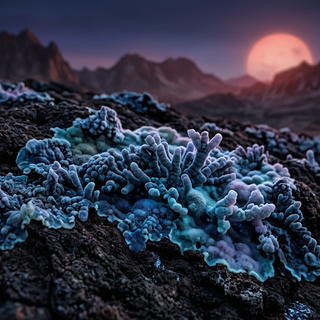
Crypsolithus thermovivax
KNOWN INTEL
CHOSEN HABITAT
Subsurface water ocean at 3–7 km depth beneath the rocky crust, maintained as a high-pressure liquid at 480–520 K due to geothermal heating and pressure stabilization. This layer is the only viable niche for stable liquid water and complex life, as surface temperatures (465–553 K) exceed the boiling point of water at 1 bar, while subsurface pressure (>100 bar) and tidal heating ensure water remains liquid despite the extreme heat. Crypsolithus thermovivax shares this exact layer with Thermovortex infernalis, co-existing by forming dense, encrusting biofilms on the gelatinous lattice structures of the primary species, thereby maximizing surface area for metabolic exchange while avoiding competition for space in the nutrient-rich hydrothermal vent zones.
METABOLIC SYMBIOSIS
Crypsolithus thermovivax and Thermovortex infernalis share a tightly coupled mutualistic relationship centered on the exchange of sulfur and carbon compounds within the extreme conditions of their subsurface ocean habitat. Thermovortex infernalis, through its thermophilic metabolism, oxidizes hydrogen sulfide (H₂S) sourced from hydrothermal vents, producing elemental sulfur (S₈) and sulfate (SO₄²⁻) as waste products, along with small amounts of volatile organic carbon compounds (VOCs) as metabolic byproducts. Crypsolithus thermovivax, in turn, is a chemolithotrophic organism that reduces elemental sulfur and sulfate back into hydrogen sulfide using the VOCs as an electron donor and carbon source, completing a closed-loop sulfur cycle. The H₂S produced by Crypsolithus thermovivax is then reabsorbed by Thermovortex infernalis as a primary energy substrate for its chemosynthetic pathways, while Crypsolithus thermovivax incorporates the carbon from VOCs into its cellular biomass via a modified acetyl-CoA pathway adapted to high temperatures and pressures. This exchange is critical to both organisms' survival. If the supply of elemental sulfur or sulfate from Thermovortex infernalis is interrupted, Crypsolithus thermovivax faces energy starvation, as it lacks alternative electron acceptors in the oxygen-deprived subsurface ocean, leading to population collapse. Conversely, without the regenerated H₂S from Crypsolithus thermovivax, Thermovortex infernalis experiences a drastic reduction in available energy substrates, stunting its growth and reducing its ability to maintain its expansive lattice structures. This symbiotic relationship likely evolved as a response to the limited availability of usable chemical energy in their high-pressure, high-temperature niche, driving the co-evolution of these two species into an interdependent biochemical network.
BIOLOGY
Crypsolithus thermovivax is a colonial, biofilm-forming organism with a structure reminiscent of terrestrial lichens or microbial mats, but adapted to the extreme conditions of Proxima Centauri b’s subsurface ocean at 480–520 K and pressures exceeding 100 bar. Its cellular chemistry is based on thermophilic proteins and lipid membranes fortified with polycyclic aromatic hydrocarbons (PAHs), mirroring the adaptations of Thermovortex infernalis and ensuring stability against thermal denaturation and pressure-induced collapse. Individual cells are microscopic, spherical units lacking any centralized structure, embedded within a dense, mineralized matrix of silica and sulfur compounds that the organism precipitates from the surrounding water as a protective exoskeleton. This matrix not only shields the colony from turbulent convective currents but also serves as a storage medium for elemental sulfur, a key metabolic resource received from Thermovortex infernalis. The metabolic pathway of Crypsolithus thermovivax is a specialized form of chemolithotrophy, centered on the reduction of sulfur compounds. It processes elemental sulfur (S₈) and sulfate (SO₄²⁻) excreted by Thermovortex infernalis, using volatile organic carbon compounds (VOCs) as an electron donor to drive the reaction, producing hydrogen sulfide (H₂S) as a waste product. This biochemistry is shaped by the habitat’s extreme heat and pressure, which necessitate high-energy intermediates and enzymes with robust tertiary structures to function in near-critical water conditions. The high-pressure environment also influences the organism’s compact, dense colonial structure, minimizing energy expenditure on
SENSES
Crypsolithus thermovivax lacks visual or auditory senses, instead perceiving its environment through chemosensory mechanisms embedded in its cellular membranes. Specialized protein complexes detect gradients of sulfur compounds and VOCs in the surrounding water, allowing the organism to identify areas of high metabolic exchange potential with Thermovortex infernalis. Communication within the colony occurs via quorum sensing, where cells release and detect signaling molecules (likely sulfur-containing thiols) to coordinate biofilm growth and metabolic activity. Interaction with Thermovortex infernalis is purely chemical, mediated by the diffusion of waste products and regenerated H₂S across their shared interface, with no direct behavioral signaling required.
LOCOMOTION
and maximizing surface area for nutrient exchange with Thermovortex infernalis. The body plan of Crypsolithus thermovivax is entirely non-motile and non-humanoid, consisting of sprawling, encrusting layers that adhere to the gelatinous lattices of Thermovortex infernalis. These biofilms can span several square meters, forming a patchwork of yellowish-gray crusts speckled with crystalline sulfur deposits. The organism’s reliance on the waste products of Thermovortex infernalis dictates its distribution within the habitat, ensuring that colonies only form in direct proximity to the primary species, particularly near hydrothermal vent zones where nutrient flux is highest. SENSES & COMMUNICATION: Crypsolithus thermovivax lacks visual or auditory senses, instead perceiving its environment through chemosensory mechanisms embedded in its cellular membranes. Specialized protein complexes detect gradients of sulfur compounds and VOCs in the surrounding water, allowing the organism to identify areas of high metabolic exchange potential with Thermovortex infernalis. Communication within the colony occurs via quorum sensing, where cells release and detect signaling molecules (likely sulfur-containing thiols) to coordinate biofilm growth and metabolic activity. Interaction with Thermovortex infernalis is purely chemical, mediated by the diffusion of waste products and regenerated H₂S across their shared interface, with no direct behavioral signaling required. LOCOMOTION: Crypsolithus thermovivax is entirely sessile, lacking any form of active locomotion. Its colonial biofilms grow by cellular division and matrix deposition, spreading across the surfaces of Thermovortex infernalis lattices or nearby rocky substrates within the subsurface ocean. Movement of the colony as a whole only occurs passively, when fragments are dislodged by strong tidal currents or convective flows and drift to new attachment sites, a process well-suited to the fluid dynamics of the high-pressure subsurface environment at 3–7 km depth.
REPRODUCTION
Reproduction in Crypsolithus thermovivax is asexual, occurring through the fragmentation of biofilms or the release of single cells that nucleate new colonies upon attachment to a suitable substrate, typically the lattice of Thermovortex infernalis. The species is strictly colonial, with no solitary individuals, and its societal structure is emergent rather than intentional—coordinated behavior arises from chemical gradients and quorum sensing rather than centralized decision-making. Population density is directly tied to the availability of Thermovortex infernalis hosts, creating dense, interconnected networks of biofilms in vent-rich zones.
SYMBIOSIS
Crypsolithus thermovivax and Thermovortex infernalis share a tightly coupled mutualistic relationship centered on the exchange of sulfur and carbon compounds within the extreme conditions of their subsurface ocean habitat. Thermovortex infernalis, through its thermophilic metabolism, oxidizes hydrogen sulfide (H₂S) sourced from hydrothermal vents, producing elemental sulfur (S₈) and sulfate (SO₄²⁻) as waste products, along with small amounts of volatile organic carbon compounds (VOCs) as metabolic byproducts. Crypsolithus thermovivax, in turn, is a chemolithotrophic organism that reduces elemental sulfur and sulfate back into hydrogen sulfide using the VOCs as an electron donor and carbon source, completing a closed-loop sulfur cycle. The H₂S produced by Crypsolithus thermovivax is then reabsorbed by Thermovortex infernalis as a primary energy substrate for its chemosynthetic pathways, while Crypsolithus thermovivax incorporates the carbon from VOCs into its cellular biomass via a modified acetyl-CoA pathway adapted to high temperatures and pressures. This exchange is critical to both organisms' survival. If the supply of elemental sulfur or sulfate from Thermovortex infernalis is interrupted, Crypsolithus thermovivax faces energy starvation, as it lacks alternative electron acceptors in the oxygen-deprived subsurface ocean, leading to population collapse. Conversely, without the regenerated H₂S from Crypsolithus thermovivax, Thermovortex infernalis experiences a drastic reduction in available energy substrates, stunting its growth and reducing its ability to maintain its expansive lattice structures. This symbiotic relationship likely evolved as a response to the limited availability of usable chemical energy in their high-pressure, high-temperature niche, driving the co-evolution of these two species into an interdependent biochemical network. BIOLOGY: Crypsolithus thermovivax is a colonial, biofilm-forming organism with a structure reminiscent of terrestrial lichens or microbial mats, but adapted to the extreme conditions of Proxima Centauri b’s subsurface ocean at 480–520 K and pressures exceeding 100 bar. Its cellular chemistry is based on thermophilic proteins and lipid membranes fortified with polycyclic aromatic hydrocarbons (PAHs), mirroring the adaptations of Thermovortex infernalis and ensuring stability against thermal denaturation and pressure-induced collapse. Individual cells are microscopic, spherical units lacking any centralized structure, embedded within a dense, mineralized matrix of silica and sulfur compounds that the organism precipitates from the surrounding water as a protective exoskeleton. This matrix not only shields the colony from turbulent convective currents but also serves as a storage medium for elemental sulfur, a key metabolic resource received from Thermovortex infernalis. The metabolic pathway of Crypsolithus thermovivax is a specialized form of chemolithotrophy, centered on the reduction of sulfur compounds. It processes elemental sulfur (S₈) and sulfate (SO₄²⁻) excreted by Thermovortex infernalis, using volatile organic carbon compounds (VOCs) as an electron donor to drive the reaction, producing hydrogen sulfide (H₂S) as a waste product. This biochemistry is shaped by the habitat’s extreme heat and pressure, which necessitate high-energy intermediates and enzymes with robust tertiary structures to function in near-critical water conditions. The high-pressure environment also influences the organism’s compact, dense colonial structure, minimizing energy expenditure on locomotion and maximizing surface area for nutrient exchange with Thermovortex infernalis. The body plan of Crypsolithus thermovivax is entirely non-motile and non-humanoid, consisting of sprawling, encrusting layers that adhere to the gelatinous lattices of Thermovortex infernalis. These biofilms can span several square meters, forming a patchwork of yellowish-gray crusts speckled with crystalline sulfur deposits. The organism’s reliance on the waste products of Thermovortex infernalis dictates its distribution within the habitat, ensuring that colonies only form in direct proximity to the primary species, particularly near hydrothermal vent zones where nutrient flux is highest. SENSES & COMMUNICATION: Crypsolithus thermovivax lacks visual or auditory senses, instead perceiving its environment through chemosensory mechanisms embedded in its cellular membranes. Specialized protein complexes detect gradients of sulfur compounds and VOCs in the surrounding water, allowing the organism to identify areas of high metabolic exchange potential with Thermovortex infernalis. Communication within the colony occurs via quorum sensing, where cells release and detect signaling molecules (likely sulfur-containing thiols) to coordinate biofilm growth and metabolic activity. Interaction with Thermovortex infernalis is purely chemical, mediated by the diffusion of waste products and regenerated H₂S across their shared interface, with no direct behavioral signaling required. LOCOMOTION: Crypsolithus thermovivax is entirely sessile, lacking any form of active locomotion. Its colonial biofilms grow by cellular division and matrix deposition, spreading across the surfaces of Thermovortex infernalis lattices or nearby rocky substrates within the subsurface ocean. Movement of the colony as a whole only occurs passively, when fragments are dislodged by strong tidal currents or convective flows and drift to new attachment sites, a process well-suited to the fluid dynamics of the high-pressure subsurface environment at 3–7 km depth. REPRODUCTION & SOCIETY: Reproduction in Crypsolithus thermovivax is asexual, occurring through the fragmentation of biofilms or the release of single cells that nucleate new colonies upon attachment to a suitable substrate, typically the lattice of Thermovortex infernalis. The species is strictly colonial, with no solitary individuals, and its societal structure is emergent rather than intentional—coordinated behavior arises from chemical gradients and quorum sensing rather than centralized decision-making. Population density is directly tied to the availability of Thermovortex infernalis hosts, creating dense, interconnected networks of biofilms in vent-rich zones. DYNAMIC NOTES: Crypsolithus thermovivax is exquisitely adapted to the extreme conditions of Proxima Centauri b’s subsurface ocean at 3–7 km depth, sharing the exact same habitat layer as Thermovortex infernalis. The equilibrium temperature of 509 K, combined with subsurface pressures exceeding 100 bar, drives the organism’s reliance on thermophilic biochemistry and dense, mineralized structures to withstand thermal and mechanical stress. The primary liquid solvent, water (H₂O), remains liquid under these conditions due to tidal heating from the planet’s proximity to its M-type red dwarf star and the gravitational influence of tidal forces, shaping a niche where chemical energy from hydrothermal vents dominates. Gravity at 1.1g slightly increases the energy cost of maintaining structural integrity, while the magnetic field of 0.94 Gauss offers minimal protection from stellar radiation, irrelevant in this shielded subsurface layer. The short day length of 11.2 hours has little impact on this non-photosynthetic species. Co-habitation with Thermovortex infernalis has driven mutual adaptations, such as Crypsolithus thermovivax’s encrusting growth form to maximize contact for metabolic exchange, and Thermovortex infernalis’s expansive lattices providing surface area for biofilm attachment. The chosen habitat layer was selected as the most thermodynamically and chemically viable niche; every adaptation is tied directly to the pressure, temperature, solvent state, and energy fluxes of this exact layer. SYMBIOSIS: The mutualistic relationship between Crypsolithus thermovivax and Thermovortex infernalis is a cornerstone of their shared ecosystem within the subsurface ocean of Proxima Centauri b. The lifecycle of their metabolic exchange begins with Thermovortex infernalis metabolizing hydrogen sulfide (H₂S) from hydrothermal vents, using it as an electron donor in chemosynthesis to produce energy, with elemental sulfur (S₈), sulfate (SO₄²⁻), and volatile organic carbon compounds (VOCs) as byproducts. These waste products diffuse into the surrounding water and are absorbed by Crypsolithus thermovivax biofilms encrusting the host’s lattice. Within Crypsolithus thermovivax, sulfur compounds are reduced back to H₂S using VOCs as an electron donor via a high-temperature acetyl-CoA pathway, with H₂S then diffusing back to Thermovortex infernalis as a renewed energy source. This closed-loop cycle ensures neither species depletes the limited chemical resources of their habitat. Physically, Crypsolithus thermovivax forms encrusting biofilms directly on the gelatinous structures of Thermovortex infernalis, particularly in regions near hydrothermal vents where nutrient flux is highest. This intimate co-location maximizes the efficiency of molecular exchange, with the porous lattice of Thermovortex infernalis acting as a scaffold that supports dense Crypsolithus thermovivax colonies while benefiting from the regenerated H₂S diffusing through its structure. The relationship is so intertwined that the distribution of Crypsolithus thermovivax is entirely dependent on the presence of its host, creating a patchwork of symbiotic zones across the subsurface ocean floor at 3–7 km depth. If either species were to go extinct, the consequences would ripple through the planet’s subsurface chemistry. Without Crypsolithus thermovivax, Thermovortex infernalis would face a critical shortage of H₂S, leading to metabolic collapse and a cascading reduction in biomass, potentially altering the sulfur cycle of the ocean by allowing sulfate to accumulate to toxic levels. Conversely, without Thermovortex infernalis, Crypsolithus thermovivax would lose its primary source of sulfur and carbon compounds, resulting in population die-off and a buildup of unprocessed H₂S, which could destabilize local pH levels. An emergent property of this pairing is the creation of a localized sulfur microcycle, a self-sustaining loop that neither organism could maintain alone. This microcycle not only supports their survival but also stabilizes the chemical environment of their niche, preventing the depletion of critical compounds in an otherwise resource-scarce habitat.
DYNAMIC NOTES
Crypsolithus thermovivax is exquisitely adapted to the extreme conditions of Proxima Centauri b’s subsurface ocean at 3–7 km depth, sharing the exact same habitat layer as Thermovortex infernalis. The equilibrium temperature of 509 K, combined with subsurface pressures exceeding 100 bar, drives the organism’s reliance on thermophilic biochemistry and dense, mineralized structures to withstand thermal and mechanical stress. The primary liquid solvent, water (H₂O), remains liquid under these conditions due to tidal heating from the planet’s proximity to its M-type red dwarf star and the gravitational influence of tidal forces, shaping a niche where chemical energy from hydrothermal vents dominates. Gravity at 1.1g slightly increases the energy cost of maintaining structural integrity, while the magnetic field of 0.94 Gauss offers minimal protection from stellar radiation, irrelevant in this shielded subsurface layer. The short day length of 11.2 hours has little impact on this non-photosynthetic species. Co-habitation with Thermovortex infernalis has driven mutual adaptations, such as Crypsolithus thermovivax’s encrusting growth form to maximize contact for metabolic exchange, and Thermovortex infernalis’s expansive lattices providing surface area for biofilm attachment. The chosen habitat layer was selected as the most thermodynamically and chemically viable niche; every adaptation is tied directly to the pressure, temperature, solvent state, and energy fluxes of this exact layer.