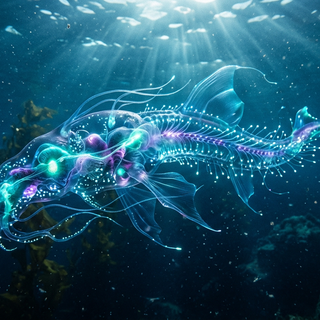
Thalassovolum aquaterris
KNOWN INTEL
CHOSEN HABITAT
Surface water oceans at 0–200 meters depth. This layer is the only viable niche for stable liquid water and complex life due to the temperature range of 255–315K (mean 285K), which ensures water remains liquid at 1 bar pressure, supporting diverse carbon-water biochemistry and abundant energy from sunlight for photosynthesis.
BIOLOGY
Thalassovolum aquaterris is a colonial, gelatinous organism adapted to the temperate, liquid water environment of Earth’s surface oceans at depths of 0–200 meters, where temperatures range from 255K to 315K (mean 285K). Its cellular chemistry is based on carbon-water biochemistry, utilizing a lipid-protein matrix for cell membranes that remain fluid within this mesophilic temperature range. Metabolic pathways rely on oxygenic photosynthesis, facilitated by symbiotic phototrophic microbes embedded within its translucent outer layers, which capture sunlight in the upper ocean layers. Structural materials consist of a flexible, polysaccharide-based gel matrix reinforced with silica spicules, providing buoyancy and protection against moderate currents and predators. This gel matrix also serves as a thermal buffer, mitigating temperature swings between 255K and 315K by storing and slowly releasing heat. The organism’s body plan is a sprawling, net-like structure, resembling a vast, undulating web of interconnected vesicles, with no centralized “body” or symmetry. This form maximizes surface area for nutrient absorption and photosynthetic efficiency in the sunlit ocean layer, while the habitat’s 1 bar pressure and 1g gravity allow for neutral buoyancy with minimal energy expenditure. The ocean habitat shapes its structure by necessitating adaptations to constant water currents and tidal forces (driven by the moon at 0.0123 Earth masses), resulting in a highly flexible, low-density form that can withstand mechanical stress from wave action and geological activity. Its biochemistry is further tuned to the oxygen-rich environment (21% O2), enabling efficient aerobic respiration to support the energy demands of maintaining a large, distributed colonial structure.
SENSES
Thalassovolum aquaterris perceives its environment through chemosensory patches distributed across its vesicular network, detecting gradients of dissolved nutrients, oxygen, and salinity in the ocean water. It also senses pressure waves caused by currents or nearby organisms through mechanosensitive membranes that ripple in response to disturbances, allowing it to detect potential threats or food sources. Communication within the colony and with nearby colonies occurs via chemical signaling, releasing specific organic compounds into the water that trigger coordinated responses, such as contracting the net to avoid predators or expanding to capture more sunlight. This chemical “language” is slow but effective in the stable, liquid medium of the ocean habitat.
LOCOMOTION
Movement in Thalassovolum aquaterris is passive and active, tailored to the fluid dynamics of its oceanic habitat. It drifts with ocean currents for long-distance travel, its net-like structure acting as a sail to harness water flow. For active movement, it employs rhythmic pulsations of its vesicles, expelling water to create localized jets that allow slow repositioning within the 0–200 meter depth range. This pulsation is energy-efficient under 1g gravity and 1 bar pressure, as the buoyant gel matrix minimizes the need for constant motion to maintain position in the water column. The physics of this movement relies on the low viscosity of liquid water and the organism’s ability to adjust its density by inflating or deflating vesicles with gas produced during photosynthesis.
REPRODUCTION
Thalassovolum aquaterris reproduces asexually through fragmentation, where portions of the colonial net break off during intense tidal or storm activity and grow into new colonies if conditions are favorable. It lacks a concept of individuality, functioning as a distributed network of semi-autonomous vesicles that share resources and genetic material through cytoplasmic bridges. There is no parental care; fragmented colonies must survive independently, often integrating with other nearby colonies to form larger networks. Socially, it exists in vast, interconnected “supercolonies” spanning kilometers of ocean surface, cooperating to optimize sunlight exposure and nutrient uptake through chemical signaling. This colonial nature reflects the evolutionary advantage of collective survival in the dynamic ocean environment.
SYMBIOSIS
, while the 1 bar pressure and 1g gravity ensure liquid water stability and neutral buoyancy in its habitat. The primary liquid solvent, water (H₂O), with surface oceans, is the foundation of its carbon-water biochemistry, making the ocean layer the only viable habitat—atmospheric layers lack liquid solvent, and subsurface environments may lack sufficient light for photosynthesis. Tidal forces from the moon (mass 0.0123 Earth masses at 60.3 Earth radii) drive intense geological activity and ocean currents, shaping the organism’s flexible, stress-resistant structure and reliance on current-driven dispersal for reproduction. The weak magnetic field (0.5 Gauss, similar to Earth) provides partial radiation protection from the G-type host star (Sun), but the organism has evolved UV-resistant pigments in its outer layers to shield against solar radiation penetrating the shallow ocean depths. No magnetotrophic traits are evident, as the field strength does not significantly influence its biology. The evolutionary timescale (5/10) indicates complex multicellular life with diverse ecosystems, reflected in the organism’s sophisticated colonial structure and symbiotic relationships with phototrophic microbes, which likely co-evolved over billions of years in response to the stable, energy-rich ocean environment. Every adaptation—buoyancy, thermal buffering, photosynthetic efficiency—is tied to the pressure (1 bar), temperature (255–315K), solvent state (liquid water), and energy fluxes (solar radiation) of the surface ocean layer, confirming it as the most thermodynamically and chemically viable niche for this life form.
DYNAMIC NOTES
The biology and adaptations of Thalassovolum aquaterris are intricately tied to Earth’s planetary conditions and the specific niche of surface water oceans at 0–200 meters depth. The equilibrium temperature of 254K and surface temperature range of 255–315K (mean 285K) shape daily survival strategies, with the organism contracting its net into denser, deeper layers (around 100–200 meters) during colder periods (near 255K) to conserve heat within its gel matrix, and expanding upward to the sunlit zone during warmer periods (near 315K) to maximize photosynthesis. The atmospheric composition (N2: 78%, O2: 21%, H2O: 1%, CO2: 0.04%) directly supports its oxygenic metabolism and photosynthetic symbiosis, while the 1 bar pressure and 1g gravity ensure liquid water stability and neutral buoyancy in its habitat. The primary liquid solvent, water (H₂O), with surface oceans, is the foundation of its carbon-water biochemistry, making the ocean layer the only viable habitat—atmospheric layers lack liquid solvent, and subsurface environments may lack sufficient light for photosynthesis. Tidal forces from the moon (mass 0.0123 Earth masses at 60.3 Earth radii) drive intense geological activity and ocean currents, shaping the organism’s flexible, stress-resistant structure and reliance on current-driven dispersal for reproduction. The weak magnetic field (0.5 Gauss, similar to Earth) provides partial radiation protection from the G-type host star (Sun), but the organism has evolved UV-resistant pigments in its outer layers to shield against solar radiation penetrating the shallow ocean depths. No magnetotrophic traits are evident, as the field strength does not significantly influence its biology. The evolutionary timescale (5/10) indicates complex multicellular life with diverse ecosystems, reflected in the organism’s sophisticated colonial structure and symbiotic relationships with phototrophic microbes, which likely co-evolved over billions of years in response to the stable, energy-rich ocean environment. Every adaptation—buoyancy, thermal buffering, photosynthetic efficiency—is tied to the pressure (1 bar), temperature (255–315K), solvent state (liquid water), and energy fluxes (solar radiation) of the surface ocean layer, confirming it as the most thermodynamically and chemically viable niche for this life form.