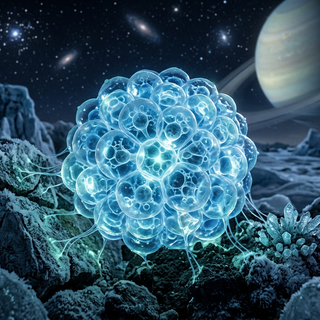
Cryosphaera gelidivora
KNOWN INTEL
CHOSEN HABITAT
Solid surface, polar and subpolar regions with persistent ice and shallow meltwater pools. This layer is the only viable niche for stable liquid water and complex life due to the planet's surface temperature range of 262–286K (mean 274K), which ensures water remains liquid or near-liquid in sheltered microhabitats during warmer cycles, supporting carbon-water biochemistry and diverse ecosystems.
BIOLOGY
Cryosphaera gelidivora is a colonial, gelatinous organism resembling a pulsating, translucent spheroid composed of interconnected cellular units, each approximately 1–3 cm in diameter. Its cellular chemistry is based on carbon-water biochemistry with cryophilic adaptations, including antifreeze glycoproteins that prevent cellular freezing during the colder extremes of Glacivernis’ surface temperature range (262K). Its metabolism relies on chemosynthesis, utilizing dissolved minerals and microbial symbionts in shallow meltwater pools to extract energy via redox reactions involving sulfur and iron compounds abundant in the rocky surface. The organism’s structural material is a flexible, silica-reinforced hydrogel matrix, which provides both protection against mechanical stress and thermal insulation, critical for surviving the temperature swings between 262K and 286K. The habitat of polar and subpolar regions shapes Cryosphaera gelidivora’s biology profoundly. The persistent cold and limited light due to the 150-hour day length favor chemosynthetic pathways over photosynthesis, as solar energy is unreliable in these latitudes. The organism forms dense, mat-like colonies that trap heat and moisture in their gelatinous matrix, creating microclimates slightly warmer than the surrounding environment. This adaptation ensures survival during the coldest periods (262K), while the matrix also allows rapid absorption of meltwater during warmer cycles (286K) for nutrient uptake. The low pressure (1 bar) and Earth-like atmospheric composition provide minimal stress on the organism’s structure, allowing it to focus energy on thermal regulation rather than pressure resistance.
SENSES
Cryosphaera gelidivora perceives its environment through chemical gradients and pressure waves within the meltwater pools and ice interfaces it inhabits. Specialized receptor cells in its outer matrix detect shifts in dissolved mineral concentrations, guiding the colony toward nutrient-rich zones. It also senses low-frequency vibrations through its hydrogel structure, likely as a means to detect environmental disturbances such as ice cracking or predator movement. Communication within the colony occurs via chemical signaling, with individual cellular units releasing pheromones that diffuse through the matrix to coordinate growth, nutrient sharing, and reproductive cycles. This chemical dialogue creates a synchronized response across the colony, functioning as a distributed sensory network.
LOCOMOTION
Movement in Cryosphaera gelidivora is a slow, amoeboid-like flow across the icy surface or within shallow meltwater pools. The colony contracts and expands its gelatinous matrix through coordinated cellular turgor pressure, allowing it to ooze over uneven terrain or between ice cracks at a rate of approximately 1–2 cm per hour. This mode of locomotion is energy-efficient in the 1g gravity of Glacivernis and suits the solid surface habitat, where anchoring or rapid movement is unnecessary. The physics of its movement relies on surface tension and viscosity, with the hydrogel matrix adhering to wet or icy surfaces to prevent displacement during wind or minor seismic activity.
REPRODUCTION
Cryosphaera gelidivora reproduces asexually through budding, where smaller spheroids detach from the main colony during warmer temperature cycles (near 286K) when liquid water is abundant. These buds drift in meltwater pools until they anchor to a suitable substrate, growing into new colonies over several 150-hour day cycles. The species is inherently colonial, with no concept of individuality; each spheroid unit functions as part of a larger super-organism, sharing resources and chemical signals. There is no parental care; new colonies grow independently, guided by environmental cues. Socially, colonies may merge during nutrient scarcity, forming expansive mats that span several meters, enhancing survival through collective thermal regulation and resource pooling.
DYNAMIC NOTES
On Glacivernis, orbiting a Sun-like G-type star named Solarae at 1.077 AU, Cryosphaera gelidivora has evolved in direct response to the planet’s environmental parameters. The equilibrium temperature of 245K would suggest a frozen world, but the estimated surface temperature range of 262–286K (mean 274K) allows for transient liquid water in polar meltwater pools, justifying the solid surface as the only viable habitat layer. Subsurface oceans are unlikely due to insufficient geothermal heating evidence, and the atmosphere at 1 bar lacks the density for stable floating organisms or complex aerial ecosystems. The temperature swing between 262K and 286K shapes daily survival strategies: during colder periods (262K), the colony contracts its matrix to minimize heat loss and enters a dormant state with reduced metabolism, while at warmer extremes (286K), it expands to absorb meltwater and nutrients, maximizing growth and reproduction. The Earth-like atmosphere and 1 bar pressure support familiar carbon-water biochemistry without necessitating exotic adaptations. Gravity at 1g ensures the organism’s gelatinous structure remains stable without excessive energy expenditure for support. The strong magnetic field of 9.75 Gauss provides significant radiation shielding against Solarae’s stellar wind and cosmic rays, reducing the need for radiation-resistant traits; however, some magnetotrophic adaptations are evident in the colony’s sensitivity to geomagnetic fluctuations, possibly aiding in navigation or nutrient detection. The evolutionary timescale of 7/10 indicates an ancient biosphere, allowing Cryosphaera gelidivora to develop highly specialized colonial behaviors and symbiotic relationships with chemosynthetic microbes, reflecting the complexity of niche adaptation over billions of years. The primary liquid solvent, water (H₂O), remains stable in liquid form only in the chosen surface microhabitats during warmer cycles, reinforcing this layer as the optimal niche. The lack of significant tidal forces means no extreme mechanical stresses shape the organism, allowing its delicate hydrogel matrix to persist. Every adaptation—thermal regulation, chemosynthesis, and slow amoeboid flow—is tied to the pressure (1 bar), temperature (262–286K), solvent state (water), and energy fluxes (chemical gradients) of the polar surface layer, ensuring biological plausibility within this specific environment.