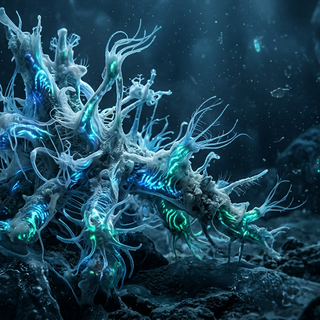
Cryofluctus titanensis
KNOWN INTEL
CHOSEN HABITAT
Subsurface methane ocean at 3–7 km depth beneath the icy crust. This layer is the only viable niche for stable liquid methane and complex life due to the protection from surface radiation, insulation from extreme surface temperatures of -177°C to -165°C, and the presence of tidal heating from intense geological activity maintaining liquid methane under pressure.
BIOLOGY
Cryofluctus titanensis is a colonial organism adapted to the cryogenic environment of Titan’s subsurface methane ocean, where temperatures stabilize around -170°C due to insulation and tidal heating at depths of 3–7 km. Its cellular chemistry is based on hydrocarbon solvents, utilizing liquid methane as the primary medium for biochemical reactions. Metabolic processes rely on chemosynthesis, exploiting chemical gradients between methane and trace ethane compounds dissolved in the ocean, likely produced by geothermal activity driven by tidal forces. Cellular membranes are composed of flexible, long-chain hydrocarbons rather than lipids, ensuring fluidity at extreme cold, while antifreeze-like molecules prevent crystallization of internal fluids. The organism’s structure is a sprawling, gelatinous network of interconnected tubules, resembling a deep-sea siphonophore but adapted to a methane-based solvent, with a porous matrix that allows methane to flow through its body for nutrient exchange and waste expulsion. The subsurface habitat shapes its body plan profoundly; the low gravity of 0.14g allows for a diffuse, low-density structure that would collapse under higher gravitational forces, while the high pressure at depth (estimated 5–10 bar) supports the stability of liquid methane and prevents phase changes that would disrupt biochemistry. The extreme cold necessitates a slow metabolism, with energy conservation prioritized through minimal movement and a symbiotic relationship with methanotrophic microbes that assist in breaking down complex hydrocarbons for energy. The lack of light in this habitat eliminates the need for photosynthesis, reinforcing chemosynthetic pathways as the dominant energy source. Each adaptation is a direct response to the cryogenic temperatures and pressure of the subsurface ocean: the hydrocarbon-based chemistry prevents freezing at -170°C, the tubular network maximizes surface area for chemical exchange in a viscous methane medium, and the slow metabolic rate conserves energy in an environment where chemical reactions occur at a sluggish pace due to the cold. This organism could not survive on the surface, where methane often freezes (given the 2% surface coverage by liquid/ice) and radiation exposure is lethal, nor in the atmosphere, where methane is gaseous and pressures are too low for its biochemistry.
SENSES
Cryofluctus titanensis perceives its environment through chemical gradients and pressure waves within the methane ocean. Specialized receptor nodes along its tubular network detect variations in methane and ethane concentrations, allowing it to locate nutrient-rich zones near geothermal vents. Pressure-sensitive filaments respond to subtle currents and tidal oscillations, helping the organism orient itself within the subsurface ocean’s dynamic flow. Communication occurs via chemical signaling, releasing specific hydrocarbon compounds that diffuse through the methane medium to signal nearby colonies about nutrient availability or environmental shifts. These chemical messages are slow but effective in the dense, cold liquid environment, fostering cooperative behavior among neighboring networks.
LOCOMOTION
Movement in Cryofluctus titanensis is passive and fluidic, adapted to the low-gravity, high-density methane ocean. The organism drifts with subsurface currents, using its porous, tubular structure to minimize resistance while occasionally contracting internal cavities to expel methane and create weak propulsion toward chemical gradients. In the 0.14g environment, active locomotion is unnecessary and energetically costly; instead, it relies on tidal-driven currents and geothermal upwellings to transport it across the ocean floor. This drifting behavior allows it to remain suspended in nutrient-rich zones without expending significant energy.
REPRODUCTION
Cryofluctus titanensis reproduces asexually through fragmentation, where portions of its tubular network break off during intense tidal flexing events and develop into new colonies if they encounter suitable chemical conditions. It is inherently colonial, with no concept of individuality; each network functions as a distributed entity, sharing nutrients and chemical signals across vast interconnected systems. There is no parental care—fragments either survive by integrating into existing colonies or perish if isolated from methane-rich zones. Socially, these colonies form loose, symbiotic associations with other subsurface organisms, creating sprawling ecosystems around geothermal vents where chemical energy is abundant.
DYNAMIC NOTES
Cryofluctus titanensis is intricately shaped by Titan’s environmental parameters. The equilibrium temperature of -184°C and surface temperature range of -177°C to -165°C (mean -171°C) dictate its subsurface habitat choice; the surface is too cold and radiation-exposed for liquid methane stability or life survival, while the atmosphere lacks the pressure to maintain methane in liquid form. The subsurface methane ocean at 3–7 km depth, warmed slightly by tidal heating from a moon with 0.015 Earth masses at 8.4 Earth radii, provides a stable liquid solvent and shields against the full stellar radiation and cosmic rays from Titan’s G-type, Sun-like host star. The absence of a significant magnetic field means no natural protection from radiation on the surface, further justifying the subsurface niche as the only viable layer—atmospheric layers lack liquid methane, and surface lakes cover only 2% of the planet, often frozen, limiting access and increasing competition. The temperature swing between -177°C and -165°C, though less extreme subsurface, influences daily survival via metabolic slowing during colder periods and slight activity increases during warmer tidal heating phases, with thermal storage in dense hydrocarbon nodes buffering minor fluctuations. The atmospheric composition (N2: 95%, CH4: 5%) and pressure (1.47 bar) indirectly affect the subsurface ocean chemistry by dictating methane saturation levels, while low gravity (0.14g) enables the organism’s diffuse, low-density structure. Tidal forces drive geological activity, creating vents that supply chemical energy for chemosynthesis, a critical adaptation in an environment without light. The lack of a magnetic field results in high radiation exposure on the surface, but the icy crust above the ocean provides shielding, negating the need for magnetotrophic traits; instead, the organism evolved robust hydrocarbon repair mechanisms to counter occasional radiation-induced damage from cosmic ray penetration. The evolutionary timescale (6/10) allowed for complex multicellularity and colonial behavior, reflecting significant biochemical and ecological diversity in the subsurface niche. The limited surface coverage by liquid/ice (2%) restricts surface methane access, reinforcing subsurface oceans as the primary habitat and driving intense competition near vents for chemical resources. Every adaptation—hydrocarbon chemistry, slow metabolism, chemical sensing—ties directly to the pressure (5–10 bar estimated), temperature (around -170°C), liquid methane state, and chemosynthetic energy fluxes of the subsurface layer, making it the only thermodynamically and chemically viable niche for Cryofluctus titanensis.