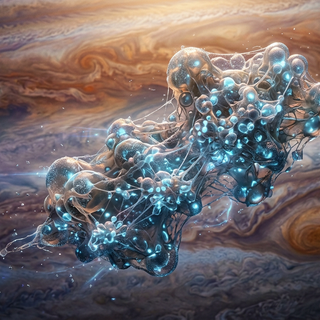
Cryonimbus jovialis
KNOWN INTEL
CHOSEN HABITAT
Upper cloud deck at 1–2 bar pressure layer. This layer is the only viable niche for complex life due to the slightly warmer temperatures (estimated -150°C to -130°C) compared to deeper layers, potential for transient liquid droplets of hydrocarbons or ammonia-water mixtures under localized pressure-temperature conditions, and access to energy from chemical gradients and stellar radiation from the G-type star.
BIOLOGY
Cryonimbus jovialis is a colonial, gas-suspended organism adapted to the cryogenic conditions of Jupiter’s upper cloud decks, where temperatures range from -150°C to -130°C, within the broader planetary surface temperature range of -219°C to -125°C (mean -172°C). Its cellular chemistry is based on a hydrocarbon-ammonia solvent system, utilizing methane and ethane as primary metabolic fluids, stabilized by antifreeze-like polypeptides that prevent crystallization even at extreme cold. Metabolic pathways rely on chemosynthesis, exploiting the abundant hydrogen (H2: 90%) in the atmosphere to reduce trace sulfur or nitrogen compounds into energy-rich molecules, a process optimized for the low temperatures and 1–2 bar pressure of this habitat layer. The organism’s structure is a diffuse, web-like matrix of interconnected micro-sacs, each filled with low-density helium (He: 10%) to maintain buoyancy against Jupiter’s high gravity of 2.53g. These micro-sacs are composed of flexible, lipid-like polymers resistant to cracking in the cold, a direct adaptation to the thermal extremes of the chosen habitat. The body plan of Cryonimbus jovialis is shaped by the need to maximize surface area for chemical exchange and energy capture in the diffuse, low-pressure environment of the cloud deck. Rather than a centralized form, it exists as a sprawling, fractal network of tendrils and sacs spanning several meters, resembling a floating lattice. This structure allows it to harness chemical gradients across vast areas while minimizing mass to counteract the high gravitational pull. The extreme cold necessitates a slow metabolic rate, with reactions facilitated by quantum-tunneling enzymes that operate efficiently below -100°C, a critical adaptation to the habitat’s temperature regime.
SENSES
Cryonimbus jovialis perceives its environment through a combination of magnetoreception and chemical gradient detection. Specialized protein clusters within its micro-sacs are sensitive to Jupiter’s moderate magnetic field (4.3 Gauss), allowing it to orient itself along field lines and detect perturbations caused by atmospheric currents or nearby organisms. Chemical sensors embedded in its tendrils detect variations in hydrogen and helium concentrations, as well as trace compounds, enabling it to locate nutrient-rich zones in the cloud deck. Communication occurs via low-frequency pressure waves, generated by rhythmic contractions of helium-filled sacs, which propagate through the dense hydrogen atmosphere. These waves carry information about nutrient availability or territorial boundaries, fostering coordination among colonial networks.
LOCOMOTION
Movement is achieved through a combination of buoyancy modulation and atmospheric drift. Cryonimbus jovialis adjusts the helium content in its micro-sacs via selective membrane diffusion, allowing it to rise or sink within the 1–2 bar cloud layer to follow chemical gradients or avoid thermal extremes. The high gravity of 2.53g necessitates energy-efficient locomotion, so it primarily relies on Jupiter’s powerful atmospheric currents for lateral movement, extending or retracting tendrils to catch or resist wind flows. This passive drifting is supplemented by subtle undulations of its lattice structure, creating small pressure differentials to steer through the gas medium.
REPRODUCTION
Reproduction in Cryonimbus jovialis is asexual and colonial, occurring through a process of budding where segments of the lattice detach and grow into independent networks. These buds inherit chemical and magnetic memory from the parent colony, ensuring continuity of learned behaviors. The species operates as a distributed super-organism, with no concept of individuality; each lattice network shares resources and information via pressure wave signals and chemical exchange. Offspring development is communal, with new buds integrated into the existing colony until they reach a critical size and split off during favorable atmospheric conditions, a strategy shaped by the need to conserve energy in the cold, resource-scarce environment. INTELLIGENCE & COGNITION: The intelligence of Cryonimbus jovialis is distributed across its colonial lattice, encoded in synchronized chemical oscillations and magnetic field interactions among its micro-sacs. This emergent cognition manifests as a form of collective problem-solving, where the colony dynamically adjusts its structure and buoyancy to optimize nutrient capture or avoid hazardous thermal drops in the cloud deck. Intelligence is expressed outwardly through environmental engineering: the colony constructs temporary “chemical traps” by releasing catalytic compounds that concentrate nutrients in localized atmospheric pockets, a behavior indicative of advanced planning. This distributed neural-analogue system, relying on slow chemical signaling, is consistent with the cryogenic metabolism and diffuse body plan, allowing complex decision-making without a centralized brain. The ancient evolutionary timescale (7/10) has refined this intelligence into a sophisticated network capable of inter-colony cooperation and territorial negotiation via pressure wave patterns.
DYNAMIC NOTES
Cryonimbus jovialis is intricately adapted to Jupiter’s harsh conditions, including the equilibrium temperature of -172°C and the extreme surface temperature range of -219°C to -125°C (mean -172°C). The chosen habitat of the upper cloud deck at 1–2 bar is the only viable niche due to its relatively warmer temperatures (-150°C to -130°C) compared to deeper layers, potential for transient liquid hydrocarbon droplets, and access to chemical energy from the H2 (90%) and He (10%) atmosphere; deeper layers are too cold and pressurized for stable biochemistry, while higher altitudes lack sufficient density for nutrient retention. The significant temperature swing of 94°C drives daily survival strategies, such as contracting its lattice to minimize surface area during extreme cold dips to -219°C, preserving internal heat via insulated helium pockets, and expanding during warmer peaks near -125°C to maximize chemical exchange. The moderate magnetic field (4.3 Gauss) provides reasonable radiation shielding from the G-type star’s output, and the organism’s magnetoreception likely evolved as a dual-purpose trait for navigation and minor radiation detection, though no specific magnetotrophic metabolism is evident. The absence of surface liquid or ice (0% coverage) confines life to atmospheric layers, intensifying competition for transient liquid droplets in the cloud deck and driving the evolution of chemical traps as a competitive strategy. The high gravity (2.53g) shapes its low-mass, buoyancy-driven design, while the short day length of 9.93 hours and lack of significant tidal forces impose minimal additional constraints. The ancient evolutionary timescale (7/10) has allowed for the development of complex colonial networks and intelligence, likely driven by the need to coordinate resource acquisition in a resource-scarce, thermally variable environment; the upper cloud deck’s dynamic conditions accelerated cognitive evolution by rewarding cooperative behaviors and environmental manipulation. The lack of a primary liquid solvent further constrained life to exploit atmospheric chemistry, reinforcing the upper cloud deck as the optimal habitat for energy flux and biochemical stability at 1–2 bar pressure and -150°C to -130°C temperatures.