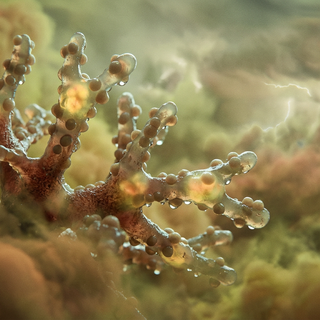
Thermococcus sulfurivagus
KNOWN INTEL
CHOSEN HABITAT
Upper cloud deck at 50–60 km altitude, corresponding to the 1 bar pressure isobar with temperatures ranging from 30°C to 70°C. This layer is the only viable niche for stable liquid sulfuric acid droplets and complex life, as it provides a temperature and pressure regime where sulfuric acid remains liquid, offers protection from surface radiation, and allows access to energy via photochemistry driven by the G-type star's radiation.
BIOLOGY
Thermococcus sulfurivagus is a colonial, gelatinous organism adapted to the extreme conditions of Venus's upper cloud deck, where temperatures range from 30°C to 70°C and sulfuric acid (H₂SO₄) serves as the primary liquid solvent at 1 bar pressure. Its cellular chemistry is thermophilic, utilizing sulfur-based metabolic pathways that exploit the abundant SO₂ (0.015% of atmosphere) and CO₂ (96.5%) for energy. The organism's structural material is a heat-resistant, flexible polymer analogous to silicate-protein hybrids, which prevents desiccation and protects against the corrosive effects of sulfuric acid. Its body plan is a sprawling, net-like structure composed of interconnected vesicles, each filled with sulfuric acid-based cytoplasm where metabolic reactions occur. These vesicles are linked by porous channels that allow nutrient exchange and waste expulsion, shaped by the need to maximize surface area for photochemical energy capture in the cloud layer's diffuse sunlight. The habitat's specific conditions dictate these adaptations: the moderate temperature range (30°C to 70°C) in the cloud deck supports thermophilic biochemistry without requiring the extreme heat resistance necessary at the surface (464°C). The low pressure (1 bar) compared to the surface (92 bar) allows for lighter, less dense structures that can remain buoyant in the dense CO₂ atmosphere. The lack of surface liquid solvent (0% coverage) forces reliance on suspended sulfuric acid droplets in the clouds, shaping T. sulfurivagus into a distributed, colonial form that can efficiently scavenge these droplets across a wide area. Its net-like structure also aids in maintaining stability amidst the turbulent winds of the upper atmosphere, a direct response to the dynamic, gaseous environment of the chosen habitat layer.
SENSES
Thermococcus sulfurivagus perceives its environment through chemical gradients and pressure differentials, detecting variations in SO₂ and CO₂ concentrations to locate nutrient-rich zones within the cloud deck. Specialized vesicles along its net-like structure contain sensory membranes that react to ultraviolet radiation fluctuations from the G-type star, allowing it to orient toward optimal light conditions for photochemistry. Communication occurs via chemical signaling, releasing volatile sulfur compounds into the surrounding atmosphere that trigger coordinated responses in nearby colonies, such as synchronized nutrient scavenging or collective buoyancy adjustments to maintain altitude in the 1 bar isobar.
LOCOMOTION
Movement in T. sulfurivagus is passive and buoyancy-driven, matching the gaseous environment of Venus's upper cloud deck. The organism adjusts its density by regulating the volume of gas-filled vesicles within its net-like structure, allowing it to ascend or descend within the 50–60 km altitude range. This process is powered by metabolic byproducts, primarily lightweight gases like carbon monoxide, which are sequestered into vesicles to control flotation. The physics of its movement relies on the dense CO₂ atmosphere (96.5%) and the organism's ability to exploit wind currents for lateral displacement, ensuring it remains within the optimal temperature and pressure zone.
REPRODUCTION
Reproduction in T. sulfurivagus is asexual and colonial, occurring through the budding of new vesicles at the edges of the net-like structure. These buds eventually detach as independent sub-colonies, drifting in the cloud layer until they grow into full networks. The species lacks a concept of individuality; each colony functions as a distributed organism with shared metabolic and sensory systems across its structure. There is no parenting behavior—sub-colonies are self-sufficient from detachment, relying on the abundant sulfuric acid droplets and photochemical energy in the habitat. Socially, colonies exhibit cooperative behavior by chemically signaling to share resources or avoid overcrowding in nutrient-poor zones, forming a loosely connected super-organism across the cloud deck. INTELLIGENCE & COGNITION: Given the ancient evolutionary timescale (7/10) of Venus's biosphere, T. sulfurivagus exhibits a distributed form of intelligence encoded in chemical gradients and synchronized metabolic oscillations across its colonial network. This intelligence manifests as emergent problem-solving behavior, such as dynamically adjusting buoyancy to avoid turbulent storm zones or optimizing photochemical exposure by reconfiguring the net's orientation toward sunlight. Outwardly, this intelligence is expressed through environmental engineering: colonies secrete sulfur-based compounds that alter local cloud chemistry, creating microenvironments with higher sulfuric acid droplet density to sustain larger populations. This behavior demonstrates a rudimentary form of territory modification and resource management, consistent with the organism's sulfuric acid-based biochemistry and buoyant, colonial body plan in the cloud deck habitat.
DYNAMIC NOTES
The adaptations of Thermococcus sulfurivagus are intricately tied to Venus's planetary conditions. The equilibrium temperature (46°C) aligns with the chosen habitat's range (30°C to 70°C) in the upper cloud deck at 50–60 km altitude, justifying this layer as the only viable niche—surface temperatures (464°C) are far too extreme for even thermophilic life without exotic chemistry beyond current understanding, and lower atmospheric layers exceed 127°C under crushing pressures (up to 92 bar), destabilizing liquid sulfuric acid. The constant surface temperature (464°C across Ts_low and Ts_high) is irrelevant to daily survival strategies as the organism resides far above the surface, instead relying on the cloud layer's milder thermal swings (30°C to 70°C) to maintain metabolic stability without specialized thermal storage or shelter behaviors. The atmospheric composition (CO₂: 96.5%, N₂: 3.5%, SO₂: 0.015%) directly supports its sulfur-based metabolism and photochemical energy capture, while the low gravity (0.904g) facilitates buoyancy in the dense atmosphere. The primary liquid solvent (sulfuric acid, H₂SO₄) is only accessible as droplets in the cloud deck, explaining the organism's dependence on this layer and its net-like structure for droplet scavenging, especially given the 0% surface coverage of liquid or ice, eliminating competition for surface solvent access and concentrating life in the clouds. The absence of a significant magnetic field exposes Venus to full stellar radiation from its G-type (Sun-like) host star, tentatively named Sol-Venus in absence of a specific designation, and cosmic rays. This drives the evolution of UV-resistant polymer structures in T. sulfurivagus and a reliance on photochemical energy, though no magnetotrophic traits emerged due to the lack of a geomagnetic field to exploit. The ancient evolutionary timescale (7/10) fostered the complexity of its colonial structure and distributed intelligence, as prolonged adaptation to the harsh, resource-scarce cloud environment necessitated cooperative behaviors and chemical signaling for survival. Intelligence emerged from evolutionary pressures to optimize resource use in the nutrient-sparse cloud deck, where competition for sulfuric acid droplets and sunlight drove the development of chemical-based cognition and environmental engineering. The habitat's constraints—limited solvent access and dynamic winds—accelerated cognitive expression through collective action and microhabitat creation. The chosen cloud deck layer (1 bar isobar) is the most thermodynamically and chemically viable niche due to stable liquid sulfuric acid, moderate temperatures (30°C to 70°C), and energy availability from sunlight, with every adaptation (buoyancy, photochemistry, colonial netting) directly tied to these conditions.