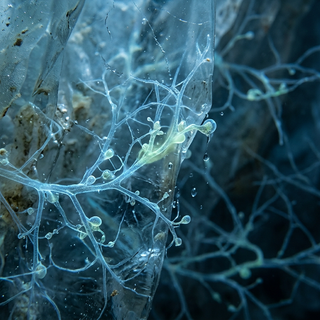
Cryosilicum frigidus
KNOWN INTEL
CHOSEN HABITAT
Subsurface water-ice matrix at 0.5–2 km depth. This layer is the only viable niche for complex life due to the presence of liquid water micro-pockets maintained by geothermal heat and pressure, despite the surface coverage of 0% liquid or ice, as it provides a stable environment insulated from the extreme surface temperature swings of -49°C to 11°C (mean -19°C).
BIOLOGY
Cryosilicum frigidus is a colonial organism resembling a network of crystalline, silica-based filaments that permeate the subsurface water-ice matrix of Glacivora at depths of 0.5–2 km. Its cellular chemistry is carbon-based but heavily reliant on silicate scaffolding for structural integrity, an adaptation to the cold, high-pressure environment where liquid water exists only in transient micro-pockets warmed by geothermal activity to temperatures near 0°C. The organism employs cryophilic biochemistry with antifreeze glycoproteins to prevent cellular freezing, and its metabolism is driven by chemosynthesis, utilizing dissolved minerals and hydrogen sulfide from volcanic vents as energy sources. This metabolic pathway is necessitated by the absence of light at these depths and the extreme cold of the habitat, which mirrors the planet’s surface mean temperature of -19°C but is buffered from the lowest extremes of -49°C by subsurface insulation. The body plan of Cryosilicum frigidus is a sprawling, interconnected lattice of translucent filaments, each filament housing symbiotic microbial communities that assist in nutrient cycling and energy extraction. This lattice structure maximizes surface area for chemical exchange in the sparse liquid water pockets, an adaptation to the limited solvent availability due to Glacivora’s 0% surface liquid coverage. The silicate matrix also provides durability against the mechanical stress of shifting ice layers under 1g gravity and 1 bar pressure conditions translated to depth. The organism’s growth is slow and deliberate, shaped by the evolutionary timescale of 7/10, allowing for highly specialized adaptations to this niche where temperature stability near 0°C supports liquid water despite surface aridity.
SENSES
Cryosilicum frigidus perceives its environment through chemosensory receptors embedded in its filaments, detecting gradients of hydrogen sulfide, methane, and other volcanic gases dissolved in the micro-pockets of liquid water. It also exhibits magnetoreception, attuned to Glacivora’s moderate magnetic field of 1 Gauss, which aids in navigating the subsurface matrix by sensing geomagnetic anomalies associated with volcanic activity. Communication occurs via chemical signaling, releasing specific molecular compounds that diffuse through the water-ice matrix to coordinate growth and resource sharing among the colonial network. This non-visual sensory system is ideal for the dark, enclosed subsurface habitat where light from the G-type star, Solara Prime, cannot penetrate.
LOCOMOTION
Movement in Cryosilicum frigidus is not active in the traditional sense but occurs through a slow, creeping expansion of its silicate filaments. These filaments grow directionally toward chemical gradients of nutrients, using a combination of osmotic pressure and micro-fracturing of surrounding ice to extend through the subsurface matrix. This mode of “locomotion” is energy-efficient under the low-temperature, high-pressure conditions of the habitat at 0.5–2 km depth and aligns with the stable 1g gravity of Glacivora, avoiding the need for rapid or dynamic movement in a static, resource-scarce environment.
REPRODUCTION
Cryosilicum frigidus reproduces asexually through fragmentation, where segments of its filament network break off and establish new colonies in adjacent water-ice micro-pockets. It is inherently colonial, with no concept of an “individual”; the entire lattice functions as a distributed super-organism with shared resources and chemical signaling. There is no parental care, as new fragments inherit the genetic and symbiotic microbial blueprint of the parent colony, growing independently through chemosynthetic processes. Social structure is based on chemical cooperation, with larger networks dominating resource-rich zones near geothermal vents, a competitive dynamic driven by the scarcity of liquid water due to 0% surface coverage. INTELLIGENCE & COGNITION: The intelligence of Cryosilicum frigidus is distributed across its colonial network, encoded in the chemical gradients and synchronized oscillatory patterns of nutrient exchange among filaments. This emergent cognition manifests as problem-solving behavior, such as optimizing filament growth patterns to exploit transient liquid water pockets or rerouting resources during ice shifts. Outwardly, this intelligence is expressed through environmental engineering: the colony secretes silicate deposits to stabilize ice fractures, creating micro-habitats that retain liquid water longer, a behavior consistent with the ancient evolutionary timescale of 7/10. This distributed intelligence aligns with the organism’s biochemistry and subsurface habitat, where centralized neural structures would be energetically costly and vulnerable to cold stress at temperatures averaging -19°C.
DYNAMIC NOTES
Cryosilicum frigidus is intricately adapted to Glacivora’s environmental parameters, particularly the equilibrium temperature of -19°C and the surface temperature range of -49°C to 11°C. Daily survival strategies include metabolic downregulation during extreme cold snaps near -49°C, where the organism enters a dormant state, preserving energy within insulated silicate nodes, and reactivating chemosynthesis when temperatures rise toward 11°C or geothermal heat stabilizes micro-pockets near 0°C. The subsurface habitat at 0.5–2 km depth was chosen as the only viable layer due to the complete absence of surface liquid water (0% coverage), rendering surface ecosystems impossible, and the lack of a thick atmosphere for stable aerial niches; only subsurface geothermal zones provide the liquid water necessary for carbon-based life. The Earth-like atmosphere at 1 bar and 1g gravity imposes no extreme constraints, but the aridity of the surface amplifies competition for subsurface liquid zones, driving the colonial structure and resource-sharing intelligence of this species. Glacivora’s moderate magnetic field of 1 Gauss offers reasonable radiation shielding from Solara Prime’s G-type star output, reducing the need for extreme radiation-adapted traits, though the organism’s magnetoreception likely evolved as a secondary benefit of this field for navigation. The ancient evolutionary timescale (7/10) has fostered complex symbiotic relationships with microbial partners and a distributed intelligence, driven by the need to adapt to scarce liquid water and fluctuating thermal conditions in a geologically active subsurface. Intelligence emerged from the evolutionary pressure to optimize resource use in a solvent-starved environment, constrained by the subsurface habitat’s isolation but accelerated by the stability of geothermal energy fluxes. The absence of tidal forces ensures a stable subsurface environment, while the 24-hour day length aligns with minimal diurnal thermal stress at depth, further justifying the subsurface as the optimal niche. Every adaptation, from cryophilic chemistry to colonial cognition, ties directly to the pressure (elevated at depth), temperature (near 0°C in micro-pockets), water solvent state (liquid in insulated zones), and energy availability (chemosynthetic) of this specific habitat layer.