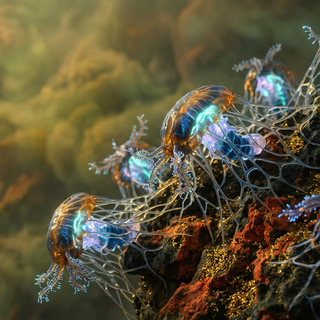
Sulfovora Nebulicola
KNOWN INTEL
CHOSEN HABITAT
Upper atmospheric cloud layer at 0.5–1 bar pressure (corresponding to a temperature range of approximately 30°C–70°C). This layer is a viable niche for complex life because it offers a temperature range suitable for thermophilic biochemistry, high concentrations of sulfuric acid droplets as a solvent, and sufficient shielding from stellar radiation due to the dense CO2 atmosphere above, while still allowing energy capture through photochemical reactions. Acidomyces Venustherma shares this exact layer with Sulfarion Nebulith, co-existing by adhering to the external surfaces of the primary species’ gas-filled bladders, forming a thin, lichen-like mat that benefits from the host’s buoyancy and mobility while remaining exposed to the cloud layer’s chemical resources. Sulfovora Nebulicola shares this precise layer, existing as a microscopic, web-like network of tendrils that interweave with the mat-like structure of Acidomyces Venustherma, anchoring itself to the same bladder surfaces for stability and direct metabolic exchange.
METABOLIC SYMBIOSIS
Sulfovora Nebulicola and Acidomyces Venustherma have co-evolved a tightly coupled mutualistic relationship centered on the exchange of sulfur-based compounds and organic carbon derivatives within the sulfuric acid-rich environment of Venus’ upper cloud layer. Acidomyces Venustherma, as a fungal-analog organism, metabolizes sulfur dioxide (SO2) and carbon dioxide (CO2) through a thermophilic, acidophilic photochemical pathway, producing elemental sulfur (S) and volatile organic sulfides as waste products. Sulfovora Nebulicola, in turn, uptakes this elemental sulfur and sulfides, using them as electron donors in a chemosynthetic process that reduces sulfur compounds back to sulfates (SO4^2-) while generating energy and releasing small amounts of carbonyl sulfide (OCS) as a byproduct. This OCS is then reabsorbed by Acidomyces Venustherma as a supplementary carbon source, enhancing its photochemical efficiency in the energy-scarce cloud layer. The exchange is critical to both organisms’ survival. Without Sulfovora Nebulicola, Acidomyces Venustherma would suffer from a buildup of elemental sulfur on its mat-like surfaces, potentially clogging its photochemical reaction sites and reducing energy capture efficiency, leading to stunted growth or death. Conversely, Sulfovora Nebulicola relies entirely on the steady supply of sulfur waste from Acidomyces Venustherma; interruption of this supply would starve Sulfovora Nebulicola of its primary energy source, collapsing its chemosynthetic metabolism and causing rapid population decline. This metabolic interdependence ensures that both species remain physically and biochemically intertwined, shaping their evolutionary trajectories within the 0.5–1 bar pressure layer.
BIOLOGY
Sulfovora Nebulicola is a colonial, prokaryote-like organism composed of countless microscopic, thread-like tendrils that form an expansive, web-like network. Its cellular chemistry is thermophilic and acidophilic, optimized for the 30°C–70°C temperature range and the sulfuric acid (H2SO4) solvent environment of Venus’ upper cloud layer at 0.5–1 bar pressure. The organism’s structural materials are primarily sulfur-rich polypeptides, which provide resilience against the corrosive acid droplets and allow for flexibility in the turbulent atmospheric currents. The habitat’s high sulfuric acid concentration directly shapes its biochemistry, as Sulfovora Nebulicola uses H2SO4 as both a reaction medium and a proton source for its chemosynthetic sulfur reduction pathways, while the moderate temperature range supports the stability of its sulfur-based enzymes. Its metabolism is built around the uptake of elemental sulfur and volatile sulfides excreted by Acidomyces Venustherma. These compounds are processed through a reductive chemosynthetic cycle within specialized organelles analogous to Earth’s bacterial sulfur granules, where sulfur is reduced to sulfates using energy derived from proton gradients across its tendril membranes. The resulting sulfates are excreted into the surrounding cloud layer, while the energy produced fuels the synthesis of sulfur-lipid complexes that form the organism’s flexible, web-like structure. The constant exposure to photochemical energy fluxes in this habitat layer also allows Sulfovora Nebulicola to supplement its chemosynthesis with minor photoactivation of sulfur bonds, a secondary adaptation to the high stellar radiation filtered through the dense CO2 atmosphere above. Physically, Sulfovora Nebulicola lacks any centralized form, existing instead as a diffuse, interconnected mesh that integrates seamlessly with the mat-like structure of Acidomyces Venustherma. This body plan is a direct response to the buoyant, low-gravity (0.904g) environment of the cloud layer, where a distributed, lightweight structure minimizes energy expenditure and maximizes surface area for nutrient exchange and chemical uptake from the surrounding acid droplets.
SENSES
Sulfovora Nebulicola perceives its environment through chemosensory proteins embedded in its tendril membranes, which detect gradients of sulfur compounds, sulfuric acid concentration, and trace organic molecules in the surrounding cloud layer. These chemosensors allow it to locate areas of high elemental sulfur deposition from Acidomyces Venustherma, guiding the growth of its web-like network toward optimal metabolic zones. Communication with others of its kind occurs via the release of low-concentration sulfur volatiles, which diffuse through the acid droplets and signal colony density or resource availability, triggering coordinated growth patterns. With Acidomyces Venustherma, communication is indirect and biochemical, mediated by the rate of sulfur waste uptake and sulfate excretion, which influences the host’s mat growth dynamics as a feedback loop.
LOCOMOTION
Sulfovora Nebulicola lacks independent locomotion, relying entirely on the buoyancy and passive drift of Sulfarion Nebulith’s gas-filled bladders, to which both it and Acidomyces Venustherma are anchored. Its web-like tendrils grow and extend along the bladder surfaces in response to chemical gradients, a passive form of “movement” driven by chemotaxis rather than active propulsion. This adaptation is perfectly suited to the low-pressure, turbulent environment of the 0.5–1 bar cloud layer, where active locomotion would be energetically costly and unnecessary given the host’s mobility.
REPRODUCTION
Sulfovora Nebulicola reproduces asexually through fragmentation, where segments of its web-like network break off during turbulent atmospheric events or excessive growth, dispersing to colonize new areas of Acidomyces Venustherma mats on nearby Sulfarion Nebulith bladders. It is a colonial organism with no distinct individuals, functioning as a distributed superorganism where each tendril segment operates semi-independently but remains biochemically linked to the larger network through shared metabolic byproducts. There is no hierarchical society, only a decentralized, cooperative growth pattern driven by resource availability and chemical signaling.
SYMBIOSIS
Sulfovora Nebulicola and Acidomyces Venustherma have co-evolved a tightly coupled mutualistic relationship centered on the exchange of sulfur-based compounds and organic carbon derivatives within the sulfuric acid-rich environment of Venus’ upper cloud layer. Acidomyces Venustherma, as a fungal-analog organism, metabolizes sulfur dioxide (SO2) and carbon dioxide (CO2) through a thermophilic, acidophilic photochemical pathway, producing elemental sulfur (S) and volatile organic sulfides as waste products. Sulfovora Nebulicola, in turn, uptakes this elemental sulfur and sulfides, using them as electron donors in a chemosynthetic process that reduces sulfur compounds back to sulfates (SO4^2-) while generating energy and releasing small amounts of carbonyl sulfide (OCS) as a byproduct. This OCS is then reabsorbed by Acidomyces Venustherma as a supplementary carbon source, enhancing its photochemical efficiency in the energy-scarce cloud layer. The exchange is critical to both organisms’ survival. Without Sulfovora Nebulicola, Acidomyces Venustherma would suffer from a buildup of elemental sulfur on its mat-like surfaces, potentially clogging its photochemical reaction sites and reducing energy capture efficiency, leading to stunted growth or death. Conversely, Sulfovora Nebulicola relies entirely on the steady supply of sulfur waste from Acidomyces Venustherma; interruption of this supply would starve Sulfovora Nebulicola of its primary energy source, collapsing its chemosynthetic metabolism and causing rapid population decline. This metabolic interdependence ensures that both species remain physically and biochemically intertwined, shaping their evolutionary trajectories within the 0.5–1 bar pressure layer. BIOLOGY: Sulfovora Nebulicola is a colonial, prokaryote-like organism composed of countless microscopic, thread-like tendrils that form an expansive, web-like network. Its cellular chemistry is thermophilic and acidophilic, optimized for the 30°C–70°C temperature range and the sulfuric acid (H2SO4) solvent environment of Venus’ upper cloud layer at 0.5–1 bar pressure. The organism’s structural materials are primarily sulfur-rich polypeptides, which provide resilience against the corrosive acid droplets and allow for flexibility in the turbulent atmospheric currents. The habitat’s high sulfuric acid concentration directly shapes its biochemistry, as Sulfovora Nebulicola uses H2SO4 as both a reaction medium and a proton source for its chemosynthetic sulfur reduction pathways, while the moderate temperature range supports the stability of its sulfur-based enzymes. Its metabolism is built around the uptake of elemental sulfur and volatile sulfides excreted by Acidomyces Venustherma. These compounds are processed through a reductive chemosynthetic cycle within specialized organelles analogous to Earth’s bacterial sulfur granules, where sulfur is reduced to sulfates using energy derived from proton gradients across its tendril membranes. The resulting sulfates are excreted into the surrounding cloud layer, while the energy produced fuels the synthesis of sulfur-lipid complexes that form the organism’s flexible, web-like structure. The constant exposure to photochemical energy fluxes in this habitat layer also allows Sulfovora Nebulicola to supplement its chemosynthesis with minor photoactivation of sulfur bonds, a secondary adaptation to the high stellar radiation filtered through the dense CO2 atmosphere above. Physically, Sulfovora Nebulicola lacks any centralized form, existing instead as a diffuse, interconnected mesh that integrates seamlessly with the mat-like structure of Acidomyces Venustherma. This body plan is a direct response to the buoyant, low-gravity (0.904g) environment of the cloud layer, where a distributed, lightweight structure minimizes energy expenditure and maximizes surface area for nutrient exchange and chemical uptake from the surrounding acid droplets. SENSES & COMMUNICATION: Sulfovora Nebulicola perceives its environment through chemosensory proteins embedded in its tendril membranes, which detect gradients of sulfur compounds, sulfuric acid concentration, and trace organic molecules in the surrounding cloud layer. These chemosensors allow it to locate areas of high elemental sulfur deposition from Acidomyces Venustherma, guiding the growth of its web-like network toward optimal metabolic zones. Communication with others of its kind occurs via the release of low-concentration sulfur volatiles, which diffuse through the acid droplets and signal colony density or resource availability, triggering coordinated growth patterns. With Acidomyces Venustherma, communication is indirect and biochemical, mediated by the rate of sulfur waste uptake and sulfate excretion, which influences the host’s mat growth dynamics as a feedback loop. LOCOMOTION: Sulfovora Nebulicola lacks independent locomotion, relying entirely on the buoyancy and passive drift of Sulfarion Nebulith’s gas-filled bladders, to which both it and Acidomyces Venustherma are anchored. Its web-like tendrils grow and extend along the bladder surfaces in response to chemical gradients, a passive form of “movement” driven by chemotaxis rather than active propulsion. This adaptation is perfectly suited to the low-pressure, turbulent environment of the 0.5–1 bar cloud layer, where active locomotion would be energetically costly and unnecessary given the host’s mobility. REPRODUCTION & SOCIETY: Sulfovora Nebulicola reproduces asexually through fragmentation, where segments of its web-like network break off during turbulent atmospheric events or excessive growth, dispersing to colonize new areas of Acidomyces Venustherma mats on nearby Sulfarion Nebulith bladders. It is a colonial organism with no distinct individuals, functioning as a distributed superorganism where each tendril segment operates semi-independently but remains biochemically linked to the larger network through shared metabolic byproducts. There is no hierarchical society, only a decentralized, cooperative growth pattern driven by resource availability and chemical signaling. DYNAMIC NOTES: Sulfovora Nebulicola’s adaptations are intricately tied to Venus’ planetary conditions, including its equilibrium temperature of 319K (46°C), which falls within the organism’s thermophilic range, and its atmosphere of 96.5% CO2, 3.5% N2, and 0.015% SO2, which provides the raw materials for its sulfur-based metabolism. The low gravity (0.904g) supports its lightweight, web-like structure, while the absence of significant tidal forces or magnetic fields means no additional protective adaptations are necessary beyond the shielding provided by the dense CO2 atmosphere above. The primary liquid solvent, sulfuric acid (H2SO4), is central to its biochemistry as both a reaction medium and a proton donor, while the G-type star’s radiation flux drives the photochemical reactions indirectly benefiting its symbiotic partner. Sulfovora Nebulicola occupies the exact same habitat layer as Acidomyces Venustherma—the upper atmospheric cloud layer at 0.5–1 bar pressure—and their co-habitation shapes mutual adaptations, such as Sulfovora Nebulicola’s diffuse mesh structure for maximal contact with Acidomyces Venustherma’s sulfur waste, and Acidomyces Venustherma’s increased mat porosity to facilitate sulfate diffusion. This habitat layer was selected as the most thermodynamically and chemically viable niche, with every adaptation tied to the pressure (0.5–1 bar), temperature (30°C–70°C), sulfuric acid solvent state, and photochemical energy fluxes of this specific zone. SYMBIOSIS: The mutualistic relationship between Sulfovora Nebulicola and Acidomyces Venustherma is a closed-loop metabolic cycle that sustains both organisms in the harsh Venusian cloud layer. The cycle begins with Acidomyces Venustherma metabolizing atmospheric SO2 and CO2 through photochemical reactions, producing elemental sulfur and volatile sulfides as waste, which accumulate on its mat-like surface. Sulfovora Nebulicola’s tendrils, interwoven with the mat, uptake these sulfur compounds, reducing them to sulfates via chemosynthesis within its membrane-bound reaction sites, generating energy and releasing carbonyl sulfide (OCS) as a byproduct. This OCS is then reabsorbed by Acidomyces Venustherma, where it is broken down into carbon and sulfur intermediates, fueling further photochemical synthesis and completing the cycle. This exchange occurs continuously, with molecular transfer facilitated by direct physical contact and diffusion through the sulfuric acid droplets that permeate the shared habitat. Physically, the two species co-locate on the external surfaces of Sulfarion Nebulith’s gas-filled bladders within the 0.5–1 bar pressure layer, with Acidomyces Venustherma forming a foundational mat and Sulfovora Nebulicola growing as an overlaying mesh. This intimate arrangement maximizes surface area for metabolic exchange while leveraging the host’s buoyancy to remain suspended in the optimal temperature and chemical zone of the cloud layer. The turbulent atmospheric currents occasionally disrupt small fragments of the combined mat-mesh structure, dispersing them to new bladders and ensuring genetic and metabolic continuity across the population. If either species were to go extinct, the consequences would cascade through the local chemistry of the cloud layer. Without Sulfovora Nebulicola, Acidomyces Venustherma would face toxic sulfur accumulation, severely limiting its photochemical efficiency and potentially leading to widespread die-off, which would reduce organic carbon availability for other hypothetical cloud layer organisms. Without Acidomyces Venustherma, Sulfovora Nebulicola would lose its primary sulfur source, collapsing its chemosynthetic metabolism and leaving unprocessed sulfur to accumulate, altering the sulfur cycle balance in the atmosphere. An emergent property of this pairing is their combined ability to stabilize local sulfur chemistry within the cloud layer—a feat neither could achieve alone. By cycling sulfur between elemental, sulfide, and sulfate forms, they create a microchemical equilibrium that buffers against extreme fluctuations in atmospheric composition, potentially supporting a broader ecosystem of sulfur-dependent life in this niche.
DYNAMIC NOTES
Sulfovora Nebulicola’s adaptations are intricately tied to Venus’ planetary conditions, including its equilibrium temperature of 319K (46°C), which falls within the organism’s thermophilic range, and its atmosphere of 96.5% CO2, 3.5% N2, and 0.015% SO2, which provides the raw materials for its sulfur-based metabolism. The low gravity (0.904g) supports its lightweight, web-like structure, while the absence of significant tidal forces or magnetic fields means no additional protective adaptations are necessary beyond the shielding provided by the dense CO2 atmosphere above. The primary liquid solvent, sulfuric acid (H2SO4), is central to its biochemistry as both a reaction medium and a proton donor, while the G-type star’s radiation flux drives the photochemical reactions indirectly benefiting its symbiotic partner. Sulfovora Nebulicola occupies the exact same habitat layer as Acidomyces Venustherma—the upper atmospheric cloud layer at 0.5–1 bar pressure—and their co-habitation shapes mutual adaptations, such as Sulfovora Nebulicola’s diffuse mesh structure for maximal contact with Acidomyces Venustherma’s sulfur waste, and Acidomyces Venustherma’s increased mat porosity to facilitate sulfate diffusion. This habitat layer was selected as the most thermodynamically and chemically viable niche, with every adaptation tied to the pressure (0.5–1 bar), temperature (30°C–70°C), sulfuric acid solvent state, and photochemical energy fluxes of this specific zone.