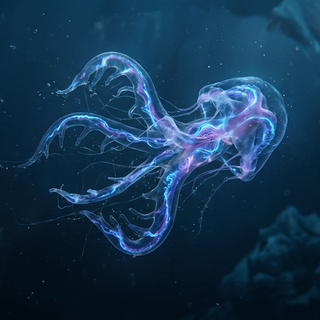
Cryothalassus Vortexus
KNOWN INTEL
CHOSEN HABITAT
Subsurface water ocean at 10–20 km depth beneath the ice shell. This layer is viable for complex life due to tidal heating from the moon’s intense geological activity, maintaining liquid water at temperatures estimated between -5°C and 5°C despite the surface mean of -170°C, and providing a shielded environment from surface radiation.
BIOLOGY
Cryothalassus Vortexus is a colonial, gelatinous macro-organism adapted to the frigid, high-pressure environment of Europa’s subsurface ocean at 10–20 km depth, where temperatures hover near 0°C (ranging from -5°C to 5°C due to tidal heat fluxes). Its cellular chemistry relies on cryophilic adaptations, including a lipid membrane enriched with antifreeze glycoproteins that prevent ice crystal formation, and a metabolic pathway based on chemosynthesis, utilizing hydrogen sulfide and methane vented from hydrothermal vents on the ocean floor as energy sources. The low temperatures necessitate slow metabolic rates, with enzymatic reactions optimized for near-freezing conditions through quantum-tunneling mechanisms that enhance reaction efficiency in the cold. Its structural material is a flexible, silica-reinforced hydrogel matrix, which provides buoyancy and resilience against the crushing pressures (estimated at 100–200 bar) at these depths, while also allowing for nutrient diffusion across its porous body. The organism’s body plan is a decentralized, toroidal network of interconnected gel sacs, spanning up to 10 meters in diameter, with no distinct "head" or centralized organs. This structure is shaped by the habitat’s uniform pressure and lack of light, eliminating the need for streamlined forms or visual systems, and instead favoring a distributed physiology that maximizes surface area for chemical exchange with the surrounding water. The subsurface ocean’s isolation from the surface temperature extremes of -223°C to -117°C ensures a stable thermal environment, negating the need for extreme thermal adaptations beyond cryophilic chemistry. The high-pressure, low-temperature niche also drives the evolution of symbiotic microbial communities within the gel matrix, which assist in breaking down complex vent-derived compounds into usable energy, a critical adaptation for survival in an energy-scarce, dark environment.
SENSES
Cryothalassus Vortexus perceives its environment through chemosensory receptors embedded in its gel matrix, detecting gradients of hydrogen sulfide, methane, and dissolved minerals to locate hydrothermal vents. It also senses pressure waves propagated through the dense ocean water, allowing it to detect distant disturbances or the movements of other organisms. Communication occurs via the release of complex chemical cocktails into the water, which diffuse slowly in the high-pressure environment, conveying information about nutrient availability, reproductive readiness, or territorial boundaries. Additionally, it exhibits a rudimentary form of magnetoreception, using trace iron particles in its matrix to detect Europa’s weak magnetic field (0.024 Gauss), aiding in orientation relative to vent fields influenced by tidal geological activity.
LOCOMOTION
In the dense, liquid environment of the subsurface ocean, Cryothalassus Vortexus moves by rhythmic pulsations of its gel sacs, expelling water through internal channels to create a slow, vortex-like propulsion. This method leverages the low gravity (0.134g) of Europa, requiring minimal energy to counteract buoyancy, and is well-suited to the high-pressure, low-viscosity water solvent at 10–20 km depth. The toroidal shape enhances this movement, creating spiraling currents that draw in nutrient-rich water while propelling the organism toward vent zones.
REPRODUCTION
Cryothalassus Vortexus reproduces asexually through fragmentation, where sections of its gel matrix detach and grow into new toroidal colonies over centuries, a slow process aligned with the low metabolic rates of its cryophilic environment. It is a colonial organism with no concept of individuality; each fragment retains a portion of the parent colony’s chemical memory, ensuring continuity of behavior and resource mapping. Social structure is emergent, with colonies forming loose networks near hydrothermal vents, sharing chemical signals to coordinate nutrient exploitation without direct competition. Offspring develop within the parent matrix before detachment, protected from environmental stressors by the gel’s insulating properties. INTELLIGENCE & COGNITION: Cryothalassus Vortexus exhibits a distributed intelligence encoded in the chemical gradients and oscillatory patterns within its gel matrix, functioning as a biochemical neural network. This intelligence manifests as advanced problem-solving in resource allocation, such as dynamically adjusting chemosynthetic activity based on vent output fluctuations, and environmental engineering, where colonies secrete silica deposits to stabilize vent openings, ensuring long-term access to energy sources. Outwardly, this intelligence is expressed through the construction of intricate chemical "maps" released into the water, guiding other fragments to optimal feeding zones, and through collective action, where multiple colonies synchronize pulsations to amplify water currents, enhancing nutrient distribution across vast ocean regions. This non-centralized cognition is consistent with its decentralized body plan and the energy constraints of a cryophilic, chemosynthetic metabolism, relying on slow but highly efficient information processing suited to the stable, dark subsurface habitat.
DYNAMIC NOTES
Cryothalassus Vortexus is intricately adapted to Europa’s unique environmental parameters. The subsurface ocean habitat at 10–20 km depth, with temperatures near 0°C (-5°C to 5°C), is justified as the most thermodynamically viable niche due to tidal heating from the moon’s intense geological activity (driven by a moon with 0.025 Earth masses at 7.5 Earth radii), which maintains liquid water despite the surface equilibrium temperature of -170°C and the extreme range of -223°C to -117°C. This layer shields the organism from the surface’s drastic thermal swings, negating the need for daily survival strategies like metabolic switching or thermal storage, as the ocean’s thermal inertia ensures stability. The trace oxygen atmosphere (100% O2 at 0.001 bar) is irrelevant to its biology, as it relies on anaerobic chemosynthesis in the anoxic ocean depths. The low gravity (0.134g) facilitates its buoyant, pulsatile locomotion, minimizing energy expenditure, while the primary solvent (water, H₂O) as a subsurface ocean beneath a 100% ice-covered surface shapes its habitat distribution, confining it to liquid zones and driving competition for vent proximity, where energy is most abundant. Europa’s weak magnetic field (0.024 Gauss) offers minimal radiation shielding, but the thick ice shell (estimated 10–30 km) above the ocean provides adequate protection from the G-type star’s (Sol-like) radiation at 5.2 AU, negating the need for magnetotrophic or radiation-adapted traits in this subsurface niche. The ancient evolutionary timescale (7/10) has allowed for the development of highly specialized cryophilic adaptations and complex colonial intelligence, driven by the need to optimize scarce energy resources in a dark, vent-dependent ecosystem. Intelligence emerged from evolutionary pressures to coordinate resource exploitation in a stable but energy-limited environment, with the subsurface habitat accelerating cognitive development by necessitating chemical communication and environmental modification over millions of years. The long day length (85.2 hours) has little impact in the lightless ocean depths, but tidal forces shape vent activity, indirectly influencing the organism’s chemosynthetic cycles and distribution. Every adaptation—cryophilic chemistry, distributed intelligence, and pulsatile locomotion—is tied to the pressure (100–200 bar), temperature (near 0°C), solvent state (liquid water), and energy fluxes (vent-derived chemicals) of the chosen subsurface ocean layer, ensuring biological plausibility in Europa’s extreme conditions.