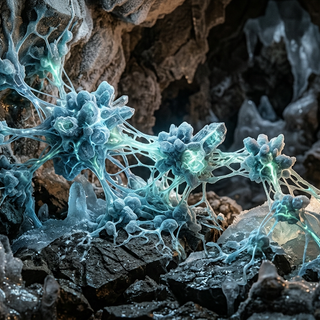
Cryolithos Symbiarchis
KNOWN INTEL
CHOSEN HABITAT
Subsurface regolith cavities at 1–3 km depth. This layer is viable for complex life due to its insulation from extreme surface temperature swings (-162°C to 28°C) and protection from stellar and cosmic radiation, while potentially harboring trace volatile ices or adsorbed water for biochemical reactions.
BIOLOGY
Cryolithos Symbiarchis is a colonial, semi-crystalline organism adapted to the frigid subsurface environment of Mars, where temperatures stabilize around -80°C to -60°C at 1–3 km depth due to geothermal gradients and insulation from surface extremes. Its cellular chemistry is based on a cryophilic biochemistry utilizing ammonia-water mixtures as a solvent, which remain liquid at these low temperatures due to natural antifreeze compounds analogous to Earth’s extremophile proteins. Metabolic energy is derived from chemosynthesis, exploiting redox reactions between trace iron oxides and subsurface hydrogen or methane, which are plausible in Mars’ ancient, mineral-rich crust. The organism’s structural matrix is composed of silicate-protein hybrids, forming a lattice-like network that mimics the surrounding regolith for camouflage and structural support. This lattice is porous, allowing the slow diffusion of volatiles and nutrients through capillary action, a direct adaptation to the low-pressure (0.007 bar at surface, slightly higher subsurface) and arid conditions where no primary liquid solvent exists on the surface. The body plan of Cryolithos Symbiarchis is a distributed network of interconnected nodes, each node a semi-autonomous unit of biocrystalline growth embedded within the regolith. These nodes extend tendril-like filaments to neighboring nodes, forming a vast underground web spanning kilometers. This structure is a direct response to the habitat’s extreme scarcity of resources and temperature swings; by distributing itself across a wide area, the organism maximizes access to trace volatiles and minerals while minimizing exposure to localized thermal or radiation stress. The cryophilic adaptations, including slow metabolic rates and thermal buffering via silicate lattices, ensure survival in the mean subsurface temperature of approximately -70°C, while the organism enters dormancy during surface-proximal temperature drops to -162°C by sealing pores to retain internal heat.
SENSES
Cryolithos Symbiarchis perceives its environment through mechanochemical gradients, detecting minute vibrations in the regolith caused by seismic activity or gas venting, which signal potential resource deposits or structural instability. It also possesses a form of chemosensory mapping, where tendrils release and detect volatile chemical signatures to locate trace water or methane. Communication between nodes occurs via low-frequency acoustic pulses transmitted through the silicate lattice, creating a resonant network that coordinates resource allocation and growth patterns across the colony. This method is uniquely suited to the subsurface habitat, where light and electromagnetic signals are irrelevant.
LOCOMOTION
Movement in Cryolithos Symbiarchis is not active in the traditional sense but occurs through slow, directed growth of its tendril network. The organism extends filaments along chemical gradients toward nutrient-rich zones, a process driven by osmotic pressure within the lattice pores. In the low gravity of Mars (0.38g), this growth requires minimal energy, allowing the organism to expand horizontally and vertically through regolith cavities over centuries. This “flowing growth” matches the subsurface habitat, where physical barriers and low pressure preclude rapid or dynamic motion.
REPRODUCTION
Reproduction in Cryolithos Symbiarchis is asexual, achieved through fragmentation of peripheral nodes that detach and initiate independent growth when resources are abundant. The organism is colonial, with no concept of individuality; each node operates as part of a greater network, sharing resources and information via tendril connections. There is no parental care; new nodes integrate into the network automatically upon reaching a critical mass. Social structure is emergent, based on resource distribution and network density, with larger colonies exerting dominance over smaller ones through chemical suppression of growth in overlapping zones. INTELLIGENCE & COGNITION: The intelligence of Cryolithos Symbiarchis is distributed across its colonial network, encoded in the resonant frequencies of acoustic pulses and chemical gradients within the silicate lattice. This distributed cognition allows for complex problem-solving, such as optimizing tendril growth paths to maximize resource acquisition in the sparse subsurface environment. Intelligence manifests behaviorally through environmental engineering; the organism modifies regolith cavities by secreting binding agents to stabilize tunnels, creating a network of reinforced pathways for efficient volatile diffusion. Outward expression of intelligence includes the construction of fractal-like lattice patterns that enhance thermal retention and resource storage, as well as synchronized pulse signaling to coordinate colony-wide responses to seismic disturbances or resource discoveries. This intelligence is consistent with the organism’s biochemistry, as the silicate-protein matrix serves as both a structural and computational substrate, leveraging the stability of cryophilic chemistry to maintain long-term memory in chemical imprints.
DYNAMIC NOTES
Cryolithos Symbiarchis is intricately adapted to Mars’ harsh conditions, including the equilibrium temperature of -67°C and extreme surface temperature swings from -162°C to 28°C. In its subsurface habitat at 1–3 km depth, the organism avoids the worst of these swings, maintaining a stable thermal environment around -70°C through lattice insulation and metabolic dormancy during extreme cold snaps. The thin atmosphere (0.007 bar, dominated by 95% CO2, 3% N2, 1.6% Ar, 0.13% O2, 0.03% H2O) offers little surface protection, but the subsurface layer shields it from the full stellar radiation of Mars’ G-type star (Sol) and cosmic rays, negating the need for magnetotrophic traits due to the absence of a significant magnetic field. The low gravity (0.38g) facilitates the organism’s sprawling growth with minimal structural stress, while the lack of tidal forces ensures a stable subsurface environment. The absence of surface liquid or ice (0% coverage) drives the organism to rely on trace adsorbed volatiles in the regolith, intensifying competition for these scarce resources and shaping its distributed colonial strategy to cover vast areas. The extreme temperature swings on the surface, though mitigated subsurface, still influence daily survival strategies; Cryolithos Symbiarchis employs thermal storage within its silicate lattice, trapping heat during warmer periods (up to 28°C at surface) to buffer against drops to -162°C. The evolutionary timescale (7/10, ancient biosphere) has allowed for the development of highly specialized adaptations, including its complex colonial structure and intelligence, driven by the need to outcompete other subsurface life for scarce volatiles over billions of years. Intelligence emerged from the evolutionary pressure to optimize resource mapping and regolith modification in this arid, solvent-scarce world, accelerated by the subsurface habitat’s stability, which provided a consistent niche for cognitive networks to evolve without disruption from surface cataclysms. The chosen subsurface regolith cavity habitat is the most thermodynamically viable niche, offering insulation from temperature extremes, radiation shielding, and access to trace chemical energy sources, all of which underpin the organism’s cryophilic chemistry, slow metabolism, and distributed intelligence.