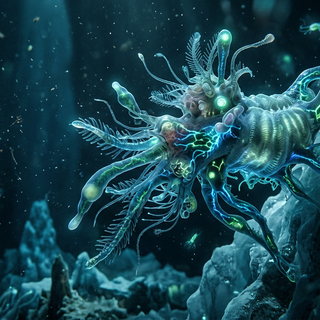
Cryothalassic Symbiovore
KNOWN INTEL
CHOSEN HABITAT
Subsurface water ocean at 10–20 km depth beneath the ice shell. This layer is viable for complex life due to tidal heating from the moon’s intense geological activity, maintaining liquid water at temperatures estimated between -5°C and 5°C despite the surface cold, and providing chemical energy gradients for chemosynthesis.
BIOLOGY
The Cryothalassic Symbiovore is a colonial organism adapted to the frigid, high-pressure environment of Europa’s subsurface ocean at 10–20 km depth, where temperatures hover between -5°C and 5°C due to tidal heating from the moon’s gravitational flexing. Its cellular chemistry is cryophilic, utilizing a water-ammonia mixture as an intracellular antifreeze to prevent freezing in the near-zero temperatures of its habitat. Metabolic pathways rely on chemosynthesis, exploiting redox gradients between hydrogen-rich hydrothermal vent fluids and oxygenated water seepages (derived from radiolytic oxygen at the surface diffusing through ice cracks). Structural materials are composed of flexible, lipid-based membranes reinforced with silicate microfibrils, scavenged from vent particulates, providing resilience against the crushing pressures of 100–200 bar at these depths. The organism’s body plan is a sprawling, gelatinous network of interconnected tendrils, resembling a vast underwater fungal mat, with a porous, sponge-like texture to maximize surface area for nutrient absorption. The habitat’s perpetual darkness and cold shape the Symbiovore’s lack of photosynthetic capability and its reliance on chemical energy. The near-freezing temperatures necessitate slow metabolic rates, with enzymatic processes optimized for efficiency at low thermal energy, likely employing quantum tunneling effects to facilitate reactions. Its tendril network is a direct adaptation to the vast, stable liquid environment of the subsurface ocean, allowing it to anchor to vent structures and spread across kilometers of seafloor to access diffuse chemical resources. The high pressure stabilizes its fluid-filled internal cavities, preventing collapse, while the low gravity of 0.134g reduces structural stress, permitting a delicate, expansive form that would be untenable in higher gravitational fields.
SENSES
The Cryothalassic Symbiovore perceives its environment through chemosensory nodules distributed across its tendril network, detecting gradients of hydrogen, methane, and oxygen in the water column to locate hydrothermal vents. It also possesses mechanosensitive filaments that detect pressure waves and currents, allowing it to sense disturbances or potential threats in the dark ocean depths. Communication occurs via chemical signaling, releasing specific molecular compounds into the water that trigger behavioral responses in nearby segments of the colony or other colonies, coordinating nutrient-sharing or defensive contractions. These chemical messages diffuse slowly in the dense, cold water, creating a time-delayed but spatially extensive communication network.
LOCOMOTION
Movement in the Cryothalassic Symbiovore is a slow, passive process driven by the physics of fluid dynamics in the subsurface ocean. The colony extends its tendrils through a combination of osmotic pressure and ciliary undulations along its edges, allowing it to “flow” across the ocean floor or around vent structures at a rate of centimeters per hour. In the low gravity of 0.134g, minimal energy is required for expansion, and the high-pressure water environment supports its sprawling form, preventing collapse. This locomotion suits the stable, liquid habitat where rapid movement is unnecessary due to the uniform distribution of chemical resources.
REPRODUCTION
The Cryothalassic Symbiovore reproduces asexually through fragmentation, where segments of its tendril network detach and grow into independent colonies when nutrient conditions are favorable. It is a colonial super-organism, lacking a concept of individuality; each colony functions as a distributed network of semi-autonomous units that share resources via fluid exchange through connecting channels. There is no parental care—detached fragments are self-sustaining from the moment of separation, relying on the same chemosynthetic processes as the parent colony. Social structure emerges from cooperative resource-sharing within and sometimes between colonies, forming vast, interconnected mats that can span kilometers, competing subtly for vent access through chemical inhibition of rival growth. INTELLIGENCE & COGNITION: The Cryothalassic Symbiovore exhibits a distributed intelligence encoded in the chemical gradients and oscillatory biochemical reactions across its tendril network, functioning as a decentralized neural analogue. This intelligence manifests in complex problem-solving behaviors, such as dynamically rerouting nutrient flows to damaged sections of the colony or optimizing tendril growth patterns to maximize vent access based on detected chemical gradients. Outward expression of intelligence is seen in environmental engineering—colonies construct vent-encircling “webs” of tendrils to trap particulate nutrients and modify local water currents, enhancing resource capture. This distributed cognition is consistent with its sprawling, colonial body plan and cryophilic biochemistry, as chemical signaling provides a robust, slow but reliable substrate for computation in the cold, high-pressure ocean depths. Intelligence likely evolved as a response to the need for efficient resource allocation in a nutrient-scarce, stable environment over Europa’s ancient evolutionary timescale.
DYNAMIC NOTES
The Cryothalassic Symbiovore is intricately adapted to Europa’s extreme conditions, particularly the equilibrium temperature of -170°C and surface temperature range of -223°C to -117°C (mean -170°C), though its subsurface habitat at 10–20 km depth maintains a stable -5°C to 5°C due to tidal heating from the moon’s intense geological activity (moon mass 0.025 Earth masses at 7.5 Earth radii). The chosen habitat in the subsurface water ocean is justified by the presence of liquid water (primary solvent: H₂O) stabilized by pressure and heat, offering a thermodynamically viable niche for cryophilic biochemistry and chemosynthesis, shielded from the lethal surface cold and near-vacuum atmospheric pressure of 0.001 bar with trace O₂ (100%). The temperature swing at the surface does not directly impact the Symbiovore, as its deep ocean environment is insulated by the ice shell; however, periodic ice fracturing from tidal forces introduces oxygenated water, which it exploits metabolically. The weak magnetic field (0.024 Gauss) offers minimal radiation shielding, but the thick ice and water layers above (surface coverage by ice: 100%) protect it from the G-type star’s (Sun-like) radiation, negating the need for specific radiation-adapted traits beyond basic cellular repair mechanisms. Europa’s low gravity of 0.134g facilitates the Symbiovore’s expansive, delicate tendril network, reducing structural demands, while the ancient evolutionary timescale (7/10) has driven the emergence of its colonial super-organism structure and distributed intelligence, honed by billions of years of competition for scarce vent resources in a stable, unchanging habitat. Intelligence likely developed from the evolutionary pressure to optimize chemical resource distribution across vast networks, constrained by the slow diffusion rates in cold, dense water but accelerated by the habitat’s stability, allowing complex biochemical signaling to evolve. The 100% ice coverage shapes its habitat distribution by confining life to subsurface liquid zones, intensifying competition around hydrothermal vents and driving cooperative colony behaviors. Every adaptation—cryophilic chemistry, chemosensory perception, and slow tendril expansion—ties directly to the pressure (100–200 bar), temperature (-5°C to 5°C), liquid water solvent state, and chemical energy fluxes of the subsurface ocean layer, ensuring biochemical and ecological viability in this ancient, cryogenic world.