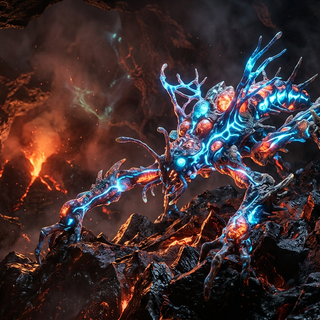
Thermolithos Vortexis
KNOWN INTEL
CHOSEN HABITAT
A furnace-hot, temperate-pressure, Earth-like gravity rocky terrestrial world with Water (H₂O) as its working solvent, orbiting a G-type (Sun-like) star.
Solid surface in thermally active subsurface cavities near volcanic vents at depths of 0.5–2 km. This layer is viable for complex life due to the presence of localized heat gradients and potential micro-pockets of superheated water or steam under high pressure, providing a niche for exotic biochemistry despite the extreme surface temperatures of 729°C–759°C (mean 744°C).
BIOLOGY
Thermolithos Vortexis is a colonial organism adapted to the searing conditions of Ignisferra’s subsurface cavities, where temperatures fluctuate between 729°C and 759°C (mean 744°C). Its cellular chemistry is based on silicon-metal oxide polymers rather than carbon, as traditional organic bonds would disintegrate under such extreme heat. Metabolic processes rely on the chemosynthesis of molten mineral compounds, particularly sulfur and iron oxides abundant in the volcanic environment, using the steep thermal gradients near vents to drive energy production through redox reactions. Structurally, the organism resembles a network of fractal, crystalline tendrils that grow and branch in response to heat and mineral availability, forming a lattice-like colony that can span several meters. These tendrils are composed of heat-resistant silicates reinforced with trace metals, providing both structural integrity and a medium for energy conduction across the colony. The habitat’s extreme temperature and pressure (approximately 1 bar at the surface, increasing slightly with depth) shape the organism’s body plan profoundly. The subsurface cavities offer slight shielding from the full brunt of surface radiation and temperature swings, while proximity to volcanic vents ensures a steady supply of molten materials for metabolism. The crystalline tendrils are not static; they grow toward heat sources, retracting from cooler zones below 700°C where metabolic efficiency drops, ensuring optimal positioning within the narrow thermal window of activity. This adaptation is a direct response to the mean surface temperature of 744°C, pushing the organism to evolve mechanisms for thermal energy storage in its silicate matrix, which acts as a heat capacitor during brief cooling periods. Additionally, the absence of surface water (0% coverage by liquid or ice) forces Thermolithos Vortexis to extract trace moisture from superheated steam or mineral-bound hydration within the subsurface. This scarcity has driven the evolution of hyper-efficient chemical extraction processes, where the organism uses localized pressure changes to condense and metabolize minimal water content as a catalyst for silicon-based reactions. The colony’s distributed nature allows it to survive localized thermal shocks by sacrificing outer tendrils while protecting core metabolic nodes deeper within the lattice.
SENSES
Thermolithos Vortexis perceives its environment through thermoreception and magnetoreception, detecting minute variations in heat gradients and Ignisferra’s moderate magnetic field (1 Gauss) via perturbations in its silicate matrix. Specialized tendril tips contain iron-rich inclusions that resonate with magnetic fluctuations, allowing the organism to navigate subsurface cavities and locate mineral-rich zones near vents. Communication within the colony occurs through low-frequency vibrations propagated through the crystalline lattice, transmitting information about thermal conditions or resource availability across meters of interconnected tendrils. These vibrations are also used to coordinate growth patterns, ensuring the colony expands in a synchronized manner toward optimal heat sources.
LOCOMOTION
Movement in Thermolithos Vortexis is not locomotion in the traditional sense but rather a dynamic growth and retraction process. The crystalline tendrils extend toward hotter zones near volcanic vents by depositing new silicate layers at their tips, a process driven by thermal energy and chemical gradients. Conversely, tendrils in cooler or resource-poor areas dissolve or retract, redistributing materials to more favorable regions of the colony. This slow, flowing growth mimics a fluid-like expansion through the rocky subsurface, constrained by the solid habitat and the need to remain anchored in thermally active zones. The physics of this movement relies on differential thermal expansion within the silicate structure, allowing the organism to “flow” across the terrain at rates of centimeters per Ignisferra day (102.8 hours).
REPRODUCTION
Reproduction in Thermolithos Vortexis is asexual and colonial, occurring through fragmentation of the lattice structure. When a colony reaches a critical size or encounters a new thermal vent, outer tendrils break off, carrying embedded metabolic nodes that nucleate new colonies. These fragments are not individuals in the human sense; the organism operates as a distributed super-organism with no distinct “self,” where each tendril network shares resources and information via vibrational signals. There is no concept of offspring rearing; new colonies grow autonomously, guided by the same environmental cues as the parent lattice. Socially, colonies exhibit cooperative behavior by linking tendrils across adjacent cavities, forming vast subsurface networks that share thermal energy and mineral resources, especially during temperature drops to 729°C. INTELLIGENCE & COGNITION: Given Ignisferra’s ancient evolutionary timescale (7/10), Thermolithos Vortexis has developed a distributed form of intelligence encoded within the vibrational patterns of its crystalline lattice. This intelligence emerges from the synchronized oscillations of tendril networks, where complex interference patterns store and process environmental data as a form of chemical and physical memory. Unlike centralized neural structures, cognition is spread across the entire colony, with larger networks exhibiting greater problem-solving capacity. This manifests in behaviors such as optimizing tendril growth to exploit new thermal vents, constructing heat-trapping lattice configurations to mitigate temperature swings, and even manipulating subsurface micro-fractures to channel steam or molten minerals toward metabolic nodes. Outwardly, intelligence is expressed through environmental engineering—colonies reshape their cavities by selective mineral deposition, creating thermal baffles that stabilize local conditions. This distributed cognition aligns with the organism’s silicate-based biochemistry and colonial body plan, relying on physical rather than biochemical substrates for information processing.
DYNAMIC NOTES
Thermolithos Vortexis is intricately adapted to Ignisferra’s extreme environment, with a mean equilibrium temperature of 744°C and a surface temperature range of 729°C–759°C. The chosen habitat of subsurface cavities near volcanic vents is justified as the most thermodynamically viable niche; it provides localized heat gradients essential for chemosynthesis and slight shielding from surface radiation, while the pressure (near 1 bar with minor depth increases) supports silicate stability. The temperature swing between 729°C and 759°C shapes daily survival strategies—during cooler periods near 729°C, the organism retracts outer tendrils and relies on stored thermal energy in its silicate matrix to maintain metabolic activity, while at peak heat (759°C), it maximizes growth toward vents to exploit abundant energy. The Earth-like atmosphere offers minimal chemical diversity for metabolism, forcing reliance on mineral-based chemosynthesis over gas-phase reactions. Gravity at 1g ensures the crystalline lattice remains structurally stable without excessive strain, while the absence of tidal forces (no significant influence) results in a stable subsurface environment without disruptive seismic shifts. Ignisferra’s moderate magnetic field (1 Gauss) provides reasonable radiation shielding from the G-type host star (provisionally named Sol Ignis), reducing surface particle flux; however, the organism’s subsurface habitat offers additional protection, negating the need for specific magnetotrophic traits beyond basic magnetoreception for navigation. The 0% surface coverage by water or ice profoundly shapes habitat distribution—lacking accessible liquid solvent, Thermolithos Vortexis competes fiercely for trace steam in subsurface cavities, driving the evolution of networked colonies to monopolize vent-adjacent zones. The ancient evolutionary timescale (7/10) has allowed for highly specialized adaptations, with intelligence emerging from the need to manage scarce resources and extreme thermal variability in a waterless environment. Cognition likely developed as a response to competition for thermal and mineral niches, accelerated by the stable subsurface habitat that permitted long-term lattice growth and vibrational memory storage. The long day length (102.8 hours) further reinforces slow, energy-conserving growth cycles, while the orbital distance of 0.06257 AU from Sol Ignis explains the extreme heat, locking life into silicon-based forms. Every adaptation ties directly to the subsurface layer’s temperature (729°C–759°C), pressure (near 1 bar), solvent scarcity (no surface H₂O), and energy fluxes from volcanic activity, ensuring biochemical and ecological plausibility.