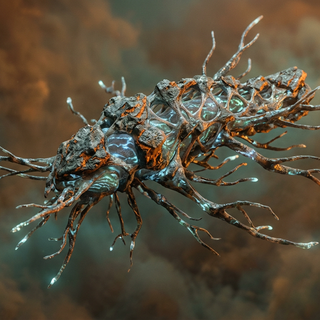
Sulfosilicus aetherion
KNOWN INTEL
CHOSEN HABITAT
Dense metallic aerosol layer at 50 bar isobar and 736°C within the upper cloud decks. This layer is viable because the high pressure stabilizes silicon-sulfur condensates and metal-oxide aerosols against dissociation while providing continuous chemical energy gradients from the G-type star's intense irradiation.
BIOLOGY
The organism employs silicon-sulfur polymer chains cross-linked with iron and titanium oxides as its primary structural and catalytic matrix. Cellular chemistry relies on reversible redox cycling between Si-S bonds and metal-oxide clusters, enabling chemosynthetic metabolism that extracts energy from sulfur aerosol oxidation and stellar UV-driven radical formation. At the prevailing 731–741°C temperatures, carbon-based molecules are impossible; instead, the biochemistry operates via high-temperature molten-mineral phases where silicon chains remain flexible yet stable under 50 bar compression. Body plan consists of a diffuse colonial lattice of crystalline filaments and vesicular nodes suspended in the aerosol flow, resembling an enlarged, heat-resistant slime mold. This architecture evolved to maximize surface area for aerosol capture while distributing thermal load across the colony. Symbiotic metal-reducing microbes within the nodes recycle waste oxides back into structural filaments, creating a closed-loop system fully adapted to the absence of any liquid solvent.
SENSES
The colony detects chemical gradients via embedded metal-oxide receptors that register sulfur and metal ion fluxes, supplemented by infrared sensing through lattice vibrations that register temperature differentials as small as 2°C. It perceives pressure waves propagating through the dense 50 bar atmosphere and uses weak induced currents for rudimentary magnetoreception. Communication occurs through pulsed releases of volatile sulfur compounds that encode colony state information across distances of several hundred meters.
LOCOMOTION
Movement is achieved by buoyancy modulation: specialized vesicles selectively absorb or expel helium-rich aerosols to adjust density relative to the surrounding 50 bar flow, allowing the lattice to rise or sink along vertical gradients. Lateral drift follows prevailing zonal winds, with filament contractions providing limited steering by altering drag coefficients in the turbulent cloud deck.
REPRODUCTION
Reproduction is strictly colonial and asexual, occurring through fragmentation when lattice sections exceed a critical mass; detached fragments seed new colonies by nucleating on existing aerosol particles. There is no concept of an individual; the lattice functions as a distributed network with continuous resource sharing via filament connections. Offspring fragments receive initial metabolic support from the parent lattice before detaching.
DYNAMIC NOTES
The 736°C equilibrium temperature and 731–741°C surface range dictate continuous operation in a silicon-sulfur redox regime, with daily 10°C swings prompting metabolic switching between high-flux oxidation during peak irradiation and low-flux oxide storage at night. The unknown atmosphere and pressure are inferred to reach 50 bar at the chosen layer, enabling condensate stability absent any primary liquid solvent. Unconfirmed 0.47g gravity reduces settling rates, favoring persistent aerosol suspension, while intense tidal forces from the 0.01 Earth-mass moon at 10 Earth radii drive constant crustal outgassing that replenishes sulfur aerosols. Unknown magnetic field implies minimal radiation shielding from the G-type star at 0.0527 AU, selecting for radiation-resistant metal-oxide lattices that tolerate elevated UV and particle flux. The 5/10 evolutionary timescale has produced multicellular colonial complexity sufficient for distributed sensing and fragmentation but not centralized structures. This 50 bar aerosol layer was selected as the sole thermodynamically viable niche where silicon-metal biochemistry can persist amid the extreme heat and gas-giant dynamics.