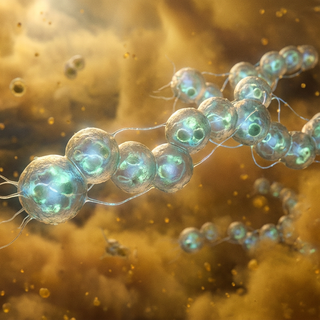
Acidosiphonara venifera
KNOWN INTEL
CHOSEN HABITAT
Sulfuric acid aerosol layer at 15 bar and 250°C. This layer is a viable niche for complex life because the elevated pressure maintains liquid sulfuric acid stability within its phase window while the reduced temperature relative to the surface permits thermophilic biochemistry and energy gradients from volcanic outgassing.
BIOLOGY
Acidosiphonara venifera exists as a modular colonial organism composed of chained vesicle units linked by conductive acid filaments. Its cellular chemistry relies on sulfuric acid as the primary solvent, with heat-stable sulfonated polymers forming membranes that resist hydrolysis at 250°C. Metabolism proceeds via chemosynthesis, oxidizing trace SO2 against CO2 to generate polysulfate energy carriers, supplemented by trace N2 fixation under the 15 bar regime. Structural materials consist of silica-sulfate composites that provide tensile strength against the 0.904g buoyancy forces while preventing collapse in the dense gas. The 250°C habitat directly dictates these traits: lower pressure than the 92 bar surface allows solvent liquidity without supercritical transition, while the G-type stellar flux filtered through the CO2 envelope supplies consistent thermal energy that the colony harnesses rather than resists. Absence of surface liquid forces total dependence on suspended aerosol droplets, shaping a diffuse body plan optimized for droplet coalescence and atmospheric mixing.
SENSES
The colony perceives via distributed chemosensors embedded in filament junctions that detect SO2 and H2SO4 concentration gradients, supplemented by infrared-sensitive sulfate crystal oscillators responding to thermal flux variations. Communication occurs through pulsed proton transfers along acid filaments, creating propagating chemical waves that encode colony state information across modules.
LOCOMOTION
Movement is achieved by controlled inflation and deflation of internal hydrogen-sulfate gas vesicles that adjust buoyancy within the 15 bar isobar. Differential vesicle contraction generates slow vertical and lateral drift, governed by the 0.904g field and local density gradients rather than directed propulsion.
REPRODUCTION
Reproduction occurs through fission of modular vesicle chains, with daughter modules dispersing via atmospheric turbulence before re-linking through chemical recognition. No discrete individuals exist; the colony functions as a continuous distributed network whose boundaries are defined by filament connectivity rather than physical separation. INTELLIGENCE & COGNITION: Intelligence emerges from synchronized chemical oscillator networks distributed across the colonial filaments, where reaction-diffusion patterns encode memory and decision states. This substrate produces collective problem-solving expressed as targeted aerosol harvesting and filament reconfiguration to optimize chemosynthetic yield, enabling environmental engineering through localized droplet nucleation that alters local gas mixing for sustained resource access.
DYNAMIC NOTES
The 15 bar sulfuric acid layer was selected because the 464°C surface temperature at 92 bar precludes stable liquid H2SO4, while the 0% surface coverage forces all solvent-dependent life into suspended atmospheric aerosols. The 46°C equilibrium temperature reflects the blackbody baseline that the thick CO2-N2-SO2 atmosphere amplifies to surface extremes, yet the chosen isobar cools sufficiently for thermophilic sulfonate chemistry. No magnetic field leaves the colony exposed to full G-type stellar radiation, countered by radiation-resistant sulfate crystal shielding within vesicles. The 7/10 evolutionary timescale permitted emergence of distributed chemical intelligence through prolonged selection for cooperative aerosol management in a solvent-scarce environment. Daily survival involves vesicle-mediated vertical migration to track minor temperature fluctuations around 250°C without encountering the 464°C surface boundary layer.