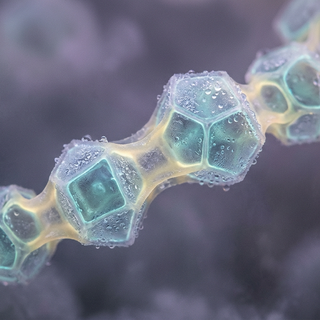
Cryovex filamentum
KNOWN INTEL
CHOSEN HABITAT
Methane-aerosol condensation layer at 1.5 bar and −155°C. This layer is viable because methane aerosols remain suspended within the temperature window of −202°C to −108°C, enabling chemosynthetic reactions and colonial cohesion without requiring a bulk liquid solvent.
BIOLOGY
Cryovex filamentum consists of colonial chains of polyhedral vesicles linked by flexible silicate-carbon filaments. Each vesicle maintains an internal hydrogen-helium mixture for buoyancy while its outer membrane incorporates methane-soluble lipids and antifreeze glycoproteins that prevent solidification down to −202°C. Cellular metabolism relies on chemosynthesis, oxidizing trace acetylene and phosphine drawn from the surrounding haze to generate ATP analogs at rates slow enough to match the mean −155°C equilibrium temperature. Structural materials are dominated by pressure-resistant, low-density aerogels reinforced with boron-nitride crystallites. These materials resist compression at 1.5 bar while permitting the colony to expand or contract vesicles, buffering the 94°C diurnal swing between −202°C and −108°C. Metabolic switching occurs via reversible phase changes in membrane lipids, allowing energy conservation during colder intervals and brief acceleration when warmer aerosols deliver higher reactant concentrations.
SENSES
The organism detects chemical gradients through membrane-bound receptors sensitive to acetylene and ammonia fluctuations. It senses pressure waves via tension changes along its connecting filaments and uses weak magnetoreception to orient within Amateru’s variable magnetic environment. Communication occurs through pulsed releases of volatile organic compounds that propagate as chemical trails between colonies, modulated by filament vibrations that encode simple frequency patterns.
LOCOMOTION
Movement is achieved by controlled venting of hydrogen from individual vesicles, creating localized buoyancy shifts that allow the colony to rise or sink within the 1.5 bar isobar. Wind shear at differing altitudes provides passive lateral transport, while coordinated filament contractions enable slow directional adjustments without limbs or appendages.
REPRODUCTION
Reproduction occurs through fragmentation: segments of the filament network detach and inflate new vesicles from ambient gases. Colonies function as distributed networks without discrete individuals; fragments integrate into neighboring chains via chemical recognition. Offspring fragments receive no parental care and immediately join the aerosol flow.
DYNAMIC NOTES
At the −155°C equilibrium temperature and within the −202°C to −108°C surface range, the 1.5 bar methane-aerosol layer supplies suspended droplets that serve as both reaction medium and structural scaffold for Cryovex filamentum. Unknown atmospheric composition is inferred to contain sufficient acetylene and phosphine for chemosynthesis, while the unconfirmed 3.5 g gravity is offset by hydrogen buoyancy. No primary liquid solvent exists, so aerosol interfaces substitute. Weak tidal forces and the uncharacterized magnetic field permit stable layering with minimal disruption; any magnetotrophic sensitivity likely mitigates radiation from the K-type star at 1.93 AU. The 5/10 evolutionary timescale has produced multicellular colonial integration sufficient for coordinated buoyancy but not centralized nervous systems. The 94°C temperature swing drives daily vesicle contraction cycles and metabolic slowdown below −173°C. This exact atmospheric isobar was selected because it alone maintains methane condensation within the observed thermal window while shielding against stellar radiation.