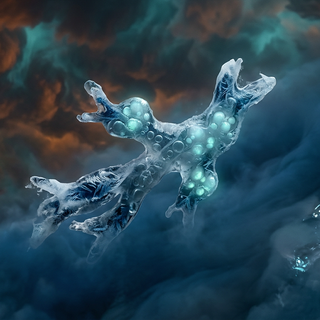
Methanocollid Aerovortex
KNOWN INTEL
CHOSEN HABITAT
1 bar methane condensation layer at −210°C in the upper cloud decks. This layer is viable because the 1 bar pressure allows transient liquid methane microdroplets to form within the H2/He/CH4 mixture, enabling solvent-based cryophilic biochemistry while remaining suspended in the gaseous environment.
BIOLOGY
The organism’s cellular chemistry relies on liquid methane as the primary solvent within membrane-bound vesicles composed of long-chain hydrocarbon polymers that remain fluid at −210°C. Metabolic pathways are chemosynthetic, oxidizing trace CH4 with H2 to generate energy via slow quantum-tunneling electron transfers across cryogenic enzyme analogs; helium acts as an inert buffer moderating reaction rates. Structural materials consist of flexible, aerogel-like silica-hydrocarbon composites that provide tensile strength against 1.14 g buoyancy forces without rigid skeletons. The habitat layer directly dictates a colonial, siphonophore-inspired body plan of interconnected gas-filled cysts and filament networks that maximize surface area for aerosol capture. No centralized organs exist; instead, distributed metabolic nodes exchange metabolites through pressurized methane channels. Adaptations such as antifreeze hydrocarbon proteins and reversible phase-change storage lipids evolved specifically to maintain fluidity across the −268°C to −194°C range, preventing solidification during temperature drops.
SENSES
The creature perceives chemical gradients of CH4 and H2 via distributed surface receptors, detects atmospheric pressure waves through resonant cyst vibrations, and senses the weak 0.14 Gauss magnetic field with embedded magnetite nanocrystals for orientation. Communication occurs via pulsed release of volatile hydrocarbon pheromones carried by winds and low-frequency pressure oscillations propagated through the gas.
LOCOMOTION
Movement occurs through buoyancy modulation: specialized cysts compress or expand internal hydrogen pockets to rise or sink within the 1 bar layer, while filament networks catch and steer along prevailing atmospheric currents. No active propulsion appendages are present; locomotion is governed by Archimedean forces and wind shear at 1.14 g.
REPRODUCTION
Reproduction is asexual fragmentation, where mature filament segments detach and inflate new cysts. The organism exists as a distributed colonial network without discrete individuals; genetic material diffuses continuously across connected nodes. Offspring cysts are released into the methane aerosol stream and integrate into existing colonies upon contact.
DYNAMIC NOTES
The −231°C equilibrium temperature and −268°C to −194°C daily swing force metabolic switching: at −268°C the colonial network contracts cysts to conserve heat and slows tunneling reactions, while at −194°C it expands to harvest more CH4 aerosols. The 1 bar H2/He/CH4 atmosphere at 1.14 g supports neutral buoyancy for the aerogel structure, while the absence of a primary liquid solvent is circumvented by the chosen 1 bar methane condensation layer that supplies transient droplets. The weak 0.14 Gauss magnetic field permits elevated cosmic-ray flux from the distant G-type star, selecting for radiation-resistant hydrocarbon matrices. The 5/10 evolutionary timescale permitted emergence of multicellular colonial integration but not centralized nervous systems. Every trait is thermodynamically anchored to the 1 bar, −210°C isobar where methane liquidity, low stellar flux, and weak magnetism converge.