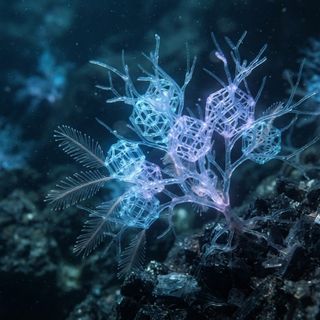
Clathramycota ammoniaphila
KNOWN INTEL
CHOSEN HABITAT
Subsurface pressurized CO₂ liquid aquifers at 2–4 km depth within regolith. This layer is viable because tidal flexing and geothermal gradients raise local temperatures to -110°C to -90°C while overburden pressure exceeds 30 bar, stabilizing liquid CO₂ against the surface range of -134°C to -88°C. The symbiont shares this exact layer and co-exists physically by embedding its vesicular networks directly into the same interconnected regolith pore spaces occupied by Cryolithospora regolithica colonial masses.
METABOLIC SYMBIOSIS
Clathramycota ammoniaphila performs biological nitrogen fixation on dissolved N₂ using energy derived from reduced carbon intermediates (primarily methanol and formaldehyde) excreted by Cryolithospora regolithica during methane oxidation. These carbon compounds are taken up through membrane transporters and fed into a reverse methanogenic pathway that generates ATP while releasing ammonia as the terminal product; the ammonia is immediately exported into the shared liquid CO₂ solvent. In return, Cryolithospora regolithica imports the ammonia to maintain its proton-shuttle cycles and fluorinated-protein flexibility. Interruption of carbon supply causes Clathramycota to cease NH₃ production within hours, leading to rapid enzymatic stiffening and metabolic arrest in Cryolithospora; conversely, loss of ammonia halts proton shuttling in Cryolithospora, starving Clathramycota of usable carbon within days.
BIOLOGY
Cellular chemistry is built around liquid CO₂ as solvent with ammonia acting as both antifreeze and nitrogen carrier. Membrane lipids incorporate fluorinated chains for fluidity at -110 °C to -90 °C, while internal silica–CO₂ clathrate vesicles provide structural rigidity against 30+ bar pressure. Metabolic pathways center on nitrogenase analogs stabilized by the same fluorinated proteins used by the primary species, allowing N₂ reduction at these temperatures. The body plan consists of a distributed colonial network of microscopic vesicles linked by flexible clathrate tubules that ramify through regolith pores, forming a living matrix physically interwoven with Cryolithospora masses. This architecture evolved directly from the need to intercept methanol and formaldehyde waste before it diffuses away in the slow-moving solvent.
SENSES
Detection occurs via membrane-bound chemoreceptors that monitor gradients of methanol, formaldehyde, ammonia, and H₂S. Tidal pressure pulses are transduced through clathrate tubule deformation into calcium-like ion waves that propagate across the colony. Communication with conspecifics and with Cryolithospora occurs by pulsed release of ammonia and trace fluorinated metabolites that serve as both nutrient signals and recognition markers.
LOCOMOTION
The organism expands by directed growth of clathrate tubules that extend through regolith pores via localized dissolution and re-precipitation of silica–CO₂ lattices, advancing at millimeters per tidal cycle without any contractile apparatus.
REPRODUCTION
Reproduction occurs through fragmentation of the colonial network into vesicle clusters that are carried by slow solvent flow to new pore spaces; each cluster can re-establish
SYMBIOSIS
Clathramycota ammoniaphila performs biological nitrogen fixation on dissolved N₂ using energy derived from reduced carbon intermediates (primarily methanol and formaldehyde) excreted by Cryolithospora regolithica during methane oxidation. These carbon compounds are taken up through membrane transporters and fed into a reverse methanogenic pathway that generates ATP while releasing ammonia as the terminal product; the ammonia is immediately exported into the shared liquid CO₂ solvent. In return, Cryolithospora regolithica imports the ammonia to maintain its proton-shuttle cycles and fluorinated-protein flexibility. Interruption of carbon supply causes Clathramycota to cease NH₃ production within hours, leading to rapid enzymatic stiffening and metabolic arrest in Cryolithospora; conversely, loss of ammonia halts proton shuttling in Cryolithospora, starving Clathramycota of usable carbon within days. BIOLOGY: Cellular chemistry is built around liquid CO₂ as solvent with ammonia acting as both antifreeze and nitrogen carrier. Membrane lipids incorporate fluorinated chains for fluidity at -110 °C to -90 °C, while internal silica–CO₂ clathrate vesicles provide structural rigidity against 30+ bar pressure. Metabolic pathways center on nitrogenase analogs stabilized by the same fluorinated proteins used by the primary species, allowing N₂ reduction at these temperatures. The body plan consists of a distributed colonial network of microscopic vesicles linked by flexible clathrate tubules that ramify through regolith pores, forming a living matrix physically interwoven with Cryolithospora masses. This architecture evolved directly from the need to intercept methanol and formaldehyde waste before it diffuses away in the slow-moving solvent. SENSES & COMMUNICATION: Detection occurs via membrane-bound chemoreceptors that monitor gradients of methanol, formaldehyde, ammonia, and H₂S. Tidal pressure pulses are transduced through clathrate tubule deformation into calcium-like ion waves that propagate across the colony. Communication with conspecifics and with Cryolithospora occurs by pulsed release of ammonia and trace fluorinated metabolites that serve as both nutrient signals and recognition markers. LOCOMOTION: The organism expands by directed growth of clathrate tubules that extend through regolith pores via localized dissolution and re-precipitation of silica–CO₂ lattices, advancing at millimeters per tidal cycle without any contractile apparatus. REPRODUCTION & SOCIETY: Reproduction occurs through fragmentation of the colonial network into vesicle clusters that are carried by slow solvent flow to new pore spaces; each cluster can re-establish symbiosis if it encounters Cryolithospora. The species exists as a distributed superorganism with no discrete individuals. DYNAMIC NOTES: At 96 K equilibrium temperature and 0.831 g gravity, the 30+ bar overburden and tidal flexing from the 5.4115-Earth-mass moon maintain liquid CO₂ stability exactly where geothermal heat intersects the 2–4 km horizon. The 2.82 Gauss magnetic field induces weak ion currents in ammonia-rich solvent that the symbiont exploits for trace energy. The G-type star’s low UV flux at 8.043 AU permits long-term stability of fluorinated compounds. Clathramycota ammoniaphila occupies the identical aquifer layer as Cryolithospora regolithica; co-habitation forces both to evolve complementary membrane transporters tuned to the same pressure–temperature–solvent window. SYMBIOSIS: Methanol and formaldehyde produced by Cryolithospora methane oxidation diffuse across the shared solvent and are actively transported into Clathramycota vesicles, where they enter a reductive pathway yielding ATP and ultimately ammonia. Ammonia diffuses back to Cryolithospora, where it participates in proton shuttling and enzyme stabilization before partial re-oxidation returns nitrogen to the pool. Physical co-location occurs as Clathramycota tubules grow along Cryolithospora clathrate surfaces, creating a shared biofilm-like interface millimeters thick. Extinction of Clathramycota would cause ammonia depletion, collapsing Cryolithospora metabolism and halting all chemosynthetic carbon fixation in the aquifer; loss of Cryolithospora would starve Clathramycota of reduced carbon, extinguishing nitrogen input and allowing N₂ to accumulate unused. An emergent property is the creation of localized ammonia–methanol microcycles that maintain solvent pH and redox balance at levels neither species can sustain independently, enabling sustained chemosynthesis at temperatures where isolated metabolism would freeze.
DYNAMIC NOTES
At 96 K equilibrium temperature and 0.831 g gravity, the 30+ bar overburden and tidal flexing from the 5.4115-Earth-mass moon maintain liquid CO₂ stability exactly where geothermal heat intersects the 2–4 km horizon. The 2.82 Gauss magnetic field induces weak ion currents in ammonia-rich solvent that the symbiont exploits for trace energy. The G-type star’s low UV flux at 8.043 AU permits long-term stability of fluorinated compounds. Clathramycota ammoniaphila occupies the identical aquifer layer as Cryolithospora regolithica; co-habitation forces both to evolve complementary membrane transporters tuned to the same pressure–temperature–solvent window.