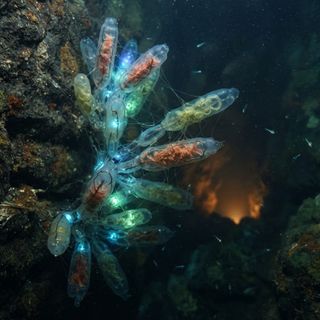
Siphonobrina halocryo
KNOWN INTEL
CHOSEN HABITAT
Subsurface briny aquifer at 4–7 km depth within cryovolcanic basalt fractures. This layer supplies stable geothermal heat and dissolved sulfur compounds shielded from the surface sulfur haze and low stellar flux, enabling chemolithotrophic metabolism in a liquid medium.
BIOLOGY
Siphonobrina halocryo consists of elongated, tubular colonial modules linked by shared cytoplasmic strands, each module specialized for sulfur oxidation or CO2 fixation. Cells employ a silicon-sulfide composite membrane reinforced with basalt-derived iron traces scavenged from surrounding rock, allowing tolerance of high salinity and episodic pressure spikes from cryovolcanism. Metabolism proceeds via anaerobic sulfur disproportionation, harvesting energy from H2S and SO2 gradients while fixing carbon into polythionate storage polymers that also serve as structural scaffolding. The organism maintains internal pH homeostasis through proton-pumping vesicles that double as buoyancy regulators. Low metal availability from the ancient, metal-poor K2V star is offset by efficient recycling of trace nickel and molybdenum within the colony, concentrated at junction nodes between modules. This architecture supports slow but continuous growth in the stable, low-energy environment beneath the dense CO2 atmosphere.
SENSES
Modules detect chemical gradients of sulfur species and dissolved metals via membrane-bound receptors that trigger peristaltic contractions along the colony. Long-range signaling occurs through pressure-wave pulses propagated by rhythmic inflation and deflation of gas vesicles, modulated by local magnetic anomalies from the basalt host rock. Colonies integrate these signals into coordinated metabolic states without centralized processing.
LOCOMOTION
Movement occurs through sequential peristaltic waves that squeeze fluid between modules, generating directional thrust in the viscous brine. Buoyancy adjustments via vesicle inflation allow slow vertical migration along fracture walls, while lateral drift follows convective currents driven by cryovolcanic heat plumes.
REPRODUCTION
Reproduction proceeds by fragmentation: mature modules detach as autonomous propagules that drift until they anchor in new fractures and initiate budding. The colony functions as a distributed superorganism with no discrete individuals; resource sharing occurs continuously through cytoplasmic connections. Offspring fragments inherit partial metabolic memory via epigenetic chemical markers passed during separation.
DYNAMIC NOTES
On Basaltica Brine, orbiting the ancient K2V orange dwarf, Siphonobrina halocryo occupies the subsurface briny aquifer to exploit geothermal sulfur sources unavailable on the cryovolcanic surface. The chosen habitat resolves the mismatch between the star’s low luminosity and the planet’s dense CO2 atmosphere by remaining below the sulfur haze layer, where stable heat and chemistry support the organism’s chemolithotrophic colonial form.