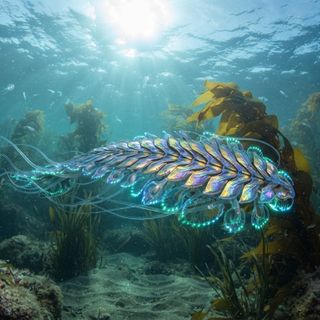
"Chitinous Zephyr"
KNOWN INTEL
CHOSEN HABITAT
Sunlit kelp prairie layer at 10–40 m depth on the shallow ocean floor. This layer supplies stable photosynthetic productivity from Achernar’s intense blue-white output while remaining within the photic zone of Caladan’s global ocean, enabling complex grazing without surface turbulence.
BIOLOGY
The Chitinous Zephyr maintains a colonial siphonophore-like body plan composed of modular zooids integrated into a 2 m elongate, dorsoventrally flattened thallus. Each zooid houses silica-reinforced chitin plates that refract Achernar’s short-wavelength radiation into iridescent structural color while shielding internal tissues from UV flux. Metabolic pathways rely on chemolithoautotrophic symbionts that oxidize dissolved manganese and iron ions advected by kelp-root currents; spiracles along the flanks function as both gas-exchange pores and pulsed-jet vents, expelling water to drive
SENSES
Infrared pit organs embedded in the leading edge detect thermal gradients created by photosynthetic kelp respiration and diurnal water-column mixing. Electroreception maps Caladan’s planetary magnetic field lines, allowing the herd to anticipate seasonal reversals and adjust migration vectors. Communication occurs via faint, modulated pressure waves generated by coordinated spiracle pulses; these produce harmonic tones that propagate through the dense kelp canopy and are sensed by neighboring individuals’ plate vibrations, coordinating group turns without visual or chemical signals.
LOCOMOTION
while harvesting dissolved oxygen and trace metals. Structural materials emphasize flexible, piezoelectric chitin composites that convert ambient magnetic-field oscillations into weak bioelectric currents, powering low-level luminescence in the plates. This luminescence attracts microbial films on kelp blades that the creature’s ventral ciliated fields then harvest. The entire organism lacks any centralized nervous mass, instead distributing sensory and motor functions across a reticulated network of electroreceptive cells that maintain herd cohesion through synchronized field pulses. SENSES & COMMUNICATION: Infrared pit organs embedded in the leading edge detect thermal gradients created by photosynthetic kelp respiration and diurnal water-column mixing. Electroreception maps Caladan’s planetary magnetic field lines, allowing the herd to anticipate seasonal reversals and adjust migration vectors. Communication occurs via faint, modulated pressure waves generated by coordinated spiracle pulses; these produce harmonic tones that propagate through the dense kelp canopy and are sensed by neighboring individuals’ plate vibrations, coordinating group turns without visual or chemical signals. LOCOMOTION: Movement is achieved through rhythmic contraction of the spiracle array, producing pulsed water jets that propel the flattened body in a smooth, undulating glide 0.5–2 m above the kelp canopy. The six flexible, fin-like extensions stabilize roll and yaw in the low-viscosity shallow-water regime but do not contact the substrate; piezoelectric chitin flexure converts magnetic-field changes into micro-adjustments of jet angle, enabling energy-efficient, long-distance herd migrations.
REPRODUCTION
Individuals are simultaneous hermaphrodites that release gametes into turbulent kelp-root upwellings during peak magnetic-field alignment. Fertilized zygotes develop into free-swimming planula-like buds that attach to kelp stipes and grow by iterative zooid budding rather than individual fission. No parental care exists; offspring integrate into the nearest migratory herd once they reach 20 cm, inheriting collective magnetic memory through horizontal transfer of endosymbiotic bacteria.
DYNAMIC NOTES
Achernar’s high UV and rapid rotation drive Caladan’s strong magnetic seasonality, which the Chitinous Zephyr exploits by grazing the sunlit kelp prairies at 10–40 m. This micro-habitat resolves the tension between the planet’s ocean-dominated character and the creature’s luminous, open-habitat requirements by remaining within the photic zone yet sheltered from surface storms, directly shaping the iridescent shielding, electroreceptive navigation, and jet-based locomotion.