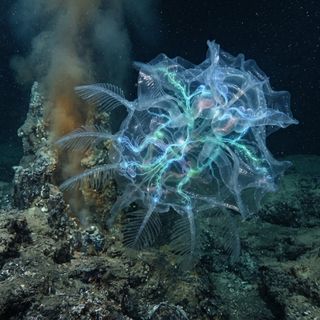
Cryolithofractura symbiotica
KNOWN INTEL
CHOSEN HABITAT
Subsurface water ocean at 8–12 km depth beneath the ice crust, where tidal heating maintains liquid water at −5°C to 4°C and 15–25 bar. This layer is viable because the thick ice shell shields against surface radiation and vacuum while tidal flexing supplies geothermal energy and maintains solvent liquidity far from the −170°C mean surface equilibrium.
BIOLOGY
Cellular chemistry relies on ammonia-water eutectic mixtures and specialized antifreeze glycoproteins that depress the freezing point to −10°C, enabling metabolism at the habitat’s −5°C to 4°C range. Metabolic pathways are chemosynthetic, oxidizing trace hydrothermal hydrogen and reduced minerals vented by tidal fracturing; cells incorporate silica and polysaccharide matrices into flexible, sheet-like colonial tissues rather than rigid skeletons. These materials resist crushing at 15–25 bar while permitting slow diffusion of dissolved gases in the low-oxygen, high-pressure liquid. The extreme surface temperature swing (−223°C to −117°C) and 0.001 bar atmosphere force all complex life below the ice; the organism’s colonial body plan therefore evolved as a distributed network of fluid-filled tubules that can seal and thaw micro-channels during episodic tidal cracks. Weak 0.024 Gauss magnetism offers negligible shielding, so the colony produces radiation-resistant manganese-oxide coatings on outer membranes, a direct adaptation to Sol’s unfiltered particle flux at 5.2 AU.
SENSES
The organism detects tidal strain via mechanosensitive ion channels distributed along its tubules and senses chemical gradients of vent-derived reductants through membrane-bound receptors. Communication occurs by synchronized release of volatile sulfur compounds that propagate as pressure waves through the dense water column; neighboring colonies modulate release timing to encode information across kilometers.
LOCOMOTION
Movement is achieved by peristaltic pumping of internal fluid through a network of contractile tubules, generating slow gliding or drifting along thermal and chemical gradients. At 0.134g, buoyancy differences allow the colony to rise or descend without limbs, using density changes from gas vesicle inflation to traverse vertical fissures opened by tidal stress.
REPRODUCTION
Reproduction is colonial fragmentation: segments detach, drift, and fuse with compatible networks, forming super-colonies that share genetic material via horizontal transfer. No discrete individuals exist; the functional unit is the connected network, which “raises” new segments by supplying nutrients through shared vascular channels until metabolic independence. INTELLIGENCE & COGNITION: Intelligence is distributed across electrochemical oscillators within the colonial matrix, producing emergent problem-solving through synchronized wave patterns. Over the 7/10 evolutionary timescale, selection for efficient resource mapping in a tidally dynamic, radiation-exposed ocean drove the evolution of long-term chemical memory and collective decision-making; colonies reroute fluid flows to dam vents or excavate ice pockets, engineering stable micro-habitats that persist across multiple tidal cycles.
DYNAMIC NOTES
At the −170°C equilibrium temperature and −223°C to −117°C surface range, only the subsurface ocean remains liquid, directly selecting the 8–12 km habitat where tidal heating counters Sol’s distant insolation. The 100 % ice/liquid coverage concentrates all biomass at ice–water interfaces, intensifying competition for vent proximity and favoring colonial fusion. Weak 0.024 Gauss magnetism permits high radiation penetration, selecting manganese-oxide defenses. The ancient 7/10 timescale allowed gradual assembly of distributed oscillators into cognitive networks capable of environmental engineering, an adaptation impossible on shorter timescales. All temperatures reported here are expressed in Celsius (°C).