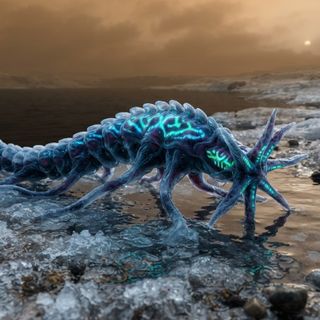
Cryosiphon methanara
KNOWN INTEL
CHOSEN HABITAT
Thin surface films of liquid methane within the 2% lake coverage at 1.47 bar and -179°C mean temperature. This layer is viable because the local pressure and temperature keep methane stably liquid while tidal heating supplies trace chemical energy gradients amid otherwise frozen terrain.
BIOLOGY
Cellular chemistry relies on methane as the primary solvent with dissolved N2 participating in slow nitrogen-fixation reactions at -179°C. Metabolic pathways are chemosynthetic, oxidizing trace acetylene or hydrogen derived from crustal outgassing, yielding energy through quantum-tunneling-assisted reactions that compensate for the extreme cold. Structural materials consist of flexible polyacetylene membranes reinforced with crystalline methane clathrates that maintain integrity across the -185°C to -173°C diurnal swing; these membranes form interconnected tubules rather than discrete cells, enabling colonial continuity. The low 0.14g gravity permits large, low-density gas vesicles filled with N2 to provide buoyancy without structural collapse, while the absence of a magnetic field has selected for radiation-hardened polymer shields that absorb cosmic rays and Sol UV by converting them into minor chemical radicals usable for metabolism.
SENSES
The organism detects chemical gradients of dissolved hydrocarbons and N2 via membrane-bound receptor arrays distributed along its tubules. It senses tidal pressure waves and long-period seismic flexing through mechanosensitive nodes that propagate signals as propagating concentration waves of dissolved ions. Communication occurs via pulsed release of volatile methane derivatives that diffuse through the thin atmosphere, creating temporary chemical “scent trails” readable by neighboring colonies.
LOCOMOTION
Movement occurs by peristaltic contraction of gas-filled vesicles that alter buoyancy and allow the colonial mat to drift across methane film surfaces or creep slowly via surface-tension-driven pseudopod extension. In the 0.14g field these contractions produce net displacement at rates of centimeters per hour, synchronized with the 382.7-hour diurnal cycle to follow retreating liquid margins.
REPRODUCTION
Reproduction is achieved through fragmentation of the colonial network into smaller viable mats that disperse via wind-driven methane aerosol. There is no discrete “individual”; the entire mat functions as a single distributed entity whose boundaries shift as tubules fuse or separate. Offspring mats inherit chemical memory gradients from the parent and are initially nourished by residual clathrate stores until they establish independent chemosynthetic activity. INTELLIGENCE & COGNITION: Intelligence is distributed across oscillating chemical gradients within the tubular network, producing emergent problem-solving through synchronized wave interference patterns. This allows the colony to optimize routes toward sparse liquid patches, modify local terrain by secreting clathrate barriers that trap methane, and coordinate collective contraction waves that redirect small flows of liquid solvent. Over the ancient 7/10 evolutionary timescale these behaviors have produced rudimentary environmental engineering, such as persistent chemical signal fields that mark territorial boundaries and facilitate inter-colony resource sharing.
DYNAMIC NOTES
Equilibrium temperature of -184°C and surface range of -185°C to -173°C force the colony to enter metabolic slowdown during the colder phase of each 382.7-hour day, retreating into clathrate-sealed pockets while maintaining minimal chemosynthetic activity. The N2:95%/CH4:5% atmosphere at 1.47 bar directly supplies both solvent and reactant gases, while 0.14g enables the gas-vesicle architecture. Tidal forces from the 0.015-Earth-mass moon at 8.4 Earth radii drive continuous geological outgassing that replenishes chemical feedstock, favoring the surface methane films over deeper frozen regolith. Absence of a magnetic field exposes the mats to full Sol cosmic-ray flux, which the radiation-hardened polymers exploit for supplemental radicals. The 2% surface liquid coverage creates intense competition, driving the evolution of distributed chemical intelligence that maps and defends liquid patches across geological timescales. The chosen surface-film habitat maximizes solvent liquidity and energy access under these exact cryogenic, low-pressure, high-radiation conditions.