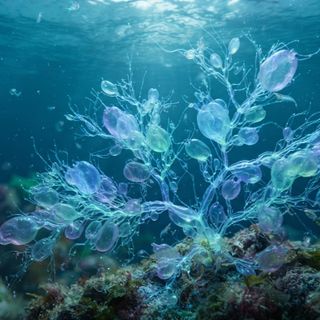
Vesicara filamentosa
KNOWN INTEL
CHOSEN HABITAT
Temperate surface ocean shallows at 0–5 m depth. This layer is viable because the planetary temperature range of -18°C to 42°C maintains stable liquid water solvent for most of the year while providing access to both dissolved gases and sunlight for energy.
BIOLOGY
Vesicara filamentosa is a colonial organism composed of specialized, interconnected vesicles and filaments rather than discrete organs. Its cells employ standard carbon-water biochemistry with mesophilic enzymes optimized for 5–35°C operation; antifreeze glycoproteins and heat-shock proteins allow survival during nightly or seasonal drops to -18°C. Metabolic pathways combine oxygenic photosynthesis in surface-exposed vesicles with chemosynthetic oxidation of dissolved organics at night or under ice cover. Structural materials consist of flexible polysaccharide matrices reinforced by silica spicules, enabling the colony to withstand 1 bar pressure and 1 g buoyancy forces without rigid skeletons. The 0–5 m habitat directly shapes a flattened, mat-like body plan that maximizes light capture while permitting vertical migration through the water column. Colonies form extensive networks anchored to submerged rocks or floating via internal gas bladders; this architecture evolved because the 71 % ocean coverage and weak 0.5 Gauss magnetic field create stable, low-radiation shallows where symbiotic microbial partners can exchange metabolites across short distances.
SENSES
The organism detects chemical gradients via membrane receptors distributed along filaments and senses pressure waves through specialized tension-sensitive vesicles. It perceives weak magnetic field fluctuations with magnetite crystals embedded in conductive filaments. Communication occurs through pulsed release of volatile organic compounds that propagate as chemical plumes, allowing neighboring colonies to coordinate metabolic states or seasonal migration.
LOCOMOTION
Movement relies on coordinated contraction of gas-filled vesicles that expel water through basal pores, producing gentle jet propulsion. Buoyancy adjustments via controlled gas production allow the colony to rise or sink within the 0–5 m layer, while ciliary currents along filaments enable slow lateral drift in response to local currents.
REPRODUCTION
Reproduction is colonial and asexual, occurring through fragmentation where detached vesicle clusters establish new mats. Genetic exchange happens via horizontal transfer of plasmids between adjacent colonies. No concept of individual exists; each mat functions as a distributed superorganism that allocates resources across its network without centralized control or parental care.
SYMBIOSIS
between photosynthetic and chemosynthetic lineages, favored by the stable liquid-water window and 71 % ocean coverage that reduces competition for solvent access. The chosen shallows layer maximizes thermodynamic stability because temperatures remain within water’s liquid phase for extended periods, solar energy penetrates, and 1 g buoyancy supports floating colonies without excessive structural cost.
DYNAMIC NOTES
The equilibrium temperature of -19°C and surface range of -18°C to 42°C (mean 12°C) force daily metabolic switching: daytime photosynthesis dominates above 10°C while nocturnal chemosynthesis sustains the colony during sub-zero periods. The 1 bar N2-O2-CO2 atmosphere supplies dissolved oxygen and carbon for both pathways at 0–5 m depth. The 0.5 Gauss magnetic field offers only partial radiation shielding from Cyrannus, selecting for modest UV-protective pigments rather than full magnetotrophy. Over the 5/10 evolutionary timescale, complex multicellularity emerged through