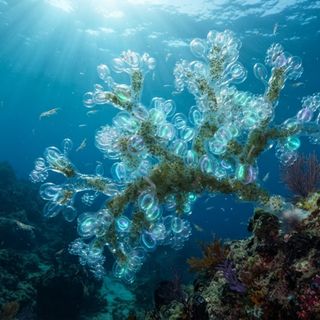
Thalassomyxa risae
KNOWN INTEL
CHOSEN HABITAT
Shallow photic zone of the global ocean at 5–30 m depth. This layer maintains stable liquid water across the planet’s full temperature range while permitting photosynthetic energy capture and gas exchange with the 1 bar N2-O2 atmosphere.
BIOLOGY
Thalassomyxa risae is a colonial organism composed of thousands of interconnected, specialized modules embedded in a transparent polysaccharide matrix. Each module contains water-based carbon biochemistry with mesophilic enzymes optimized for 17°C mean conditions; oxygen diffuses inward from the atmosphere while CO2 is fixed by symbiotic photosynthetic organelles during daylight hours. Structural rigidity derives from cross-linked chitinous microfibrils that resist deformation at 1 g while remaining flexible enough to accommodate thermal expansion between -13°C and 47°C. The colony maintains internal osmolyte gradients that prevent ice nucleation at the lower temperature extreme and heat-shock proteins that stabilize membranes during brief surface warming events. Metabolism switches between net autotrophy in illuminated hours and chemosynthetic supplementation at night or during ice-cover episodes, drawing on dissolved organics and reduced sulfur compounds from deeper water. The absence of centralized organs follows directly from the stable, low-shear environment of the photic zone, where diffusive transport and modular redundancy suffice for all physiological functions.
SENSES
Modules detect chemical gradients of dissolved oxygen, CO2, and organic metabolites via membrane receptors distributed across the colony surface. Pressure-wave sensitivity arises from stretch-activated ion channels that register passing turbulence or conspecific movements. Communication occurs through propagating waves of bioluminescent pulses and diffusible signaling molecules that coordinate contraction or expansion of gas-filled vesicles for buoyancy adjustment.
LOCOMOTION
The colony drifts passively with surface currents while fine-tuning vertical position by coordinated inflation or deflation of internal nitrogen-filled vesicles. Weak ciliary beating on the matrix exterior provides slow directional propulsion in still water, governed by the low Reynolds-number physics of the 5–30 m layer.
REPRODUCTION
Reproduction is entirely asexual through fragmentation and budding; any sufficiently large fragment can regenerate a full colony. No concept of individuality exists; the organism functions as a distributed network whose modules can detach, fuse, or be exchanged with neighboring colonies, forming temporary super-colonies during resource-rich periods.
DYNAMIC NOTES
The 5–30 m layer was selected because it keeps water liquid across the -13°C to 47°C surface range while receiving sufficient photons from Risa’s Star for photosynthesis at 1 bar pressure. Daily thermal swings drive reversible retraction of peripheral modules into the insulating matrix core during cold excursions and increased photosynthetic surface area during warm periods. The 0.5 Gauss magnetic field offers only partial shielding, so the colony produces UV-absorbing pigments in its upper matrix when solar flux is high. At evolutionary timescale 5/10, multicellular integration has reached modular specialization but not centralized nervous tissue. With 80% of the surface covered by water or ice, Thalassomyxa risae is restricted to ice-free liquid patches, resulting in high competition for open-water space and frequent fragmentation events when ice advances.