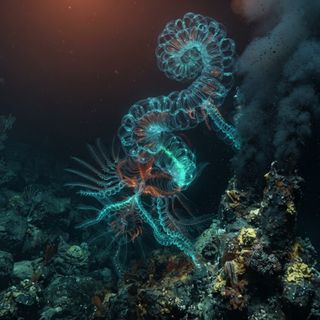
Vorticosiphon aethelwynii
KNOWN INTEL
CHOSEN HABITAT
Deep hydrothermal vent fields at 4–7 km depth along oceanic fracture zones. This layer remains viable for complex life because the planet’s continuous tidal storms and dense CO2 atmosphere are buffered by kilometers of water, while geothermal energy from the crust supplies stable chemical gradients independent of the K5 giant’s variable output.
BIOLOGY
Vorticosiphon aethelwynii exists as a colonial siphonophore-like organism built from chained, fluid-filled tubules of silica-reinforced polysaccharide gel. Individual modules specialize in chemosynthesis, drawing dissolved CO2 and reduced sulfur compounds from vent plumes to fix carbon via a reverse Krebs cycle augmented by nickel-iron catalysts. The colony’s outer sheath incorporates manganese oxides scavenged from surrounding sediments, forming a flexible, pressure-resistant lattice that prevents collapse under 1.4 G while permitting slow osmotic inflation for buoyancy control. Metabolic waste is excreted as microscopic carbonate crystals that accrete into the colony’s anchoring holdfast, gradually building mineral spires around the vent. Because surface tidal energy never reaches these depths, the organism relies entirely on vent-driven convection currents for nutrient delivery and never developed photosynthetic pigments.
SENSES
The colony detects chemical gradients through distributed membrane receptors along each tubule and senses pressure waves via embedded piezoelectric silica nodes that transduce tidal micro-seismic vibrations into coordinated peristaltic contractions. Communication occurs through pulsed releases of volatile sulfur compounds that propagate as distinct chemical “signatures” along the vent plume, allowing neighboring colonies to synchronize reproductive timing without any centralized nervous tissue.
LOCOMOTION
Entire colonies remain anchored by mineral holdfasts but extend free-floating reproductive modules that drift within vent upwelling currents. These modules adjust buoyancy by controlled gas secretion and are carried short distances by convection cells before settling, allowing slow, passive redistribution across the vent field without limbs or directed swimming.
REPRODUCTION
Reproduction is colonial and modular: specialized terminal modules detach as buoyant gamete packets that fuse with compatible modules from other colonies, forming new tubules that drift until they locate fresh vent fissures. There is no concept of an individual; the colony functions as a distributed superorganism whose modules can be lost and replaced indefinitely. Offspring modules receive no parental care beyond initial chemical provisioning and must locate suitable substrate within hours or dissolve.
DYNAMIC NOTES
On Aethelwyne, the orange giant Aldebaran’s high luminosity and the planet’s dense CO2 atmosphere create perpetual surface storms, yet the 4–7 km vent habitat remains thermally and chemically stable. This micro-habitat resolves apparent conflicts by shielding the organism from stellar flux and atmospheric turbulence while exploiting the tidal stresses that fracture the crust and sustain hydrothermal activity, directly shaping the colony’s pressure-wave sensing and mineral accretion adaptations.