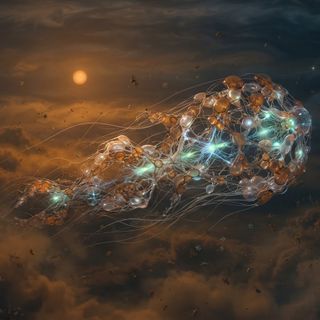
Nebulosiphona dimidiana
KNOWN INTEL
CHOSEN HABITAT
A world, orbiting Gloomgazer.
Mid-level hydrogen-ammonia cloud deck at 0.9–1.4 bar. This stable isobaric layer within Dimidium’s H2/He envelope receives sufficient filtered flux from Gloomgazer to sustain redox chemistry while providing neutral buoyancy for macroscopic colonial structures.
BIOLOGY
Nebulosiphona dimidiana is a colonial siphonophore-like organism composed of thousands of specialized, membrane-bound vesicles linked by conductive protein filaments. Its cells employ a hydrogen-oxidizing metabolism in which H2 is split at tungsten-iron clusters to generate a proton-motive force, supplemented by trace-metal catalysis of ammonia-derived nitrogen compounds. Structural integrity derives from flexible siloxane polymers that resist shear forces in the 0.47 g environment and maintain internal helium pockets for lift. Metabolic waste is vented as microscopic water aerosols that condense on the colony’s outer vesicles, creating a self-reinforcing hydration shell. Because Gloomgazer’s low, stable luminosity penetrates only to this depth, the organism concentrates photosensitive pigments within its uppermost vesicles to harvest the narrow orange-red window that reaches the cloud deck.
SENSES
The colony detects chemical gradients via ligand-binding sites distributed across its filament network and senses pressure waves through resonant vibrations in its gas bladders. Long-distance coordination occurs by pulsed electromagnetic discharges generated across the conductive filaments, modulated at frequencies that propagate efficiently through the conductive H2/He medium; these pulses also allow entrainment with Dimidium’s weak magnetic field lines.
LOCOMOTION
Individual vesicles adjust buoyancy by controlled electrolysis of local H2 into lighter He or by venting heavier aerosols. Coordinated contraction of filament rings produces directional gas jets, allowing the colony to tack against prevailing winds or rise and sink between adjacent cloud strata without any rigid locomotor appendages.
REPRODUCTION
Reproduction is achieved through fragmentation: mature colonies fission into smaller autonomous sub-colonies when filament tension exceeds a threshold. Offspring inherit a distributed memory encoded in the polarity patterns of their filament networks; there is no parental care or concept of individual, only continuous colonial growth and merger events when compatible sub-colonies encounter one another.
DYNAMIC NOTES
Gloomgazer’s ancient, metal-poor output and Dimidium’s H2-dominated envelope together restrict complex chemistry to the narrow 0.9–1.4 bar window where ammonia condensation and hydrogen redox gradients coexist. Nebulosiphona dimidiana’s helium buoyancy sacs and tungsten-based hydrogen metabolism are direct adaptations to this micro-habitat, allowing it to remain suspended where Gloomgazer’s stable flux can drive its metabolism without the crushing pressures or metal scarcity found at other altitudes.