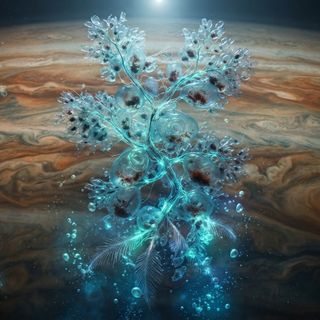
Cryoammonic Siphonocolony
KNOWN INTEL
CHOSEN HABITAT
A frigid, dense-aired, high-gravity gas giant cloud decks world with Ammonia (NH₃) as its working solvent, orbiting Sol.
10 bar atmospheric layer at -161°C. This layer is viable because the 10 bar pressure stabilizes liquid ammonia micro-droplets within the H2-He mix, creating persistent solvent aerosols amid the -176°C to -146°C range where cryophilic biochemistry can operate without solvent freezing.
BIOLOGY
The organism is a colonial aggregate of ammonia-solvent vesicles linked by proteinaceous filaments. Cellular chemistry relies on ammonia-water eutectic mixtures with dissolved methane derivatives as antifreeze, enabling metabolic reactions at -161°C through quantum-tunneling enzymes that lower activation energies. Energy is harvested via chemosynthesis: hydrogenase complexes split atmospheric H2 to reduce NH3 and CH4 into complex nitrogenous polymers, forming structural lattices of polyamide-like cryogels reinforced by helium-trapping microbubbles for buoyancy. The 2.53g gravity and 10 bar pressure compress the colony into a flattened, discoid morphology that resists collapse while maximizing surface area for gas exchange; the extreme cold dictates extremely slow metabolism, with thermal storage in phase-change ammonia reservoirs that buffer the daily -176°C to -146°C swing by controlled freezing and thawing of internal solvent pockets. No centralized tissues exist; instead, the colony functions as a distributed slime-mold analogue where individual vesicles exchange metabolites through cytoplasmic bridges, allowing rapid reconfiguration in response to ammonia aerosol density.
SENSES
Magnetoreception via aligned ferromagnetic inclusions in vesicle walls detects the 4.3 Gauss field lines for navigation and orientation. Chemical gradient sensing occurs through membrane receptors tuned to NH3 and CH4 fluctuations, while pressure-wave detection uses elastic filament vibrations to register atmospheric turbulence. Communication is achieved by synchronized release of volatile amine pheromones that propagate as standing waves within the dense 10 bar layer, encoding colony state through concentration pulses.
LOCOMOTION
The colony drifts and adjusts altitude by modulating helium microbubbles and ammonia-filled ballast vesicles, achieving neutral buoyancy at the 10 bar isobar. Vertical movement exploits density gradients created by localized heating from metabolic waste, while horizontal displacement follows magnetic field curvature and wind shear, with filament contractions providing limited steering without any limb-like structures.
REPRODUCTION
Reproduction occurs through fragmentation: mature colonies pinch off daughter clusters that inherit a subset of vesicles and chemical memory gradients. No true individuals exist; the entity is a distributed colonial network that maintains genetic continuity via horizontal vesicle transfer. Offspring clusters remain tethered by temporary filaments until independent buoyancy is achieved, with no parental care beyond shared chemical signaling. INTELLIGENCE & COGNITION: Intelligence emerges as an emergent property of synchronized chemical oscillators distributed across the colonial network, where phase-locked reaction cycles encode environmental maps and predictive models. This distributed cognition solves resource-location problems by modulating pheromone gradients to steer the entire colony toward methane-rich updrafts. Outward expression includes construction of persistent ammonia-crystal lattices that act as passive chemical memory archives, allowing the colony to modify local aerosol chemistry and signal territorial boundaries to neighboring colonies over evolutionary timescales.
DYNAMIC NOTES
The 10 bar layer was selected because it aligns exactly with the given atmospheric pressure and places the colony within the -176°C to -146°C range where ammonia remains a viable cryosolvent under 10 bar compression. Daily survival involves metabolic switching: at -176°C the colony contracts vesicles to minimize exposed surface and relies on stored ammonia phase-change heat; at -146°C it expands to maximize H2 chemosynthesis. The 4.3 Gauss magnetic field provides moderate radiation shielding from Sol, enabling magnetotrophic vesicle alignment without lethal exposure. The 7/10 evolutionary timescale permitted development of colonial super-organism intelligence through repeated tidal flexing cycles from the 0.08 Earth-mass moon, which stirs atmospheric mixing and creates persistent chemical niches that reward distributed problem-solving for locating stable ammonia aerosols. All adaptations are thermodynamically coupled to the 10 bar pressure, ammonia solvent stability, and Sol-driven radiation environment at 5.2 AU.