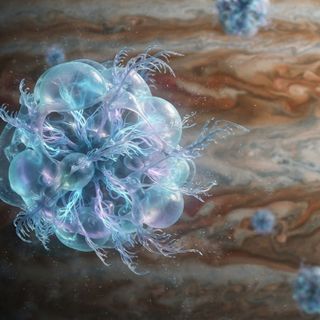
Cryoammonisphaera venticola
KNOWN INTEL
CHOSEN HABITAT
A frigid, dense-aired, high-gravity gas giant cloud decks world with Ammonia (NH₃) as its working solvent, orbiting Sol.
10 bar atmospheric layer at -161°C. This layer is viable because the elevated pressure raises ammonia’s liquid stability window sufficiently to permit persistent micro-droplet and filament networks within the dense H2–He cloud deck, enabling solvent-based biochemistry at the planet’s mean temperature.
BIOLOGY
Cellular chemistry relies on ammonia as the primary solvent, with phospholipid-analogue membranes formed from long-chain amines and hydrocarbons that remain fluid at -176°C to -146°C. Metabolic pathways are strictly chemosynthetic: membrane-bound hydrogenases oxidize atmospheric H2 while reducing trace CH4 and NH3 to generate energy and biosynthetic precursors, supplemented by occasional uptake of upward-convected phosphine. Structural materials consist of flexible polyamine matrices reinforced with helium-filled vesicles that provide both buoyancy and resistance to the 2.53 g compressive load. The habitat layer directly dictates a colonial, non-cellular body plan. Individual modules are microscopic ammonia-filled sacs linked by conductive filaments; the entire super-organism spans tens of metres and drifts as a coherent network. Cryophilic adaptations include ammonia–water eutectic antifreeze proteins and quantum-tunnelling enzymes that maintain reaction rates despite the mean temperature of -161°C and the 30 °C diurnal swing.
SENSES
The organism perceives its environment through distributed magnetoreceptors that detect variations in the 4.3 Gauss field for orientation and through chemosensory filaments that track gradients of H2, CH4 and NH3. Communication occurs via propagated electrochemical pulses along the filament network, modulated by local pressure-wave distortions caused by the creature’s own gas venting.
LOCOMOTION
Movement is achieved by controlled venting of metabolic helium and hydrogen through adjustable pores, altering buoyancy and allowing the colonial mass to ascend or descend within the 10 bar isobar while riding zonal winds. The 2.53 g field compresses the structure into a flattened, ribbon-like morphology that minimises drag and maximises surface area for gas exchange.
REPRODUCTION
Reproduction is entirely colonial: modules periodically fission and re-fuse, exchanging genetic material through direct filament anastomosis. There is no concept of an individual; the functional unit is the kilometre-scale network that can fragment and later recombine. Offspring networks inherit portions of the parent’s chemical memory gradients rather than discrete genomes. INTELLIGENCE & COGNITION: Intelligence is an emergent property of synchronised electrochemical oscillators distributed across the colonial filaments. Problem-solving manifests as collective reconfiguration of filament topology to optimise chemosynthetic yield or to steer the network toward resource-rich updrafts. Over the 7/10 evolutionary timescale, selection for efficient exploitation of transient ammonia clouds has produced rudimentary symbolic signalling—repeating pulse sequences that encode spatial maps of wind shear and chemical plumes—expressed outwardly through coordinated gas-venting patterns that modify local atmospheric flow.
DYNAMIC NOTES
The 10 bar layer was selected because it is the only pressure–temperature regime on this Sol-illuminated gas giant where ammonia remains liquid between -176 °C and -146 °C while still receiving sufficient convective mixing of H2, CH4 and NH3 for sustained chemosynthesis. The 30 °C temperature swing drives daily metabolic switching: at -176 °C the network contracts its helium vesicles and slows reaction rates; at -146 °C it expands venting to shed excess heat and accelerate reduction chemistry. The moderate 4.3 Gauss magnetic field provides adequate radiation shielding against Sol’s output at 5.2 AU, permitting the evolution of magnetosensitive filaments rather than heavy radiation-resistant armour. The ancient 7/10 timescale allowed repeated selection cycles for distributed cognition, with intelligence arising from the need to track and exploit ephemeral chemical plumes in a tidally flexed, high-gravity atmosphere where solitary modules cannot survive.