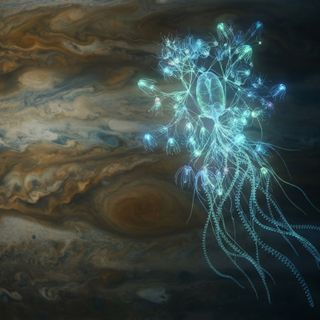
Cryoammonic Siphonocolony
KNOWN INTEL
CHOSEN HABITAT
A frigid, dense-aired, high-gravity gas giant cloud decks world with Ammonia (NH₃) as its working solvent, orbiting Sol.
10 bar atmospheric layer at -161°C mean within the ammonia aerosol deck. This layer is viable because the 10 bar pressure stabilizes ammonia droplets and dissolved volatiles against rapid phase loss while the moderate magnetic field and H2/He envelope provide both buoyancy support and radiation shielding for sustained chemosynthetic activity.
BIOLOGY
The organism is a colonial super-organism composed of specialized zooids linked by ammonia-permeable polysaccharide filaments. Cellular chemistry relies on ammonia as the primary solvent with dissolved methane and hydrogen acting as electron donors in a chemosynthetic pathway that reduces nitrogen compounds to polyamines for structural polymers. At the prevailing -161°C, metabolism proceeds via quantum-tunneling-enhanced enzyme analogs that maintain reaction rates despite extreme kinetic slowing; cryophilic antifreeze proteins keep ammonia-water eutectic mixtures liquid within internal vesicles. The body plan consists of buoyant hydrogen-helium sacs reinforced by methane-hydrate lattices, with no centralized symmetry, allowing the colony to deform and stream through turbulent wind shear. Structural materials are ammonia-soluble silicates and nitrogen-rich aerogels that resist the 2.53g compression while remaining flexible at cryogenic temperatures. Energy is harvested from the 0.3% CH4 and trace NH3 gradients that exist stably at 10 bar; the colony periodically descends or ascends a few hundred meters to exploit vertical chemical stratification created by the planet’s rapid 9.9-hour rotation.
SENSES
The colony detects pressure waves and magnetic field fluctuations through embedded magnetosensitive crystallites that modulate ion flows along the filament network. Chemical gradients of H2, CH4, and NH3 are sensed via surface receptors that trigger synchronized zooid contractions. Communication occurs through pulsed release of volatile amine signals that propagate as coherent wavefronts within the dense 10 bar atmosphere, allowing colony-wide coordination without any centralized neural structure.
LOCOMOTION
Movement is achieved by rhythmic inflation and deflation of hydrogen-filled bladders that exploit buoyancy differences against the 2.53g gravitational field and 10 bar density. The colony streams laterally by undulating its filament web to generate lift in the prevailing zonal winds, while controlled venting of helium allows precise vertical migration between chemical strata.
REPRODUCTION
Reproduction is colonial budding in which mature zooids detach as self-sufficient daughter colonies after exchanging genetic material via ammonia-borne plasmids. There is no concept of a solitary individual; the super-organism maintains continuity through constant filament fusion and fission, with “offspring” colonies inheriting chemical memory gradients from the parent network. INTELLIGENCE & COGNITION: Intelligence is distributed across synchronized chemical oscillators within the filament network, producing emergent problem-solving through phase-locked oscillations that encode environmental maps and resource forecasts. This allows the colony to execute collective behaviors such as deliberate vertical migration to intercept methane plumes, construction of temporary ammonia-ice rafts that concentrate nutrients, and long-term modification of local aerosol chemistry to favor its own growth. These capacities emerged from the need to track sparse chemical resources across the ancient, tidally stressed atmosphere.
DYNAMIC NOTES
The 10 bar layer at mean -161°C was selected because it is the only pressure-temperature window where ammonia remains a viable liquid solvent within the given H2/He/CH4/NH3 mixture, enabling both buoyancy and chemosynthesis under 2.53g. Daily temperature swings between -176°C and -146°C drive metabolic switching: at the colder extreme the colony contracts filaments and slows oscillator frequencies to conserve energy, while warmer intervals trigger rapid nutrient uptake and filament extension. The 4.3 Gauss magnetic field reduces radiation exposure from Sol sufficiently to permit long-term surface exposure of delicate ammonia vesicles without lethal ionization. The 7/10 evolutionary timescale has allowed repeated selection for distributed chemical intelligence because the constant tidal flexing from the 0.08 Earth-mass moon generates persistent vertical mixing that rewards colonies capable of anticipating and exploiting transient chemical plumes. All adaptations are therefore locked to the exact thermodynamic and chemical conditions of the 10 bar ammonia-aerosol isobar.