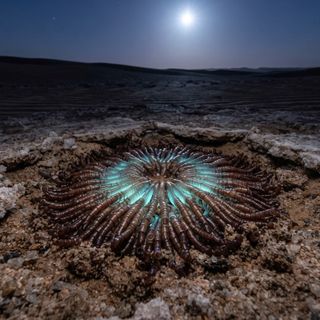
"Sand-Skitter"
KNOWN INTEL
CHOSEN HABITAT
A world, orbiting Alpheratz.
Shallow subsurface sand matrix 15–60 cm beneath dune surfaces, with periodic emergence through salt crusts. This layer shields the organism from Alpheratz’s intense UV flux and diurnal temperature swings while permitting direct access to surface organic films during wind-driven sand turnover.
BIOLOGY
The Sand-Skitter is a colonial siphonophore-like organism composed of thousands of fused, chitinous tubules arranged in a flattened, radially symmetric mat. Each tubule houses a distinct metabolic compartment: outer layers contain manganese-oxidizing bacteria that harvest trace metals from Arrakis’s high-metallicity regolith, while inner chambers perform chemolithoautotrophic fixation of atmospheric N2 and CO2 using hydrogen sulfide from subsurface mineral reactions. The colony’s structural matrix is reinforced by silica-protein composites that resist abrasion and reflect UV, allowing it to persist in the thin aerobic zone just below the surface crust. Metabolic activity peaks during periods of surface exposure when wind exposes fresh melange residues; the colony then extrudes digestive filaments that enzymatically break down complex hydrocarbons and return nutrients to the shared gastrovascular network. High CO2 tolerance and anoxygenic photosynthesis using far-red wavelengths permit survival during prolonged burial under shifting dunes.
SENSES
The colony detects chemical gradients of melange volatiles and moisture via distributed membrane receptors along its tubules. It senses substrate vibrations and barometric pressure changes through hydrostatic pressure sensors within fluid-filled chambers. Communication occurs via pulsed release of volatile organic compounds that propagate through connected pore spaces in the sand, allowing neighboring colonies to synchronize emergence and feeding events.
LOCOMOTION
Movement occurs through coordinated hydraulic inflation and deflation of peripheral tubules, generating peristaltic waves that push the entire mat forward beneath the sand. When emerging, the colony uses rapid gas expulsion from specialized chambers to “skip” short distances across the surface in a series of low-angle hops driven by Arrakis’s 0.95 g and low atmospheric density.
REPRODUCTION
The organism reproduces by binary fission of the colonial mat, with daughter colonies separating along pre-formed fracture lines after nutrient accumulation. No discrete individuals exist; each mat functions as a single distributed entity that can fragment and re-fuse with compatible colonies. Offspring mats inherit symbiotic microbes vertically and disperse via wind-driven sand transport before re-establishing subsurface networks.
DYNAMIC NOTES
Alpheratz’s high UV and 200-solar-luminosity output at 14 AU render the open surface lethal except during brief, wind-exposed intervals; Arrakis’s extreme aridity and polar ice-driven moisture cycles concentrate resources in the shallow subsurface. The chosen habitat resolves these constraints by allowing surface feeding on melange films while maintaining UV shielding and thermal stability. The Sand-Skitter’s colonial, non-vertebrate body plan and hydraulic locomotion are direct adaptations to this narrow, dynamic niche beneath Arrakis’s dunes.