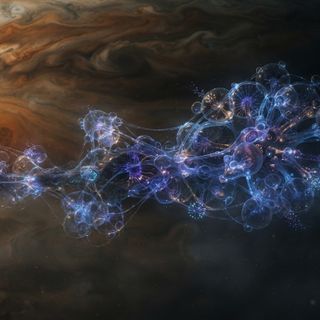
Cryoammonic Siphonocolony
KNOWN INTEL
CHOSEN HABITAT
A frigid, dense-aired, high-gravity gas giant cloud decks world with Ammonia (NH₃) as its working solvent, orbiting Sol.
10 bar atmospheric layer at -161°C. This layer is viable because the given 10 bar pressure elevates ammonia condensation thresholds sufficiently for localized liquid micro-droplets within dense cloud decks while the moderate magnetic field provides radiation shielding and the intense tidal forces drive continuous vertical mixing that supplies chemical energy.
BIOLOGY
The organism is a colonial super-organism composed of thousands of interconnected vesicles, each 0.2–1.5 m across, suspended in the 10 bar hydrogen-helium envelope. Cellular chemistry relies on ammonia-water eutectic mixtures stabilized by antifreeze glycoproteins that depress freezing to -180°C, permitting liquid-phase metabolism at the observed -176°C to -146°C range. Metabolic pathways are chemosynthetic, oxidizing trace methane and ammonia against hydrogen gradients via membrane-bound hydrogenases; waste is vented as nitrogen microbubbles that contribute to buoyancy. Structural materials consist of flexible polyamide-like polymers cross-linked with ammonia ice microcrystals, forming tensile webs that resist 2.53 g compressive forces without rigid skeletons. The habitat pressure and cryogenic temperatures dictate a body plan of minimal solid mass and maximal surface area for gas exchange. Vesicles contain helium-hydrogen lift bladders whose volume is actively regulated by reversible ammonia phase changes, allowing the colony to maintain neutral buoyancy. Metabolic rates are extremely slow, with quantum-tunneling enzymes enabling reactions at -161°C mean; daily temperature swings of 30°C trigger reversible contraction of the polymer webs, reducing exposed area during the -176°C minima to conserve heat.
SENSES
The colony perceives via distributed chemosensors that detect gradients of methane, ammonia, and hydrogen sulfide across its 50–200 m extent, supplemented by magnetoreception through embedded iron-sulfide crystals aligned with the 4.3 Gauss field. Pressure-wave detection occurs through resonant vibration of the polymer webs, allowing mapping of vertical wind shear and tidal flexing. Communication occurs by pulsed release of volatile ammonia plumes that encode chemical “words” via concentration, duration, and isotopic ratios; neighboring colonies decode these plumes through membrane receptors, enabling coordinated vertical migration.
LOCOMOTION
Movement is achieved by rhythmic inflation and deflation of internal gas bladders coupled with expulsion of nitrogen microbubbles, producing slow, controlled vertical drift and limited horizontal translation via jetting. At 2.53 g the colony maintains position by continuously adjusting lift against the dense 10 bar atmosphere, riding tidal-driven updrafts rather than active swimming.
REPRODUCTION
Reproduction is colonial fission: a mature super-organism fragments into 3–12 daughter colonies when vesicle count exceeds a chemical threshold, each inheriting a portion of the shared chemical memory gradient. There is no concept of the individual; the colony functions as a distributed network with no central locus. Offspring colonies remain chemically linked for years via trace pheromone exchange until physical separation exceeds 10 km. INTELLIGENCE & COGNITION: Intelligence is emergent from synchronized chemical oscillators distributed across the vesicle network, forming a non-neural, gradient-based computation substrate. Problem-solving manifests as collective adjustment of buoyancy profiles to exploit transient methane upwellings or to avoid descending into colder, denser layers. Over the 7/10 evolutionary timescale, selection for efficient resource mapping in a vertically stratified, tidally stirred atmosphere drove the development of long-term chemical memory, enabling predictive seasonal migration patterns and inter-colony signaling that functions as symbolic communication. Outward expression occurs through coordinated construction of persistent ammonia-ice “scaffolds” that trap and concentrate nutrients, effectively engineering local micro-environments.
DYNAMIC NOTES
The 10 bar layer was selected because it is the only isobar where ammonia remains transiently liquid within the -176°C to -146°C range while receiving continuous chemical energy from tidal mixing and Sol’s ultraviolet-driven photochemistry on methane. Daily swings between -176°C and -146°C are survived by active contraction of polymer webs during minima and metabolic upregulation during maxima, with ammonia phase-change bladders acting as thermal buffers. The 4.3 Gauss field reduces radiation exposure enough to permit surface vesicle exposure without lethal DNA damage, selecting for magnetosensitive iron-sulfide crystals. The ancient 7/10 timescale allowed incremental refinement of distributed chemical computation, with cognition driven by the need to track sparse, vertically migrating chemical resources in a high-gravity, high-pressure gas envelope; intelligence therefore expresses as environmental engineering and long-range chemical signaling rather than physical manipulation.