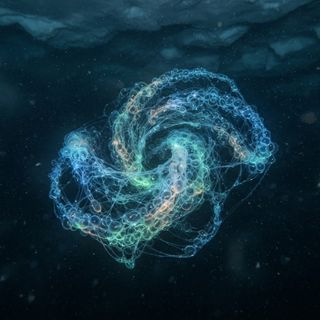
Myxovortex cryolithus
KNOWN INTEL
CHOSEN HABITAT
A frigid, near-vacuum, near-weightless ice world world with Water (H₂O), subsurface ocean beneath ice shell as its working solvent, orbiting Sol.
Subsurface water ocean at 8–25 km depth beneath the ice shell. This layer is viable because tidal heating from the moon’s orbital resonance maintains liquid water stability at –5°C to 4°C under 20–80 bar pressure, shielding organisms from the surface’s cryogenic extremes while providing chemosynthetic energy gradients.
BIOLOGY
Myxovortex cryolithus exists as a colonial super-organism of fused vesicles suspended in the subsurface ocean. Each vesicle employs ammonia-water eutectic mixtures and antifreeze glycoproteins to remain fluid at –5°C, enabling slow but continuous metabolic activity powered by chemosynthesis that oxidizes trace dissolved reductants from hydrothermal vents using the planet’s minimal free oxygen. Structural integrity derives from flexible polysaccharide matrices reinforced by ice-binding proteins that prevent crystal damage during minor pressure fluctuations. The low 0.134g environment permits expansive, low-density colonial forms that drift without structural collapse, while the 100% ice-covered surface forces total dependence on vent-derived chemical energy rather than photosynthesis. Body plan consists of elongated, branching vesicle chains up to 40 m long that function as distributed metabolic factories, with no centralized morphology resembling terrestrial animals.
SENSES
The colony perceives its environment through distributed chemosensors embedded in vesicle walls that detect redox gradients and dissolved ion shifts, supplemented by mechanoreceptive tension fibers that register pressure waves from tidal flexing. Communication occurs via propagated chemical pulses and synchronized vesicle contractions that transmit information as traveling concentration waves across the colonial network.
LOCOMOTION
Movement relies on coordinated peristaltic pumping of internal fluid through the vesicle network, generating jet-like propulsion in the low-gravity liquid medium. Differential contraction of vesicle walls allows steering along chemical and thermal gradients without any limb-like appendages.
REPRODUCTION
Reproduction occurs through fragmentation of mature vesicle chains, with each fragment capable of regenerating a full colony. The organism lacks discrete individuals; instead, it functions as a continuous distributed network that exchanges genetic material through vesicle fusion, with no parental care or social hierarchy. INTELLIGENCE & COGNITION: Intelligence emerges from synchronized chemical oscillators distributed throughout the colonial network, enabling collective problem-solving such as rerouting metabolic flows around vent blockages or optimizing position within tidal currents. This manifests as environmental engineering through selective deposition of polysaccharide barriers that channel vent fluids and symbolic chemical signaling that coordinates colony-wide responses to changing redox conditions.
DYNAMIC NOTES
The –170°C equilibrium temperature and surface range of –223°C to –117°C drive continuous ice-shell thickening and fracturing, which the subsurface colony exploits by positioning near tidal cracks for occasional solvent exchange while remaining protected at stable –5°C depths. The trace O2 atmosphere at 0.001 bar pressure has no direct influence, but the weak 0.024 Gauss magnetic field permits high radiation flux from Sol at 5.2 AU, selecting for robust DNA-repair enzymes within vesicles. The 7/10 evolutionary timescale has produced highly specialized colonial super-organisms whose distributed intelligence arose from the need to integrate sparse vent signals across vast ocean volumes under 100% ice coverage. Tidal forces supply the sole reliable energy flux, accelerating cognitive complexity by demanding predictive coordination of metabolic activity with 85.2-hour tidal cycles. Every adaptation is tied to water liquidity, low pressure, and radiation exposure in this exact subsurface layer.