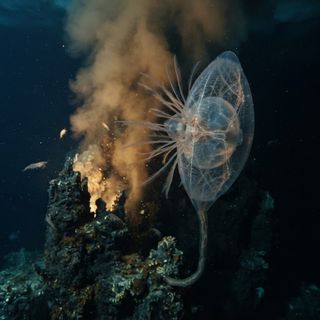
Ventovortex lentiformis
KNOWN INTEL
CHOSEN HABITAT
A frigid, near-vacuum, near-weightless ice world world with Water (H₂O), subsurface ocean beneath ice shell as its working solvent, orbiting Sol.
Subsurface water ocean, 3–8 km beneath ice shell at hydrothermal vent fields (5–40 bar, 4–40 °C); this layer supplies the only sustained chemical disequilibrium and thermal energy on the world.
BIOLOGY
Water solvent supports H₂-driven chemolithoautotrophy with proton-motive force across Fe–S mineral membranes. Structural material is a low-density polysaccharide–silicate gel reinforced by internal mineral lattices whose compressive strength is adequate under 0.134 g and 40 bar. Development proceeds from a buoyant propagule that settles at a vent, then differentiates into a central fluid-filled torus containing two counter-rotating fluid volumes and an outer corona of electroreceptive filaments. Differentiation is maintained by positional chemical gradients established by vent flow.
SENSES
Electroreception dominates because vent plumes generate mV-scale electric fields detectable over tens of metres; chemical gradients serve short-range contact only. Acoustic pressure waves propagate efficiently in the liquid but are secondary because they lack directional precision at the low Reynolds numbers of the habitat.
LOCOMOTION
Counter-rotating fluid volumes inside the toroidal body generate net torque-free thrust via conservation of angular momentum; Reynolds number ~10³–10⁴ allows efficient cruising at 0.1–0.5 body lengths per second without external appendages.
REPRODUCTION
The organism is a single integrated individual that releases modular, genetically identical propagules after reaching critical size; each propagule carries a subset of differentiated cell types that re-assemble the full body plan upon settlement. No colonial fusion occurs.
DYNAMIC NOTES
Tidal heating sustains vent temperatures between 4 °C and 40 °C against the −170 °C mean surface; the 0.024 G field permits modest cosmic-ray penetration that supplies trace oxidants. Day length 85.2 h has no effect inside the ocean. Uncertainty remains in exact vent H₂ flux (uncertain: vent mineralogy). IMAGE GENERATION PROMPT: National Geographic meets Blade Runner, photorealistic, dark atmospheric lighting from faint hydrothermal glow at 15 °C. Inside a 5 bar hydrothermal vent field 5 km beneath Europa’s ice shell, a 2-metre-wide translucent gel torus of Ventovortex lentiformis hovers 3 metres above a black smoker chimney; two counter-rotating internal fluid chambers are visible as swirling refractive distortions. The corona of fine electroreceptive filaments extends outward, one filament discharging a brief blue-white electric arc toward a rising plume of H₂ bubbles. Scale is shown by a 20 cm mineral tube of the primary producer anchored to the vent rim; the scene captures the instant of active electro-location and propulsion adjustment, with faint particulate streams tracing the organism’s thrust vortices. No humanoid features, no limbs, no eyes.