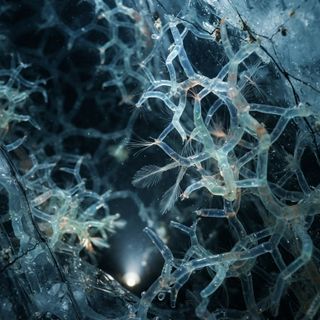
Cryorete turris
KNOWN INTEL
CHOSEN HABITAT
A world, orbiting 40 Eridani A.
Burrow network inside the 8–12 km ice shell with sensory towers reaching surface fissures; this layer is viable because tidal heating sustains thin water films at -8 °C to +3 °C while the overlying ice shields the organism from radiation and supplies mechanical anchorage.
BIOLOGY
Cryorete turris is a colonial super-organism whose body consists of a ramified network of silica-chitin tubules 2–8 cm in diameter that penetrate brine films within the ice. Cellular metabolism relies on water at near-freezing temperatures; cells concentrate glycine-rich antifreeze proteins and operate a reverse methanogenic pathway that oxidises vent-derived H₂ while reducing trace CO₂, yielding ATP at rates sufficient for slow network extension. Structural walls incorporate hydrated silica plates that resist ice creep and permit controlled fracturing for nutrient transport. The visible portions are only the 1–3 m tall sensory towers that emerge through surface fissures. Each tower is a rigid, segmented silica exoskeleton enclosing vascular hyphae that circulate oxygenated brine upward; towers darken to deep indigo under visible light to minimise radiative heat loss during the -49 °C nights. No centralised body exists; the entire network functions as a single distributed metabolism whose total biomass can exceed 10⁴ kg per square kilometre of ice.
SENSES
The organism detects mechanical pressure waves transmitted through ice and water films via piezoelectric silica crystals in the tower walls. Chemical gradients of H₂S and CH₄ are sensed by membrane-bound metalloproteins that trigger calcium-wave propagation along the hyphal network. Weak electric fields generated by its own redox activity allow electroreception for locating conspecific networks up to 400 m distant; communication occurs by modulating these fields into patterned pulses lasting 30–90 seconds.
LOCOMOTION
Movement occurs by hydraulic extension: water is pumped into terminal hyphae at 0.2–0.5 MPa, fracturing ice ahead of the growing tip at ~0.8 cm per hour. Retraction is achieved by osmotic withdrawal of fluid, allowing the network to shift position within existing fractures without external limbs.
REPRODUCTION
Reproduction is entirely colonial; new towers bud from existing hyphae when local H₂ concentration exceeds 12 µmol L⁻¹. Genetic material is exchanged via fusion of adjacent networks, after which the combined super-organism may fragment along stress planes in the ice. No concept of individual exists; each tower is functionally interchangeable and offspring towers are nourished by the parent network for decades until they reach independent fissure access.
DYNAMIC NOTES
The 40 Eridani A spectrum and Europa’s 0.134 g O₂ exosphere together produce the observed -49 °C to 11 °C surface swing; Cryorete turris survives the cold extreme by retreating fluid into deeper, tidally warmed films while towers remain dormant. The 1 Gauss field reduces cosmic-ray flux enough that no additional magnetotrophic adaptations were required. Zero surface liquid forces all solvent access to the ice–ocean interface, so the burrow network is strictly confined to brine films and cannot colonise open water. The chosen ice-shell layer is the only thermodynamically stable niche that simultaneously supplies liquid water, mechanical support, and radiation shielding under Europa’s tidal regime.