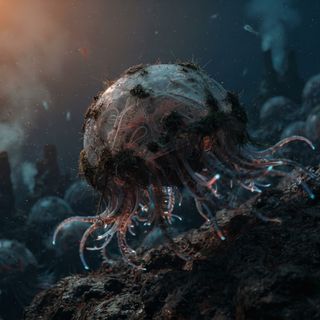
Vortocore domensis
KNOWN INTEL
CHOSEN HABITAT
A world, orbiting Cinderos.
Global ocean at 20–80 m depth. This layer is viable because the dense CO2 haze and oceanic thermal inertia maintain liquid water between -5°C and +8°C despite tidal locking, while 1.4g hydrostatic pressure supplies mechanical energy for jet propulsion.
BIOLOGY
Vortocore domensis maintains cellular chemistry based on piezotolerant proteins and glycoprotein antifreeze that keep cytoplasmic water liquid at 0–8°C. Metabolism centers on chemosynthetic reduction of dissolved CO2 using vent-derived hydrogen, supplemented by weak accessory phototrophy from K2V infrared penetrating the haze. Structural materials consist of a calcareous-silica dome reinforced by radial internal struts; pressurized water bladders within the dome store and expel solvent through six symmetrically placed nozzles. The 1.4g environment and 20–80 m pressure regime shaped a compact, low-profile silhouette that resists collapse while allowing rapid expulsion cycles. Each nozzle is lined with contractile protein sheets that generate 3–5 bar overpressure for directed thrust. Metabolic heat is retained in a central coelomic fluid reservoir, buffering daily swings between -5°C and +8°C.
SENSES
The organism detects pressure-wave gradients via strain-sensitive membranes lining the nozzle interiors and senses chemical gradients of dissolved sulfides and CO2 through distributed chemosensory pits across the dome surface. Communication occurs by modulated low-frequency pressure pulses produced during jet cycles, encoding colony identity and resource location.
LOCOMOTION
Vortocore domensis moves by rapid, sequential expulsion of seawater through its six radial nozzles, generating pulsed thrust vectors that allow translation, rotation, and depth adjustment. Physics of movement relies on conservation of momentum from 3–5 bar overpressure releases, achieving 0.2–0.8 m/s sustained speeds within the 20–80 m isobar.
REPRODUCTION
Reproduction is colonial; the dome periodically buds smaller satellite units that detach and drift until they anchor on suitable vent-proximate substrates. No concept of individual exists; the colony functions as a distributed network sharing metabolites through transient fluid bridges. Offspring receive initial nutrient stores from the parent dome before independent chemosynthesis begins.
DYNAMIC NOTES
On Murkwater, orbiting the K2V star Cinderos, the chosen 20–80 m ocean layer resolves the tide-locked thermal extremes and 0% surface liquid coverage by providing stable liquid water shielded from haze-induced cooling. Daily temperature swings of -5°C to +8°C are managed by central fluid heat storage and metabolic downregulation during cooler periods. The 1.4g field compresses the dome, favoring the pressure-jet architecture, while the 1-Gauss magnetic field offers adequate radiation shielding without additional magnetotrophic traits. Chemosynthesis exploits CO2-rich haze dissolution into the water column.