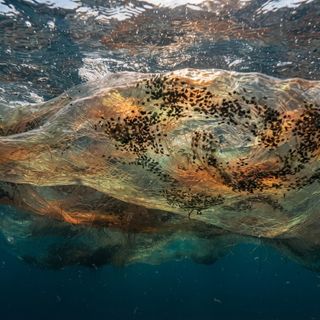
Laminavortex cinerosus
KNOWN INTEL
CHOSEN HABITAT
A world, orbiting Cinderos.
Ocean surface microlayer, 0–5 m depth. This layer is viable for complex life because it supplies stable liquid water, access to attenuated K2V photons, and persistent air–water redox gradients within the 224–284 K thermal window.
BIOLOGY
The organism is a continuous, square-kilometre-scale lipid–protein bilayer sheet 0.2–2 mm thick reinforced by cellulose-analogue microfibrils. Photosynthetic reaction centres tuned to 650–750 nm embed in the upper surface, driving proton pumping that powers both carbon fixation and peristaltic wave propagation; lower surface hosts chemosensory proteins that detect dissolved organic gradients. Structural rigidity is maintained by tensioned protein cables rather than a skeleton, permitted by 1 g buoyancy and low shear at the surface. Differentiation produces three functional zones: photosynthetic lamina, contractile transport ridges, and reproductive margins that bud 1–10 m² fragments.
SENSES
The sheet perceives via distributed mechanoreceptors that detect surface tension and pressure waves from wind and conspecific ripples; chemical gradients are read by membrane-bound receptors sampling dissolved metabolites over tens of metres. Long-range coordination occurs through propagating peristaltic waves that encode information in frequency and amplitude, effective over kilometres because water efficiently transmits low-frequency shear.
LOCOMOTION
Propulsion is achieved by coordinated travelling waves of contraction that ripple across the sheet at 0.1–0.5 m s⁻¹, generating thrust against surface tension and wind drag; the sheet can also fold into a loose roll and be advected by surface currents or wind, then unfurl when conditions change.
REPRODUCTION
Reproduction is by fragmentation: fertile margins detach viable 1–10 m² patches that drift, grow, and differentiate independently. The parent sheet is a single genetic individual that maintains continuity through cytoplasmic streaming; fragments inherit differentiated zones and can fuse edge-to-edge upon contact if genetically compatible, forming larger clonal networks.
DYNAMIC NOTES
Cinderos’ redder spectrum and reduced flux at 1 AU selected for expanded photosynthetic surface area and longer-wavelength pigments, while Earth’s 1 bar O₂/N₂ atmosphere and 0–5 m microlayer provide the stable water–air interface and diurnal thermal stability (224–284 K) required for continuous membrane function. The 1 G field offers negligible shielding benefit at this depth; 7/10 biosphere age permits the evolution of macroscopic differentiation. No solvent conflict exists; the chosen microlayer resolves any surface-coverage discrepancy by exploiting the air–water boundary. IMAGE GENERATION PROMPT: National Geographic meets Blade Runner, dark atmospheric photorealistic shot inside the ocean surface microlayer at 1 m scale: a single square-kilometre crimson-and-ochre membrane sheet ripples under low red-orange K2V light filtered through mist, its contractile ridges pulsing in a coordinated wave as it engulfs a drifting mat of smaller photosynthetic fragments during a spawning bloom; translucent contractile cables glow faintly amber where proton gradients fire, surface tension dimples along the leading edge, scattered droplets refract the dim stellar light, camera positioned level with the membrane’s undulating surface so the vast sheet fills the frame with no horizon or sky visible.