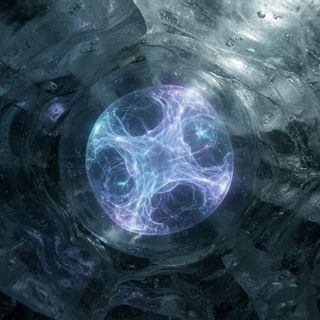
Resonans glacieus
KNOWN INTEL
CHOSEN HABITAT
upper 80–200 m of the 32 % ice sheet, within 2 km of the terminator, where cosmic-ray flux and tidal shear intersect; this interface supplies the only persistent free-energy gradient and mechanical work source capable of sustaining macroscopic coherence without bulk liquid.
BIOLOGY
Resonans glacieus maintains coherence as a self-sustaining standing acoustic mode trapped inside a pressure-sealed ice lens 0.4–1.2 m across. Radiolytic radicals generated by cosmic-ray muons and stellar UV provide the ~10⁻⁵ W m⁻³ power budget; the mode’s nodes organise dislocation walls that both harvest recombination energy and mechanically reinforce the lens against collapse under 0.8–1.2 g. Differentiation produces three tissue analogues: high-defect “collector” walls that maximise radical lifetime, low-defect “waveguide” corridors that propagate the acoustic mode, and sacrificial “buffer” layers that anneal under shear. Growth proceeds by templated addition of new dislocations at the lens margin, with heritability stored in the precise geometry of the mode’s nodal surfaces rather than molecular sequence.
SENSES
Detects local shear and normal stress via shifts in resonant frequency (range ~0.1–10 Hz across lens diameter) and senses radiolytic flux through changes in defect conductivity. Competing modalities (chemical diffusion, thermal contrast) lose because bulk diffusion is frozen and diurnal temperature swings remain unquantified.
LOCOMOTION
Propagates by resonant pumping of the ice lens: constructive interference at one boundary melts a transient film that refreezes behind the advancing front, producing net migration at ~0.2–2 m yr⁻¹ along tidal stress gradients. Reynolds number is irrelevant; motion is solid-state creep modulated by acoustic energy.
REPRODUCTION
When lens diameter permits two stable nodal minima, the mode spontaneously buds a daughter lens that inherits a subset of the parent dislocation pattern. Individuality is maintained by the unique modal frequency; social interdependence occurs when multiple lenses phase-lock across fracture networks, sharing radical flux during high-shear events. This precludes reduction to undifferentiated colonial growth.
DYNAMIC NOTES
Operates at equilibrium temperature –19 °C with ice as structural matrix; unknown atmospheric composition and pressure affect only surface UV penetration depth (uncertain: 0.1–5 bar range). Tidal shear from uncharacterised moons supplies the mechanical work that sustains the mode against decoherence. Day/night or seasonal survival relies on the thermal inertia of the ice lens itself; radiolytic input is continuous. Biosphere age 7/10 permits multiple generations of modal refinement. All temperatures reported in °C. IMAGE GENERATION PROMPT: Inside a translucent blue-white ice lens 1.5 m across embedded in a fractured glacier under faint G-star illumination, a standing acoustic mode manifests as shimmering interference fringes that cause thin melt films to form and refreeze at the advancing edge; the lens is actively budding a smaller daughter lens at one pole while cosmic-ray tracks appear as faint glowing filaments within the lattice; scale shown by a 3 cm ice grain caught mid-migration along a dislocation wall; dark atmospheric photorealistic style with National Geographic detail, camera positioned inside the ice at lens scale, no humanoid forms, no faces or limbs, only geometric lattice structures and dynamic refreezing fronts.