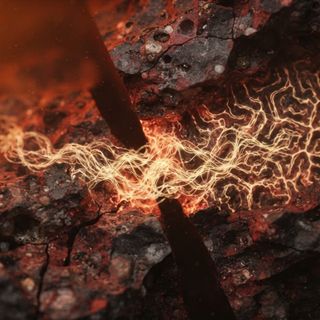
Dislocara radiovincta
KNOWN INTEL
CHOSEN HABITAT
upper 50 m of fractured basaltic regolith, 92 bar, 464 °C; chosen because cosmic-ray secondaries and volcanic heat gradients intersect mineral surfaces at maximum defect-production rate while supercritical CO₂ provides convective transport.
BIOLOGY
Dislocara radiovincta is a braided network of mobile dislocations and domain walls in olivine–pyroxene lattices whose topology stores heritable information. Radiolytic production of electron–hole pairs by galactic cosmic rays supplies ~10⁻⁶ W kg⁻¹; polarons hop along dislocation cores, driving mineral recrystallization that extends the braid. Structural material is the host silicate itself; 0.904 g and 92 bar confine growth to planar fracture networks rather than volumetric bodies. Differentiation proceeds by selective pinning of screw versus edge dislocations, creating distinct conduction versus storage modules within a single contiguous lattice.
SENSES
Detects local radiation flux gradients via spin-polarised defect states and shear-wave acoustic emission from propagating dislocations. Signals propagate as modulated phonon packets along fracture planes (range ~10 m) because electromagnetic attenuation in conductive regolith renders longer-range EM impractical.
LOCOMOTION
Propagates by stress-driven climb and glide of dislocations under thermal gradients and radiation-induced swelling; effective Reynolds number is irrelevant because motion occurs inside solid rock at ~10⁻⁹ m s⁻¹.
REPRODUCTION
Reproduces when braid topology reaches a critical density of closed loops; a daughter braid buds by pinning a new domain wall that detaches along a pre-existing fracture. Individuality is topological rather than spatial; modules remain physically continuous with neighbouring organisms, exchanging charge carriers across shared grain boundaries.
DYNAMIC NOTES
Constant 464 °C surface temperature eliminates thermal cycling; survival relies on continuous cosmic-ray flux (no magnetic shielding) and volcanic fracturing that refreshes mineral surfaces. Supercritical CO₂ density (~60 kg m⁻³) enables slow convective redistribution of radicals. Uncertainties: exact polaron mobility at 464 °C in natural basalt (speculative — mechanism is thermodynamically permitted but unobserved). IMAGE GENERATION PROMPT: National Geographic meets Blade Runner, photorealistic, dark atmospheric lighting from faint red-shifted sunlight filtered through 92 bar CO₂ haze. Inside a 2 m wide basaltic fracture at 464 °C, a dense web of glowing blue-white dislocation braids spreads across olivine crystals like luminous lightning frozen in stone; fresh daughter braid detaches along a fracture plane while charged aerosol particles stream past in supercritical CO₂ currents, scale shown by 3 cm pyrite crystal embedded in the rock wall, no humanoid features, no faces, no limbs.