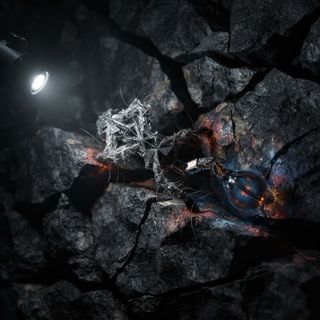
Defectura radiocursor
KNOWN INTEL
CHOSEN HABITAT
interconnected fracture networks 200–800 m beneath fresh basaltic flows, 92 bar, 464 °C; this pore volume supplies both continuous radiolytic feedstock and mechanical confinement that stabilises extended defect structures against annealing.
BIOLOGY
Core biochemistry operates entirely within the silicate lattice: radiolytic generation of electron–hole pairs at oxygen vacancies powers polaron migration along dislocation lines. Structural material is the host basalt itself, reinforced by strain-induced quartz and feldspar exsolution that raises yield strength under 0.904 g and 92 bar. Differentiation occurs through three domain types—charge-collection lamellae, mechanical-anchor nodes, and propagule buds—whose boundaries are maintained by charge-density waves whose coherence time exceeds the ~10⁴ yr erosion timescale of individual fractures.
SENSES
Electrostatic field mapping via polaron drift senses local charge gradients over centimetres; shear-wave propagation through the lattice reports mechanical stress at fracture tips. Both modalities outcompete chemical diffusion, which is immobilised at 464 °C, and photon sensing, which is blocked by the opaque regolith.
LOCOMOTION
Extension occurs by directed dislocation glide and climb, advancing the organism’s leading edge at ~10⁻⁹ m s⁻¹ through creep under differential stress; retraction of trailing domains follows the same lattice vectors, producing net translocation without fluid flow.
REPRODUCTION
A propagule bud nucleates a new dislocation knot once stored charge exceeds a threshold; the bud detaches by fracture propagation and is transported by lava movement or seismic pumping. Individuality is maintained by unique polaron-pattern “genomes” that persist ~10⁵ yr, longer than the local fracture lifetime. Organisms interact ecologically through charge theft and lattice annealing, forming transient consortia rather than colonies.
DYNAMIC NOTES
Constant 464 °C eliminates thermal cycling; survival relies on continuous cosmic-ray input (no magnetic shielding) and volcanic fracturing that refreshes surfaces. Uncertainties: exact radiolytic yield in supercritical CO₂–SO₂ mixtures and long-term creep rates at 92 bar (speculative—thermodynamically permitted but unobserved). All temperatures reported in °C. IMAGE GENERATION PROMPT: Inside a narrow basalt fracture at 500 m depth, a translucent lattice of glowing blue-white polaron lines advances through dark olivine rock under 464 °C red-black illumination from scattered thermal emission; the leading edge shows branching dislocation fans where fresh radiolytic charge is being harvested, with older annealed trails fading into the mineral matrix; scale is shown by a 3 cm fracture aperture; photorealistic, high-contrast National Geographic meets Blade Runner, dark atmospheric lighting, no humanoid elements.