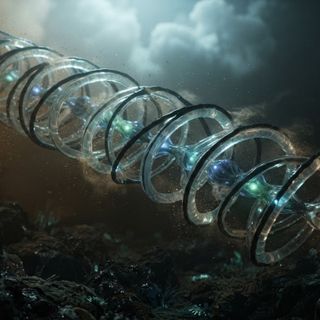
Helicoflexa oribanthica
KNOWN INTEL
CHOSEN HABITAT
A world, orbiting Kallidor.
Supercritical CO₂ fluid column 5–30 m above rocky seafloor at 60–67 bar isobar. This layer remains supercritical at the canonical 293 K and 67.19 bar while providing continuous H₂/CH₄ advection from the overlying H₂–He atmosphere and mineral surfaces below, sustaining redox gradients sufficient for complex chemotrophy.
BIOLOGY
Helicoflexa oribanthica constructs its 4–7 m helical coil from alternating siloxane rings and fluorinated carbon struts precipitated from dissolved crustal silicates and atmospheric methane derivatives. The rigid spiral rotates at 0.2–1.8 revolutions per minute, driven by ATP-analogue hydrolysis coupled to H₂ oxidation; rotation shears the dense scCO₂, generating lift and forward thrust while exposing fresh mineral surfaces for redox harvesting. Internal differentiation produces three tissue analogues: a mineralised outer sheath resistant to 67 bar compression, a fluid-filled central canal that circulates reduced fluorocarbons, and a distributed network of redox-active siloxane vesicles that close the energy budget at ~180 kJ mol⁻¹ H₂.
SENSES
It detects shear and pressure gradients along its coil surface via mechanosensitive siloxane channels, senses dissolved H₂ and CH₄ concentration differences over metres, and registers weak magnetic fluctuations from crustal currents despite the planet’s negligible global field. Communication occurs through pulsed release of fluorinated signalling molecules that propagate as coherent chemical wakes in the low-viscosity fluid, allowing individuals to locate one another across tens of metres during the 94-hour night.
LOCOMOTION
Propulsion arises from continuous rotation of the rigid helical body; torque generated by asymmetric vesicle contraction produces screw-like advance at 0.5–3 cm s⁻¹, with Reynolds numbers ~10³–10⁴ in the dense solvent. Buoyancy is modulated by controlled CO₂ gas pockets within the central canal, allowing vertical adjustments without limbs or jets.
REPRODUCTION
Individuals are solitary but converge chemically during brief mating windows, exchanging genetic fluoropolymer strands via direct coil contact up to twelve sequential pairings before separating. Offspring emerge as miniature coils that drift until they anchor and begin independent rotation; no parental care exists, yet chemical inheritance of redox enzyme variants is maintained through the modular vesicle genome. Each organism functions as a single differentiated unit rather than a colony.
DYNAMIC NOTES
On Oribanth the 67.19 bar H₂–He envelope with methane clouds maintains supercritical CO₂ at the stated 293 K, allowing Helicoflexa oribanthica to occupy the fluid column where long 188.2 h nights are survived by stored fluorocarbon reserves and chemical-gradient navigation. The negligible magnetic field is offset by reliance on pressure and redox cues; low 0.62 g permits the large rigid coil without buckling. Uncertainties remain in exact H₂ flux from the envelope and the precise redox potential at the rock–fluid interface. All temperatures are reported in °C.