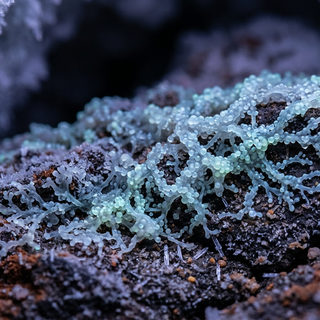
Glaciovita marsicola
KNOWN INTEL
CHOSEN HABITAT
Subsurface regolith cavities at 1–3 km depth. This layer is the only viable niche for complex life as it provides thermal insulation against the extreme surface temperature swings (-162°C to 28°C) and potential access to trace subsurface water ice or transient liquid brines, critical for cryophilic biochemistry, while shielding from unmitigated stellar and cosmic radiation due to the lack of a significant magnetic field. Glaciovita marsicola shares this exact layer with Cryolithus marsianus, co-existing by forming a thin, encrusting layer around the filamentous lattice of the primary species, directly interfacing with its structure to facilitate metabolic exchange while occupying the same microcavities within the regolith.
METABOLIC SYMBIOSIS
Glaciovita marsicola and Cryolithus marsianus share a tightly coupled mutualistic relationship based on the exchange of volatile organic compounds and nitrogenous waste products. Cryolithus marsianus, through its cryophilic metabolism in ammonia-water mixtures, produces small amounts of methane (CH₄) and other volatile hydrocarbons as byproducts of its anaerobic decomposition of subsurface organic traces. These compounds, which would otherwise accumulate and potentially disrupt the delicate chemical balance of Cryolithus marsianus’ lattice, are absorbed by Glaciovita marsicola. The symbiont employs a unique methanotrophic pathway, utilizing trace oxygen (likely derived from radiolytic processes in the regolith) to oxidize methane into formaldehyde and eventually into simpler carbon compounds, releasing nitrogen oxides (NOₓ) as a waste product. These nitrogen oxides are, in turn, critical for Cryolithus marsianus, which incorporates them into its cellular matrix as a nitrogen source for protein-like structural polymers, essential for maintaining its lattice integrity under the extreme cold and low-pressure conditions of their shared habitat. If the supply of methane from Cryolithus marsianus is interrupted, Glaciovita marsicola faces metabolic collapse, as methane serves as its primary energy source; prolonged deprivation would lead to dormancy or death of its colonies. Conversely, without the nitrogen oxides provided by Glaciovita marsicola, Cryolithus marsianus would suffer structural degradation, as nitrogen is a limiting nutrient in the Martian subsurface, leading to weakened lattices and reduced expansion rates. This interdependence has driven their co-evolution, with each species fine-tuning its metabolism to maximize the efficiency of this chemical handshake over millions of years in the isolated, resource-scarce environment of Mars’ subsurface.
BIOLOGY
Glaciovita marsicola is a colonial, lichen-like organism composed of interconnected, microscopic vesicle clusters that form a brittle, encrusting mat over the surfaces of Cryolithus marsianus’ filamentous lattice and the surrounding regolith walls. Its cellular chemistry is adapted to the frigid temperatures of 206K (-67°C) in the subsurface cavities, utilizing a cryophilic metabolism based on ammonia-water mixtures as a solvent to prevent freezing. Its structural materials are primarily silica-based, scavenged from the regolith, and reinforced with organic polymers synthesized from the methane it absorbs from Cryolithus marsianus. This methane is processed through a slow, low-energy methanotrophic pathway, leveraging trace oxygen from radiolytic dissociation of water ice in the regolith to drive oxidative reactions, producing energy and releasing nitrogen oxides as a byproduct. The habitat layer at 1–3 km depth shapes every aspect of Glaciovita marsicola’s biology. The stable, cold temperature and insulation from surface extremes allow its cryophilic chemistry to function without the risk of solvent freezing or thermal disruption, while the low pressure (derived from the thin Martian atmosphere seeping into cavities) and scarcity of liquid solvents necessitate a highly efficient, low-water metabolism. Its encrusting body plan maximizes surface area for methane absorption and minimizes energy expenditure in the low-gravity (0.38g) environment, where structural stress is reduced. The organism’s reliance on Cryolithus marsianus’ waste methane has driven the evolution of specialized membrane pores that selectively uptake CH₄, ensuring a steady energy supply in an otherwise nutrient-poor niche. Physically, Glaciovita marsicola resembles a translucent, frost-like crust with a faint bluish-green tint, a result of light scattering through its silica matrix and trace metal impurities absorbed from the regolith. Its colonies grow in thin, fractal patterns, rarely exceeding a few millimeters in thickness, to avoid overburdening the delicate lattice of Cryolithus marsianus. This intimate physical association ensures constant access to methane while providing structural stability to both organisms in the loose, granular regolith environment.
SENSES
Glaciovita marsicola lacks visual or auditory senses, instead relying on chemosensory mechanisms to perceive its environment. Specialized membrane receptors detect gradients of methane and other volatile compounds in the microcavities of the subsurface, allowing it to orient its growth toward areas of higher concentration, typically near Cryolithus marsianus colonies. Communication with others of its kind occurs through the diffusion of low-molecular-weight signaling molecules, which trigger synchronized metabolic shifts across a colony, such as increased methane uptake during periods of abundance. Interaction with Cryolithus marsianus is purely chemical, mediated by the direct exchange of waste products through their shared interface, with no evidence of active signaling beyond passive diffusion.
LOCOMOTION
Glaciovita marsicola exhibits no active locomotion, instead relying on passive growth and expansion to spread across surfaces within the subsurface regolith cavities. Its colonies extend through a slow process of cellular division and vesicle budding, forming encrusting layers that creep along the lattice of Cryolithus marsianus and adjacent regolith walls at a rate of mere micrometers per Martian day. This sedentary strategy is well-suited to the stable, confined environment of the 1–3 km depth layer, where energy conservation is paramount, and the low gravity (0.38g) reduces structural demands on its brittle form.
REPRODUCTION
Reproduction in Glaciovita marsicola is asexual, occurring through the fragmentation of its colonial mats. Small vesicles detach from the parent colony, carried by microscopic currents of sublimating gases or transient brines within the regolith cavities, and adhere to new surfaces to initiate growth. It is a strictly colonial organism, with no solitary individuals; each fragment retains the genetic and metabolic blueprint of the parent, ensuring rapid adaptation to the local chemical environment. There is no social hierarchy, but colonies exhibit cooperative behavior through chemical diffusion, pooling resources like methane across interconnected vesicles to buffer against scarcity.
SYMBIOSIS
Glaciovita marsicola and Cryolithus marsianus share a tightly coupled mutualistic relationship based on the exchange of volatile organic compounds and nitrogenous waste products. Cryolithus marsianus, through its cryophilic metabolism in ammonia-water mixtures, produces small amounts of methane (CH₄) and other volatile hydrocarbons as byproducts of its anaerobic decomposition of subsurface organic traces. These compounds, which would otherwise accumulate and potentially disrupt the delicate chemical balance of Cryolithus marsianus’ lattice, are absorbed by Glaciovita marsicola. The symbiont employs a unique methanotrophic pathway, utilizing trace oxygen (likely derived from radiolytic processes in the regolith) to oxidize methane into formaldehyde and eventually into simpler carbon compounds, releasing nitrogen oxides (NOₓ) as a waste product. These nitrogen oxides are, in turn, critical for Cryolithus marsianus, which incorporates them into its cellular matrix as a nitrogen source for protein-like structural polymers, essential for maintaining its lattice integrity under the extreme cold and low-pressure conditions of their shared habitat. If the supply of methane from Cryolithus marsianus is interrupted, Glaciovita marsicola faces metabolic collapse, as methane serves as its primary energy source; prolonged deprivation would lead to dormancy or death of its colonies. Conversely, without the nitrogen oxides provided by Glaciovita marsicola, Cryolithus marsianus would suffer structural degradation, as nitrogen is a limiting nutrient in the Martian subsurface, leading to weakened lattices and reduced expansion rates. This interdependence has driven their co-evolution, with each species fine-tuning its metabolism to maximize the efficiency of this chemical handshake over millions of years in the isolated, resource-scarce environment of Mars’ subsurface. BIOLOGY: Glaciovita marsicola is a colonial, lichen-like organism composed of interconnected, microscopic vesicle clusters that form a brittle, encrusting mat over the surfaces of Cryolithus marsianus’ filamentous lattice and the surrounding regolith walls. Its cellular chemistry is adapted to the frigid temperatures of 206K (-67°C) in the subsurface cavities, utilizing a cryophilic metabolism based on ammonia-water mixtures as a solvent to prevent freezing. Its structural materials are primarily silica-based, scavenged from the regolith, and reinforced with organic polymers synthesized from the methane it absorbs from Cryolithus marsianus. This methane is processed through a slow, low-energy methanotrophic pathway, leveraging trace oxygen from radiolytic dissociation of water ice in the regolith to drive oxidative reactions, producing energy and releasing nitrogen oxides as a byproduct. The habitat layer at 1–3 km depth shapes every aspect of Glaciovita marsicola’s biology. The stable, cold temperature and insulation from surface extremes allow its cryophilic chemistry to function without the risk of solvent freezing or thermal disruption, while the low pressure (derived from the thin Martian atmosphere seeping into cavities) and scarcity of liquid solvents necessitate a highly efficient, low-water metabolism. Its encrusting body plan maximizes surface area for methane absorption and minimizes energy expenditure in the low-gravity (0.38g) environment, where structural stress is reduced. The organism’s reliance on Cryolithus marsianus’ waste methane has driven the evolution of specialized membrane pores that selectively uptake CH₄, ensuring a steady energy supply in an otherwise nutrient-poor niche. Physically, Glaciovita marsicola resembles a translucent, frost-like crust with a faint bluish-green tint, a result of light scattering through its silica matrix and trace metal impurities absorbed from the regolith. Its colonies grow in thin, fractal patterns, rarely exceeding a few millimeters in thickness, to avoid overburdening the delicate lattice of Cryolithus marsianus. This intimate physical association ensures constant access to methane while providing structural stability to both organisms in the loose, granular regolith environment. SENSES & COMMUNICATION: Glaciovita marsicola lacks visual or auditory senses, instead relying on chemosensory mechanisms to perceive its environment. Specialized membrane receptors detect gradients of methane and other volatile compounds in the microcavities of the subsurface, allowing it to orient its growth toward areas of higher concentration, typically near Cryolithus marsianus colonies. Communication with others of its kind occurs through the diffusion of low-molecular-weight signaling molecules, which trigger synchronized metabolic shifts across a colony, such as increased methane uptake during periods of abundance. Interaction with Cryolithus marsianus is purely chemical, mediated by the direct exchange of waste products through their shared interface, with no evidence of active signaling beyond passive diffusion. LOCOMOTION: Glaciovita marsicola exhibits no active locomotion, instead relying on passive growth and expansion to spread across surfaces within the subsurface regolith cavities. Its colonies extend through a slow process of cellular division and vesicle budding, forming encrusting layers that creep along the lattice of Cryolithus marsianus and adjacent regolith walls at a rate of mere micrometers per Martian day. This sedentary strategy is well-suited to the stable, confined environment of the 1–3 km depth layer, where energy conservation is paramount, and the low gravity (0.38g) reduces structural demands on its brittle form. REPRODUCTION & SOCIETY: Reproduction in Glaciovita marsicola is asexual, occurring through the fragmentation of its colonial mats. Small vesicles detach from the parent colony, carried by microscopic currents of sublimating gases or transient brines within the regolith cavities, and adhere to new surfaces to initiate growth. It is a strictly colonial organism, with no solitary individuals; each fragment retains the genetic and metabolic blueprint of the parent, ensuring rapid adaptation to the local chemical environment. There is no social hierarchy, but colonies exhibit cooperative behavior through chemical diffusion, pooling resources like methane across interconnected vesicles to buffer against scarcity. DYNAMIC NOTES: Glaciovita marsicola’s adaptations are finely tuned to the subsurface regolith cavities at 1–3 km depth on Mars, the same habitat layer as Cryolithus marsianus, where the equilibrium temperature of 206K (-67°C) necessitates cryophilic chemistry with ammonia-water solvents to prevent freezing. The atmosphere (N2: 2.6%, O2: 0.13%, CO2: 95%, H2O: 0.03%) provides negligible influence at this depth, though trace oxygen from radiolysis supports its methanotrophic metabolism. Low gravity (0.38g) allows its delicate, encrusting structure to spread without significant mechanical stress, while the absence of tidal forces or a significant magnetic field reinforces the necessity of subsurface shielding from cosmic radiation. With no primary liquid solvent identified on the surface, the organism relies on transient subsurface water ice or brines, mirroring Cryolithus marsianus’ strategy. Co-habitation shapes both species’ adaptations: Glaciovita marsicola’s encrusting growth stabilizes Cryolithus marsianus’ lattice against regolith shifts, while the primary species’ methane output dictates the symbiont’s distribution and metabolic rate. This habitat layer was selected as the most thermodynamically and chemically viable niche; every adaptation ties directly to the stable pressure, frigid temperature, limited solvent state, and minimal energy fluxes of this exact environment. SYMBIOSIS: The mutualistic relationship between Glaciovita marsicola and Cryolithus marsianus centers on a closed-loop metabolic exchange that sustains both organisms in the harsh Martian subsurface. Cryolithus marsianus, during its anaerobic decomposition of scarce organic material, releases methane (CH₄) as a waste product, which diffuses through the microcavities of the regolith and is absorbed by Glaciovita marsicola’s specialized membrane pores. Within the symbiont, methane is oxidized using trace radiolytic oxygen into formaldehyde and simpler carbon compounds, yielding energy for growth and releasing nitrogen oxides (NOₓ) as a byproduct. These nitrogen oxides diffuse back to Cryolithus marsianus, which uptakes them through its lattice surface and incorporates the nitrogen into structural polymers, critical for maintaining cellular integrity under extreme cold. This cycle—methane from primary to symbiont, nitrogen oxides from symbiont to primary—repeats continuously, ensuring neither organism accumulates toxic waste while providing essential resources. Physically, the two species are inseparable within their shared habitat layer at 1–3 km depth. Glaciovita marsicola forms a thin, encrusting layer directly on and around the filamentous lattice of Cryolithus marsianus, maximizing contact for chemical exchange while anchoring both organisms within the loose regolith. This intimate association means that Glaciovita marsicola’s colonies rarely extend beyond the immediate vicinity of Cryolithus marsianus, creating a patchwork of symbiotic microecosystems within larger cavities. The physical interface also offers mutual protection: the symbiont’s silica-rich crust reinforces the primary species against microfractures in the regolith, while Cryolithus marsianus’ lattice provides a stable substrate for the symbiont’s growth. If either species were to go extinct, the consequences would ripple through the Martian subsurface chemistry. Without Glaciovita marsicola, Cryolithus marsianus would face nitrogen starvation, leading to weakened lattices and eventual population collapse, while methane accumulation could alter local gas compositions, potentially inhibiting other microbial processes. Conversely, without Cryolithus marsianus, Glaciovita marsicola would lose its primary energy source, entering dormancy or dying off, which might reduce nitrogen oxide levels in the regolith, affecting other trace chemistries. An emergent property of this pairing is their combined ability to cycle nitrogen and carbon in an otherwise stagnant environment, creating localized chemical gradients that could support other microfauna—a feat neither could achieve alone. This symbiosis transforms their shared niche into a dynamic, self-sustaining microecosystem, a rare bastion of biochemical activity in the desolate Martian depths.
DYNAMIC NOTES
Glaciovita marsicola’s adaptations are finely tuned to the subsurface regolith cavities at 1–3 km depth on Mars, the same habitat layer as Cryolithus marsianus, where the equilibrium temperature of 206K (-67°C) necessitates cryophilic chemistry with ammonia-water solvents to prevent freezing. The atmosphere (N2: 2.6%, O2: 0.13%, CO2: 95%, H2O: 0.03%) provides negligible influence at this depth, though trace oxygen from radiolysis supports its methanotrophic metabolism. Low gravity (0.38g) allows its delicate, encrusting structure to spread without significant mechanical stress, while the absence of tidal forces or a significant magnetic field reinforces the necessity of subsurface shielding from cosmic radiation. With no primary liquid solvent identified on the surface, the organism relies on transient subsurface water ice or brines, mirroring Cryolithus marsianus’ strategy. Co-habitation shapes both species’ adaptations: Glaciovita marsicola’s encrusting growth stabilizes Cryolithus marsianus’ lattice against regolith shifts, while the primary species’ methane output dictates the symbiont’s distribution and metabolic rate. This habitat layer was selected as the most thermodynamically and chemically viable niche; every adaptation ties directly to the stable pressure, frigid temperature, limited solvent state, and minimal energy fluxes of this exact environment.