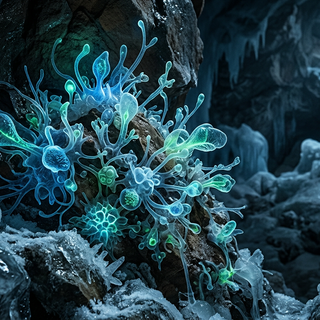
Cryolithus marsianus
KNOWN INTEL
CHOSEN HABITAT
Subsurface regolith cavities at 1–3 km depth. This layer is the only viable niche for complex life as it provides thermal insulation against the extreme surface temperature swings (-162°C to 28°C) and potential access to trace subsurface water ice or transient liquid brines, critical for cryophilic biochemistry, while shielding from unmitigated stellar and cosmic radiation due to the lack of a significant magnetic field.
BIOLOGY
Cryolithus marsianus is a colonial, fungal-analogue organism adapted to the frigid subsurface environment of Mars, where temperatures at 1–3 km depth are stabilized around a mean of -67°C, insulated from the surface extremes of -162°C to 28°C. Its cellular chemistry relies on a cryophilic metabolism utilizing ammonia-water mixtures as an antifreeze solvent, allowing biochemical reactions to persist in subzero conditions. The organism’s structural matrix is composed of silicate-reinforced polysaccharides, a direct adaptation to the rocky subsurface environment, providing durability against abrasive regolith while enabling flexibility to expand through microfractures. Energy metabolism is chemosynthetic, based on redox reactions involving trace iron oxides and sulfates abundant in Martian regolith, supplemented by the minimal CO2 (95% of atmosphere) that diffuses into subsurface cavities despite the low atmospheric pressure of 0.007 bar. The body plan of Cryolithus marsianus resembles a sprawling, lattice-like network of interconnected filaments, forming a decentralized colonial structure rather than a singular entity. This morphology maximizes surface area for nutrient absorption and minimizes energy expenditure in the low-gravity environment of 0.38g, where structural support requirements are reduced. The extreme temperature swings at the surface have driven this species to evolve insulated microcavities within its lattice, trapping heat from metabolic processes to maintain internal temperatures above -73°C, the threshold for cryophilic chemistry. The subsurface habitat shields it from the harsh radiation environment and dictates its reliance on chemical energy gradients rather than photosynthesis, as no light penetrates to these depths.
SENSES
Cryolithus marsianus perceives its environment through chemosensory filaments that detect gradients of iron oxides, sulfates, and trace water vapor in the regolith, allowing it to navigate toward nutrient-rich zones. It also exhibits a form of mechanosensitivity, detecting microseismic vibrations in the subsurface to sense geological shifts or the presence of other colonial networks. Communication occurs via chemical signaling, releasing volatile organic compounds into the surrounding regolith pores to coordinate growth patterns or warn of environmental stressors across the colony. This non-visual sensory array is ideally suited to the dark, enclosed subsurface habitat where traditional light-based perception is irrelevant.
LOCOMOTION
Movement in Cryolithus marsianus is achieved through a slow, amoeboid-like expansion of its filamentous lattice, driven by cytoplasmic streaming within its network. In the low-gravity environment of 0.38g, this process requires minimal energy, allowing the colony to gradually infiltrate new regolith cavities by chemically dissolving silicate barriers over time. The physics of this movement is akin to a viscous flow, exploiting microfractures and pore spaces at 1–3 km depth, ensuring the organism remains anchored and protected within its subsurface niche.
REPRODUCTION
Cryolithus marsianus reproduces asexually through fragmentation, where segments of the colonial lattice detach and establish independent networks in adjacent regolith cavities. It lacks a concept of individuality, functioning as a distributed super-organism where each filament contributes to the collective. There is no parental care; instead, fragmented colonies inherit chemical memory in the form of molecular imprints, ensuring adaptive behaviors are retained. Social structure is emergent, with overlapping colonies engaging in chemical competition for scarce subsurface resources like water ice, leading to dynamic territorial boundaries defined by inhibitory compound gradients. INTELLIGENCE & COGNITION: The intelligence of Cryolithus marsianus is distributed across its colonial network, encoded in the dynamic chemical gradients and feedback loops within its filamentous lattice, rather than a centralized neural structure. This form of cognition manifests as problem-solving through adaptive growth patterns, such as rerouting filaments to bypass depleted nutrient zones or collaboratively sealing breaches in regolith cavities to retain heat. Intelligence is expressed outwardly through environmental engineering—constructing intricate silicate-polysaccharide barriers to insulate thermal microenvironments and regulate chemical exchange with surrounding colonies. This distributed cognition is consistent with the organism’s cryophilic biochemistry and subsurface habitat, relying on slow, chemical-based processing suited to the stable but resource-scarce conditions at 1–3 km depth.
DYNAMIC NOTES
Cryolithus marsianus is intricately adapted to Mars’ environmental parameters, including the equilibrium temperature of -67°C and the extreme surface temperature range of -162°C to 28°C (mean -67°C). The subsurface habitat at 1–3 km depth is the only viable layer due to its thermal stability, shielding from radiation (given no significant magnetic field), and potential access to trace water ice or brines, as surface coverage by liquid/ice is 0%, ruling out surface ecosystems. No atmospheric layer can support life at 0.007 bar with such low H2O content (0.03%), and no global liquid bodies exist. The temperature swing of 190°C drives daily survival strategies, such as metabolic downregulation during extreme cold (-162°C) and heat retention in insulated lattice cavities during warmer periods (up to 28°C). The lack of a magnetic field results in high radiation exposure at the surface, necessitating subsurface adaptations, though no magnetotrophic traits evolved due to the insulated habitat. The atmospheric composition (95% CO2, 3% N2, 1.6% Ar, 0.13% O2, 0.03% H2O) influences chemosynthetic pathways, with CO2 serving as a minor carbon source. Low gravity (0.38g) reduces structural demands, enabling expansive lattice growth, while the day length of 24.623 hours and minimal tidal forces impose no significant circadian or mechanical stress. The G-type star (Sol analogue) radiation environment, unmitigated by a magnetic field, further justifies subsurface life as the only shield against stellar and cosmic rays. The evolutionary timescale of 7/10 reflects an ancient biosphere, fostering the complexity of Cryolithus marsianus’ colonial structure and distributed intelligence. Intelligence emerged from evolutionary pressures like resource scarcity (no surface liquid/ice) and extreme thermal variability, driving the need for chemical problem-solving and environmental manipulation to secure microhabitats. The subsurface habitat constrained cognitive expression to slow, chemical-based processes but accelerated its development through intense competition for trace water and nutrients in a solvent-scarce world. Every adaptation ties to the pressure (negligible at depth beyond overburden), temperature (mean -67°C), and energy fluxes (chemosynthetic) of the chosen subsurface layer, ensuring biochemical viability in this harsh Martian niche.