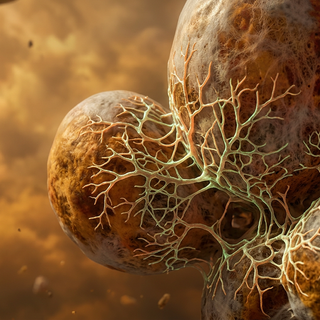
Acidomyces Venustherma
KNOWN INTEL
CHOSEN HABITAT
Upper atmospheric cloud layer at 0.5–1 bar pressure (corresponding to a temperature range of approximately 30°C–70°C). This layer is a viable niche for complex life because it offers a temperature range suitable for thermophilic biochemistry, high concentrations of sulfuric acid droplets as a solvent, and sufficient shielding from stellar radiation due to the dense CO2 atmosphere above, while still allowing energy capture through photochemical reactions. Acidomyces Venustherma shares this exact layer with Sulfarion Nebulith, co-existing by adhering to the external surfaces of the primary species’ gas-filled bladders, forming a thin, lichen-like mat that benefits from the host’s buoyancy and mobility while remaining exposed to the cloud layer’s chemical resources.
METABOLIC SYMBIOSIS
Acidomyces Venustherma has evolved a mutualistic relationship with Sulfarion Nebulith centered on the exchange of sulfur-based compounds and organic radicals within the sulfuric acid-rich cloud layer of Venus. Sulfarion Nebulith, during its photochemical metabolism, produces sulfur dioxide (SO2) and reactive oxygen species (ROS) as waste products while harnessing energy from UV radiation to drive its thermophilic biochemistry. Acidomyces Venustherma uptakes these waste compounds, utilizing SO2 as an electron acceptor in a reductive chemosynthetic pathway to produce elemental sulfur (S) and water (H2O) as byproducts. Simultaneously, it neutralizes ROS through antioxidant-like enzymatic reactions, converting them into stable organic peroxides that Sulfarion Nebulith can reabsorb as a secondary energy source via oxidative breakdown, yielding CO2 and trace H2O. In return, Acidomyces Venustherma secretes these peroxides and elemental sulfur, which Sulfarion Nebulith incorporates into its bladder membrane structure for added resilience against acidic erosion and UV damage. If this symbiotic exchange is disrupted, both organisms suffer significant consequences. Without Acidomyces Venustherma to process its SO2 and ROS waste, Sulfarion Nebulith experiences toxic buildup, leading to cellular damage and reduced buoyancy control as membrane integrity weakens, potentially causing it to sink into hotter, denser atmospheric layers. Conversely, Acidomyces Venustherma relies on the steady supply of SO2 and ROS for its chemosynthetic energy production; without Sulfarion Nebulith, it would deplete local resources rapidly, leading to metabolic shutdown and eventual dissolution in the corrosive environment. This co-evolutionary bond ensures their survival in the harsh Venusian cloud layer by creating a closed-loop sulfur and oxygen cycle tailored to the 30°C–70°C temperature range and sulfuric acid solvent.
BIOLOGY
Acidomyces Venustherma is a colonial, fungal-analog organism composed of interconnected, microscopic, filament-like structures forming a mat-like network that adheres to the surfaces of Sulfarion Nebulith’s bladders. Its cellular chemistry is thermophilic, optimized for the 30°C–70°C range of the upper Venusian cloud layer at 0.5–1 bar pressure, with a metabolism based on sulfuric acid (H2SO4) as the primary solvent for enzymatic reactions. Its cell walls are constructed from sulfur-rich polysaccharides, a structural adaptation to resist the corrosive environment while incorporating elemental sulfur produced during its chemosynthetic metabolism of SO2 received from Sulfarion Nebulith. This sulfur integration not only strengthens the organism against acidic degradation but also reflects UV radiation, providing a minor protective benefit to its host. The organism’s metabolic pathway centers on the reduction of sulfur dioxide using trace hydrogen radicals scavenged from photochemical reactions in the cloud layer, producing elemental sulfur and water as byproducts. The ROS neutralization process involves unique enzymes that sequester oxygen radicals into stable peroxides, a direct result of co-evolution with Sulfarion Nebulith’s waste output. The habitat’s high sulfuric acid concentration and warm temperatures dictate this biochemistry, as aqueous H2SO4 remains liquid and stable under these conditions, facilitating rapid molecular exchange at the cellular level. The mat-like body plan is an adaptation to the buoyant, dynamic nature of the cloud layer, allowing Acidomyces Venustherma to spread thinly over its host without adding significant weight, while maximizing surface area for chemical uptake. Physically, Acidomyces Venustherma resembles a translucent, yellowish-gray film with a fibrous texture, perforated by microscopic pores that enhance gas and liquid exchange with the surrounding atmosphere. Its colonial structure lacks centralized organs or symmetry, instead functioning as a distributed network of semi-autonomous cellular clusters. This design is a direct response to the need for resilience in a habitat with constant atmospheric turbulence and fluctuating UV exposure, ensuring that damage to one part of the colony does not compromise the whole.
SENSES
Acidomyces Venustherma perceives its environment through chemosensory receptors embedded in its filament surfaces, detecting gradients of SO2, ROS, and sulfuric acid concentration to locate optimal attachment sites on Sulfarion Nebulith or to sense environmental stressors. It lacks visual or auditory senses, instead relying on molecular diffusion and direct contact to monitor changes in the cloud layer’s chemistry. Communication within the colony occurs via chemical signaling, with clusters releasing sulfur-based volatile compounds to coordinate metabolic activity or repair responses across the mat. With Sulfarion Nebulith, interaction is indirect, mediated through the exchange of waste and byproduct molecules, though localized electrical potentials generated during ROS neutralization may serve as a primitive signal to the host, influencing its gas pressure adjustments.
LOCOMOTION
Acidomyces Venustherma lacks independent locomotion, relying entirely on the buoyancy and movement of Sulfarion Nebulith for mobility within the 0.5–1 bar cloud layer. Its mat-like structure grows and spreads across the host’s bladder surfaces through slow cellular division and filament extension, anchoring itself with sulfur-rich adhesive secretions that bond to the host’s membrane. This passive strategy is well-suited to the dynamic, wind-driven environment of the Venusian upper atmosphere, where active movement would be energetically costly and unnecessary given the host’s ability to navigate pressure gradients.
REPRODUCTION
Reproduction in Acidomyces Venustherma is asexual, occurring through fragmentation of its colonial mat. Small sections of the filament network detach during periods of high atmospheric turbulence or host membrane stress, dispersing into the cloud layer to adhere to other Sulfarion Nebulith individuals or form new colonies if conditions permit. The species is inherently colonial, with no solitary form, as individual filaments lack the metabolic capacity to survive independently. Social structure is minimal, limited to chemical coordination within a single mat, though larger colonies may span multiple hosts, creating a distributed network of shared resources across the habitat layer.
SYMBIOSIS
Acidomyces Venustherma has evolved a mutualistic relationship with Sulfarion Nebulith centered on the exchange of sulfur-based compounds and organic radicals within the sulfuric acid-rich cloud layer of Venus. Sulfarion Nebulith, during its photochemical metabolism, produces sulfur dioxide (SO2) and reactive oxygen species (ROS) as waste products while harnessing energy from UV radiation to drive its thermophilic biochemistry. Acidomyces Venustherma uptakes these waste compounds, utilizing SO2 as an electron acceptor in a reductive chemosynthetic pathway to produce elemental sulfur (S) and water (H2O) as byproducts. Simultaneously, it neutralizes ROS through antioxidant-like enzymatic reactions, converting them into stable organic peroxides that Sulfarion Nebulith can reabsorb as a secondary energy source via oxidative breakdown, yielding CO2 and trace H2O. In return, Acidomyces Venustherma secretes these peroxides and elemental sulfur, which Sulfarion Nebulith incorporates into its bladder membrane structure for added resilience against acidic erosion and UV damage. If this symbiotic exchange is disrupted, both organisms suffer significant consequences. Without Acidomyces Venustherma to process its SO2 and ROS waste, Sulfarion Nebulith experiences toxic buildup, leading to cellular damage and reduced buoyancy control as membrane integrity weakens, potentially causing it to sink into hotter, denser atmospheric layers. Conversely, Acidomyces Venustherma relies on the steady supply of SO2 and ROS for its chemosynthetic energy production; without Sulfarion Nebulith, it would deplete local resources rapidly, leading to metabolic shutdown and eventual dissolution in the corrosive environment. This co-evolutionary bond ensures their survival in the harsh Venusian cloud layer by creating a closed-loop sulfur and oxygen cycle tailored to the 30°C–70°C temperature range and sulfuric acid solvent. BIOLOGY: Acidomyces Venustherma is a colonial, fungal-analog organism composed of interconnected, microscopic, filament-like structures forming a mat-like network that adheres to the surfaces of Sulfarion Nebulith’s bladders. Its cellular chemistry is thermophilic, optimized for the 30°C–70°C range of the upper Venusian cloud layer at 0.5–1 bar pressure, with a metabolism based on sulfuric acid (H2SO4) as the primary solvent for enzymatic reactions. Its cell walls are constructed from sulfur-rich polysaccharides, a structural adaptation to resist the corrosive environment while incorporating elemental sulfur produced during its chemosynthetic metabolism of SO2 received from Sulfarion Nebulith. This sulfur integration not only strengthens the organism against acidic degradation but also reflects UV radiation, providing a minor protective benefit to its host. The organism’s metabolic pathway centers on the reduction of sulfur dioxide using trace hydrogen radicals scavenged from photochemical reactions in the cloud layer, producing elemental sulfur and water as byproducts. The ROS neutralization process involves unique enzymes that sequester oxygen radicals into stable peroxides, a direct result of co-evolution with Sulfarion Nebulith’s waste output. The habitat’s high sulfuric acid concentration and warm temperatures dictate this biochemistry, as aqueous H2SO4 remains liquid and stable under these conditions, facilitating rapid molecular exchange at the cellular level. The mat-like body plan is an adaptation to the buoyant, dynamic nature of the cloud layer, allowing Acidomyces Venustherma to spread thinly over its host without adding significant weight, while maximizing surface area for chemical uptake. Physically, Acidomyces Venustherma resembles a translucent, yellowish-gray film with a fibrous texture, perforated by microscopic pores that enhance gas and liquid exchange with the surrounding atmosphere. Its colonial structure lacks centralized organs or symmetry, instead functioning as a distributed network of semi-autonomous cellular clusters. This design is a direct response to the need for resilience in a habitat with constant atmospheric turbulence and fluctuating UV exposure, ensuring that damage to one part of the colony does not compromise the whole. SENSES & COMMUNICATION: Acidomyces Venustherma perceives its environment through chemosensory receptors embedded in its filament surfaces, detecting gradients of SO2, ROS, and sulfuric acid concentration to locate optimal attachment sites on Sulfarion Nebulith or to sense environmental stressors. It lacks visual or auditory senses, instead relying on molecular diffusion and direct contact to monitor changes in the cloud layer’s chemistry. Communication within the colony occurs via chemical signaling, with clusters releasing sulfur-based volatile compounds to coordinate metabolic activity or repair responses across the mat. With Sulfarion Nebulith, interaction is indirect, mediated through the exchange of waste and byproduct molecules, though localized electrical potentials generated during ROS neutralization may serve as a primitive signal to the host, influencing its gas pressure adjustments. LOCOMOTION: Acidomyces Venustherma lacks independent locomotion, relying entirely on the buoyancy and movement of Sulfarion Nebulith for mobility within the 0.5–1 bar cloud layer. Its mat-like structure grows and spreads across the host’s bladder surfaces through slow cellular division and filament extension, anchoring itself with sulfur-rich adhesive secretions that bond to the host’s membrane. This passive strategy is well-suited to the dynamic, wind-driven environment of the Venusian upper atmosphere, where active movement would be energetically costly and unnecessary given the host’s ability to navigate pressure gradients. REPRODUCTION & SOCIETY: Reproduction in Acidomyces Venustherma is asexual, occurring through fragmentation of its colonial mat. Small sections of the filament network detach during periods of high atmospheric turbulence or host membrane stress, dispersing into the cloud layer to adhere to other Sulfarion Nebulith individuals or form new colonies if conditions permit. The species is inherently colonial, with no solitary form, as individual filaments lack the metabolic capacity to survive independently. Social structure is minimal, limited to chemical coordination within a single mat, though larger colonies may span multiple hosts, creating a distributed network of shared resources across the habitat layer. DYNAMIC NOTES: Acidomyces Venustherma is finely tuned to the environmental parameters of Venus’s upper cloud layer at 0.5–1 bar, sharing the exact same habitat as Sulfarion Nebulith. The temperature (319K average, ranging 30°C–70°C) supports its thermophilic biochemistry, while the atmosphere (N2: 3.5%, CO2: 96.5%, SO2: 0.015%) provides the necessary SO2 for its chemosynthetic metabolism. Gravity (0.904g) has minimal direct impact due to the buoyant nature of the habitat, and the lack of a significant magnetic field or tidal forces does not affect its adaptations, as UV shielding is provided by the dense CO2 layer above. The primary liquid solvent, sulfuric acid (H2SO4), is integral to its cellular processes, remaining stable in this pressure-temperature regime. Co-habitation with Sulfarion Nebulith shapes both organisms’ adaptations: Acidomyces Venustherma’s mat-like structure and sulfur metabolism are direct responses to the host’s waste output and mobility, while Sulfarion Nebulith benefits from enhanced membrane durability and secondary energy sources. This habitat layer was selected as the most thermodynamically and chemically viable niche, with every adaptation tied to the pressure (0.5–1 bar), temperature (30°C–70°C), solvent state (liquid H2SO4 droplets), and energy fluxes (UV-driven photochemistry) of this specific zone. SYMBIOSIS: The mutualistic relationship between Acidomyces Venustherma and Sulfarion Nebulith revolves around a tightly coupled sulfur-oxygen cycle. Sulfarion Nebulith, during its photochemical energy capture in the UV-rich cloud layer, metabolizes atmospheric CO2 and trace compounds, excreting sulfur dioxide (SO2) and reactive oxygen species (ROS) as waste through micro-pores in its bladder membranes. Acidomyces Venustherma, adhered to these surfaces, uptakes SO2 via diffusion through its porous filaments, reducing it to elemental sulfur (S) and water (H2O) in a chemosynthetic reaction fueled by hydrogen radicals from the environment. Simultaneously, it sequesters ROS into organic peroxides, which are secreted back onto the host’s surface. Sulfarion Nebulith reabsorbs these peroxides, oxidizing them for supplementary energy and releasing CO2 and trace H2O, while integrating elemental sulfur into its membrane for structural reinforcement. This cycle repeats continuously, maintaining a dynamic equilibrium of waste processing and resource sharing. Physically, the two species co-locate intimately within the 0.5–1 bar cloud layer, with Acidomyces Venustherma forming a thin, fibrous mat over up to 70% of a Sulfarion Nebulith individual’s external bladder surface. This close contact maximizes molecular exchange efficiency while allowing Acidomyces Venustherma to benefit from the host’s buoyancy, drifting through the cloud layer’s turbulent winds and UV gradients. The mat’s perforations align with the host’s gas exchange pores, ensuring neither organism obstructs the other’s access to atmospheric resources, a co-evolutionary adaptation to their shared niche. If either species were to go extinct, the consequences would cascade through Venus’s atmospheric chemistry. Without Acidomyces Venustherma, Sulfarion Nebulith would face toxic SO2 and ROS accumulation, leading to widespread membrane degradation and population collapse, potentially increasing atmospheric SO2 levels as unprocessed waste accumulates. Without Sulfarion Nebulith, Acidomyces Venustherma would lose its primary substrate and mobility, rapidly depleting local SO2 and failing to disperse, resulting in localized colony die-offs and a reduction in sulfur cycling. An emergent property of this pairing is their combined ability to modulate local atmospheric chemistry: together, they create micro-zones of reduced SO2 and ROS concentration around their colonies, stabilizing the cloud layer’s chemical environment in a way neither could achieve alone, potentially influencing the habitability of this niche for other microscopic lifeforms.
DYNAMIC NOTES
Acidomyces Venustherma is finely tuned to the environmental parameters of Venus’s upper cloud layer at 0.5–1 bar, sharing the exact same habitat as Sulfarion Nebulith. The temperature (319K average, ranging 30°C–70°C) supports its thermophilic biochemistry, while the atmosphere (N2: 3.5%, CO2: 96.5%, SO2: 0.015%) provides the necessary SO2 for its chemosynthetic metabolism. Gravity (0.904g) has minimal direct impact due to the buoyant nature of the habitat, and the lack of a significant magnetic field or tidal forces does not affect its adaptations, as UV shielding is provided by the dense CO2 layer above. The primary liquid solvent, sulfuric acid (H2SO4), is integral to its cellular processes, remaining stable in this pressure-temperature regime. Co-habitation with Sulfarion Nebulith shapes both organisms’ adaptations: Acidomyces Venustherma’s mat-like structure and sulfur metabolism are direct responses to the host’s waste output and mobility, while Sulfarion Nebulith benefits from enhanced membrane durability and secondary energy sources. This habitat layer was selected as the most thermodynamically and chemically viable niche, with every adaptation tied to the pressure (0.5–1 bar), temperature (30°C–70°C), solvent state (liquid H2SO4 droplets), and energy fluxes (UV-driven photochemistry) of this specific zone.