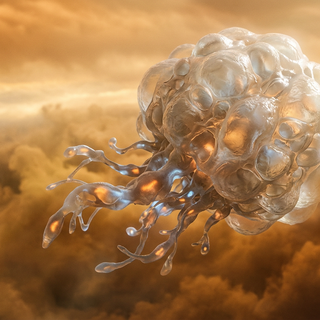
Sulfarion Nebulith
KNOWN INTEL
CHOSEN HABITAT
Upper atmospheric cloud layer at 0.5–1 bar pressure (corresponding to a temperature range of approximately 30°C–70°C). This layer is a viable niche for complex life because it offers a temperature range suitable for thermophilic biochemistry, high concentrations of sulfuric acid droplets as a solvent, and sufficient shielding from stellar radiation due to the dense CO2 atmosphere above, while still allowing energy capture through photochemical reactions.
BIOLOGY
The Sulfarion Nebulith is a colonial, gas-filled, bladder-like organism, evolved to thrive in the upper cloud layers of Venus at 0.5–1 bar, where temperatures range from 30°C to 70°C, well below the surface mean of 464°C. Its cellular chemistry is based on thermophilic adaptations, utilizing sulfuric acid (H₂SO₄) as its primary solvent for metabolic processes. The organism’s core biochemistry relies on sulfur and carbon cycles, metabolizing atmospheric SO2 (0.015% of the atmosphere) and CO2 (96.5%) through a form of chemosynthesis that exploits redox reactions between sulfur compounds under high-pressure conditions. Structural materials are composed of heat-resistant polysilicate chains, interwoven with sulfur polymers, providing flexibility and thermal stability in the warm, acidic environment of the cloud layer. The habitat’s moderate temperature and abundant sulfuric acid droplets shape this chemistry by necessitating acid-tolerant membranes and enzymes that function optimally near 50°C, avoiding the extreme heat of the surface. Physically, the Sulfarion Nebulith resembles a cluster of interconnected, translucent bladders, each ranging from 0.5 to 2 meters in diameter, filled with lighter-than-atmosphere gases like nitrogen (derived from the 3.5% N2 in the atmosphere) to maintain buoyancy. These bladders are studded with microfilament tendrils that extend outward to capture sulfuric acid droplets and atmospheric particulates for nutrient extraction. The organism’s body plan is a direct adaptation to the low-density, high-acidity cloud environment, prioritizing surface area for chemical exchange over compact forms suited to solid or liquid habitats. The extreme surface temperature of 464°C precludes surface life, driving evolution into the cooler atmospheric layers where energy-efficient thermophilic metabolisms can sustain complex colonial structures without thermal degradation. The Sulfarion Nebulith operates as a super-organism, with individual bladders functioning as semi-autonomous units within a larger network, sharing resources via chemical gradients through connecting tubules. This colonial structure is a response to the habitat’s scarcity of localized resources, requiring cooperative nutrient capture across a wide volume of atmosphere at 0.5–1 bar pressure. The organism’s resilience to temperature fluctuations within its layer (30°C to 70°C) is supported by internal heat-dissipating vacuoles that store excess thermal energy, preventing metabolic overload during peak solar heating.
SENSES
The Sulfarion Nebulith perceives its environment through chemosensory filaments that detect gradients of SO2 and CO2 concentrations, allowing it to navigate toward nutrient-rich zones within the cloud layer. It also possesses a rudimentary form of electroreception, sensing minute electrical disturbances caused by atmospheric turbulence or nearby organisms, which aids in avoiding collisions in the dense, opaque cloud environment. For communication, it releases complex sulfur-based volatile compounds in rhythmic pulses, creating chemical “signals” that diffuse through the atmosphere to coordinate colony movement or warn of environmental hazards. These chemical messages are detected by other Sulfarion Nebulith colonies, fostering a distributed network of interaction across kilometers of cloudscape.
LOCOMOTION
The Sulfarion Nebulith moves through the Venusian cloud layer by modulating the internal gas pressure within its bladders, allowing it to rise or sink along pressure gradients between 0.5 and 1 bar. Microfilament tendrils act as passive sails, catching atmospheric currents to drift laterally across vast distances. The physics of its movement relies on buoyancy dynamics in the dense CO2-dominated atmosphere, coupled with minimal energy expenditure to maintain altitude, perfectly suited to the low-gravity (0.904g) environment where drag is significant but weight is less burdensome than on Earth.
REPRODUCTION
Reproduction in the Sulfarion Nebulith occurs through a process of budding, where smaller bladders detach from the main colony, carrying genetic material encoded in sulfur-protein complexes. These buds drift independently until they mature, eventually linking with other colonies to form new super-organisms. The species is inherently colonial, with no concept of individuality—each bladder contributes to a shared chemical network that functions as a single “mind.” There is no parental care; instead, the colony’s chemical signals guide immature buds to nutrient-rich zones, ensuring survival through collective behavior. Socially, colonies form loose alliances, sharing chemical signals to coordinate migration patterns across the cloud layer, optimizing resource access in a competitive, solvent-scarce atmosphere. INTELLIGENCE & COGNITION: The Sulfarion Nebulith exhibits a distributed intelligence, emergent from the synchronized chemical oscillations across its colonial network of bladders. This intelligence is encoded in the dynamic exchange of sulfur-based signaling molecules, creating a form of biochemical computation that processes environmental data and coordinates responses. It manifests behaviorally through problem-solving, such as rerouting colony movement to avoid turbulent atmospheric zones or clustering bladders to shield vulnerable units during intense solar flares. Outwardly, this intelligence is expressed through environmental engineering—colonies release specific volatiles to alter local cloud chemistry, creating temporary nutrient traps that benefit the super-organism and allied colonies. This distributed cognition is consistent with the organism’s biochemistry, relying on acid-tolerant signaling molecules, and its habitat, where long-range communication is necessary due to the diffuse nature of resources in the 0.5–1 bar layer.
DYNAMIC NOTES
The Sulfarion Nebulith’s adaptations are intricately tied to Venus’s environmental parameters. The equilibrium temperature of 46°C (without atmosphere) contrasts sharply with the surface temperature of 464°C, driving life into the cooler upper cloud layer at 0.5–1 bar (30°C–70°C), where sulfuric acid (H₂SO₄) exists as stable droplets, serving as the primary solvent for metabolism. This habitat layer was chosen as the most thermodynamically viable niche, balancing temperature, pressure (92 bar at surface, reduced to 0.5–1 bar in clouds), and energy availability via photochemical reactions fueled by the G-type star’s radiation (referred to as Sol-like in local nomenclature). The consistent surface temperature of 464°C across day and night (due to the slow 5832-hour rotation) eliminates diurnal thermal swings, so the organism focuses on altitude-based thermal regulation, descending to cooler sub-layers during peak solar input to avoid overheating. The dense CO2 (96.5%) and trace SO2 (0.015%) atmosphere provides raw materials for chemosynthesis, while N2 (3.5%) is sequestered for buoyancy. The absence of a significant magnetic field exposes the surface to full stellar and cosmic radiation, but the thick atmospheric layer above 0.5–1 bar offers substantial shielding, negating the need for magnetotrophic traits; instead, the organism evolved radiation-resistant polysilicate structures. The evolutionary timescale (7/10) reflects an ancient biosphere, fostering the complexity of colonial super-organisms like the Sulfarion Nebulith, with intelligence emerging from competitive pressures for scarce atmospheric resources and the need to coordinate across vast distances in the cloud layer. The lack of surface liquid or ice (0% coverage of H₂SO₄) confines life to atmospheric niches, intensifying competition for sulfuric acid droplets and driving the evolution of cooperative colonial networks. Intelligence developed as a response to navigating dynamic cloud currents and optimizing nutrient capture in a solvent-scarce environment, accelerated by the stable, long-term conditions of the ancient biosphere, and constrained by the need for chemical rather than physical signaling in a gaseous habitat. Low gravity (0.904g) aids buoyancy, while negligible tidal forces ensure stable atmospheric patterns, supporting predictable migration. Every adaptation—biochemical, structural, and cognitive—aligns with the pressure, temperature (30°C–70°C in habitat), solvent state (H₂SO₄ droplets), and energy fluxes of the chosen atmospheric layer.