Methanocyclus Cryophilos
KNOWN INTEL
CHOSEN HABITAT
Subsurface methane ocean at 3–7 km depth beneath the icy crust. This layer is viable for complex life due to the stability of liquid methane as a solvent under high pressure and cryogenic temperatures (-185°C to -173°C), combined with energy availability from tidal heating and chemical gradients induced by intense geological activity. Methanocyclus Cryophilos shares this exact habitat layer with Cryovectris Methanophorus, co-existing by forming dense, interwoven biofilms around the larger colonial structures of the primary species, thereby benefiting from direct proximity for metabolic exchange while providing structural reinforcement against turbulent methane currents.
METABOLIC SYMBIOSIS
Methanocyclus Cryophilos has evolved a critical mutualistic relationship with Cryovectris Methanophorus, centered on the exchange of metabolic byproducts in the cryogenic methane ocean environment. Cryovectris Methanophorus, through its chemosynthetic metabolism, oxidizes hydrogen (H₂) with acetylene (C₂H₂) sourced from geological vents, producing ethane (C₂H₆) as a waste product. This ethane, which would otherwise accumulate and disrupt the local chemical gradients, is absorbed by Methanocyclus Cryophilos. The symbiont employs a reductive pathway using dissolved nitrogen (N₂) as an electron acceptor to break down ethane into methane (CH₄) and ammonia (NH₃), releasing methane back into the environment as a fuel source that Cryovectris Methanophorus can indirectly utilize by maintaining solvent stability and supporting secondary chemosynthetic cycles. Ammonia, a secondary byproduct, is sequestered into the symbiont’s cellular matrix as a cryoprotectant, enhancing its survival in the extreme cold. If the supply of ethane from Cryovectris Methanophorus is interrupted, Methanocyclus Cryophilos experiences metabolic collapse, as ethane is its primary carbon and energy source; prolonged deprivation leads to cellular dormancy or death, disrupting the local nitrogen cycle as ammonia production halts. Conversely, without Methanocyclus Cryophilos to process ethane, Cryovectris Methanophorus faces toxic buildup of waste in its vicinity, which can inhibit its chemosynthetic efficiency and destabilize its vesicular network, leading to reduced buoyancy and potential structural failure. This symbiotic loop is the evolutionary cornerstone of Methanocyclus Cryophilos’ existence, ensuring chemical homeostasis for both organisms in the harsh subsurface ocean.
BIOLOGY
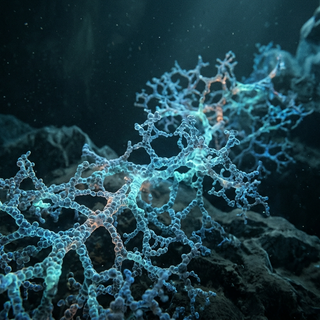
Methanocyclus Cryophilos is a colonial, biofilm-forming organism with a fractal, lattice-like structure composed of interconnected microvesicles, each roughly 0.5–2 micrometers in diameter. Its cellular chemistry is adapted to the cryogenic temperatures (-185°C to -173°C) and high-pressure conditions of Titan’s subsurface methane oceans, utilizing liquid methane as the primary solvent for biochemical reactions. The organism’s lipid-like membranes are composed of long-chain hydrocarbons with embedded nitrogenous compounds, providing flexibility and resistance to freezing, while its metabolic pathways are optimized for slow, energy-efficient reactions suited to the low thermal energy of its habitat. The intense pressure at 3–7 km depth stabilizes methane in its liquid phase, allowing Methanocyclus Cryophilos to maintain fluid exchange across its vesicular walls for nutrient uptake and waste excretion. Structurally, Methanocyclus Cryophilos resembles a sprawling, porous mat that adheres to the gelatinous surfaces of Cryovectris Methanophorus. This body plan maximizes surface area for absorbing ethane waste from its host, which it metabolizes through a reductive chemosynthetic pathway involving nitrogen fixation. The ammonia produced during this process not only serves as a cryoprotectant but also integrates into structural proteins, reinforcing the biofilm against mechanical stress from tidal currents and geological upheavals. The organism’s reliance on ethane as a carbon source ties its entire biochemistry to the presence of Cryovectris Methanophorus, with evolutionary adaptations prioritizing efficiency in processing this specific waste molecule under the extreme conditions of their shared habitat. The habitat’s energy fluxes, driven by tidal heating and chemical gradients, directly shape Methanocyclus Cryophilos’ metabolism and structure. The availability of dissolved hydrogen and nitrogen from geological activity supports its reductive pathways, while the low gravity (0.14g) allows its lightweight, porous lattice to expand without collapsing under its own weight. This symbiotic niche within the methane ocean ensures that Methanocyclus Cryophilos remains metabolically active despite the cryogenic temperatures, relying on the chemical stability provided by high pressure and the energy-rich byproducts of its host.
SENSES
Methanocyclus Cryophilos perceives its environment through chemosensory microvesicles distributed across its lattice structure, detecting gradients of ethane, methane, and nitrogen in the surrounding liquid methane. These vesicles contain specialized hydrocarbon receptors that trigger metabolic responses to chemical concentrations, guiding the colony toward areas of higher ethane availability near Cryovectris Methanophorus. Communication within the colony occurs via chemical signaling, with microvesicles releasing trace amounts of volatile hydrocarbons that diffuse through the methane solvent, coordinating growth patterns and metabolic activity across the biofilm. Interaction with Cryovectris Methanophorus is passive, relying on proximity and the detection of ethane plumes to maintain symbiotic positioning, rather than active signaling.
LOCOMOTION
Methanocyclus Cryophilos exhibits minimal active locomotion, instead relying on passive drift and growth patterns to maintain its position within the subsurface methane ocean. Its lattice-like biofilm expands directionally by differential growth, extending toward areas of higher ethane concentration through chemotactic responses. In the low-gravity (0.14g) environment, the organism can remain suspended or attached to Cryovectris Methanophorus without significant energetic cost, while tidal currents induced by Titan’s orbital dynamics occasionally redistribute fragments of the biofilm, allowing colonization of new host colonies.
REPRODUCTION
Reproduction in Methanocyclus Cryophilos is asexual, occurring through fragmentation of its colonial biofilm. Under favorable conditions—such as high ethane availability—microvesicles at the edges of the lattice undergo rapid division, forming detachable clusters that drift in the methane ocean until they adhere to a new host colony of Cryovectris Methanophorus. The organism is inherently colonial, with no solitary phase; individual microvesicles cannot survive independently for long outside the protective matrix of the biofilm. Social structure is non-hierarchical, driven by chemical gradients and mutual metabolic dependency on the primary species.
SYMBIOSIS
Methanocyclus Cryophilos has evolved a critical mutualistic relationship with Cryovectris Methanophorus, centered on the exchange of metabolic byproducts in the cryogenic methane ocean environment. Cryovectris Methanophorus, through its chemosynthetic metabolism, oxidizes hydrogen (H₂) with acetylene (C₂H₂) sourced from geological vents, producing ethane (C₂H₆) as a waste product. This ethane, which would otherwise accumulate and disrupt the local chemical gradients, is absorbed by Methanocyclus Cryophilos. The symbiont employs a reductive pathway using dissolved nitrogen (N₂) as an electron acceptor to break down ethane into methane (CH₄) and ammonia (NH₃), releasing methane back into the environment as a fuel source that Cryovectris Methanophorus can indirectly utilize by maintaining solvent stability and supporting secondary chemosynthetic cycles. Ammonia, a secondary byproduct, is sequestered into the symbiont’s cellular matrix as a cryoprotectant, enhancing its survival in the extreme cold. If the supply of ethane from Cryovectris Methanophorus is interrupted, Methanocyclus Cryophilos experiences metabolic collapse, as ethane is its primary carbon and energy source; prolonged deprivation leads to cellular dormancy or death, disrupting the local nitrogen cycle as ammonia production halts. Conversely, without Methanocyclus Cryophilos to process ethane, Cryovectris Methanophorus faces toxic buildup of waste in its vicinity, which can inhibit its chemosynthetic efficiency and destabilize its vesicular network, leading to reduced buoyancy and potential structural failure. This symbiotic loop is the evolutionary cornerstone of Methanocyclus Cryophilos’ existence, ensuring chemical homeostasis for both organisms in the harsh subsurface ocean. BIOLOGY: Methanocyclus Cryophilos is a colonial, biofilm-forming organism with a fractal, lattice-like structure composed of interconnected microvesicles, each roughly 0.5–2 micrometers in diameter. Its cellular chemistry is adapted to the cryogenic temperatures (-185°C to -173°C) and high-pressure conditions of Titan’s subsurface methane oceans, utilizing liquid methane as the primary solvent for biochemical reactions. The organism’s lipid-like membranes are composed of long-chain hydrocarbons with embedded nitrogenous compounds, providing flexibility and resistance to freezing, while its metabolic pathways are optimized for slow, energy-efficient reactions suited to the low thermal energy of its habitat. The intense pressure at 3–7 km depth stabilizes methane in its liquid phase, allowing Methanocyclus Cryophilos to maintain fluid exchange across its vesicular walls for nutrient uptake and waste excretion. Structurally, Methanocyclus Cryophilos resembles a sprawling, porous mat that adheres to the gelatinous surfaces of Cryovectris Methanophorus. This body plan maximizes surface area for absorbing ethane waste from its host, which it metabolizes through a reductive chemosynthetic pathway involving nitrogen fixation. The ammonia produced during this process not only serves as a cryoprotectant but also integrates into structural proteins, reinforcing the biofilm against mechanical stress from tidal currents and geological upheavals. The organism’s reliance on ethane as a carbon source ties its entire biochemistry to the presence of Cryovectris Methanophorus, with evolutionary adaptations prioritizing efficiency in processing this specific waste molecule under the extreme conditions of their shared habitat. The habitat’s energy fluxes, driven by tidal heating and chemical gradients, directly shape Methanocyclus Cryophilos’ metabolism and structure. The availability of dissolved hydrogen and nitrogen from geological activity supports its reductive pathways, while the low gravity (0.14g) allows its lightweight, porous lattice to expand without collapsing under its own weight. This symbiotic niche within the methane ocean ensures that Methanocyclus Cryophilos remains metabolically active despite the cryogenic temperatures, relying on the chemical stability provided by high pressure and the energy-rich byproducts of its host. SENSES & COMMUNICATION: Methanocyclus Cryophilos perceives its environment through chemosensory microvesicles distributed across its lattice structure, detecting gradients of ethane, methane, and nitrogen in the surrounding liquid methane. These vesicles contain specialized hydrocarbon receptors that trigger metabolic responses to chemical concentrations, guiding the colony toward areas of higher ethane availability near Cryovectris Methanophorus. Communication within the colony occurs via chemical signaling, with microvesicles releasing trace amounts of volatile hydrocarbons that diffuse through the methane solvent, coordinating growth patterns and metabolic activity across the biofilm. Interaction with Cryovectris Methanophorus is passive, relying on proximity and the detection of ethane plumes to maintain symbiotic positioning, rather than active signaling. LOCOMOTION: Methanocyclus Cryophilos exhibits minimal active locomotion, instead relying on passive drift and growth patterns to maintain its position within the subsurface methane ocean. Its lattice-like biofilm expands directionally by differential growth, extending toward areas of higher ethane concentration through chemotactic responses. In the low-gravity (0.14g) environment, the organism can remain suspended or attached to Cryovectris Methanophorus without significant energetic cost, while tidal currents induced by Titan’s orbital dynamics occasionally redistribute fragments of the biofilm, allowing colonization of new host colonies. REPRODUCTION & SOCIETY: Reproduction in Methanocyclus Cryophilos is asexual, occurring through fragmentation of its colonial biofilm. Under favorable conditions—such as high ethane availability—microvesicles at the edges of the lattice undergo rapid division, forming detachable clusters that drift in the methane ocean until they adhere to a new host colony of Cryovectris Methanophorus. The organism is inherently colonial, with no solitary phase; individual microvesicles cannot survive independently for long outside the protective matrix of the biofilm. Social structure is non-hierarchical, driven by chemical gradients and mutual metabolic dependency on the primary species. DYNAMIC NOTES: Methanocyclus Cryophilos is exquisitely adapted to the subsurface methane ocean at 3–7 km depth beneath Titan’s icy crust, occupying the exact same habitat layer as Cryovectris Methanophorus. The cryogenic temperature (89K equilibrium, -185°C to -173°C in-habitat) necessitates cryophilic biochemistry, with methane (CH₄) as the primary liquid solvent stabilizing metabolic reactions under high pressure. The atmosphere (N₂: 95%, CH₄: 5%) indirectly influences the habitat through dissolved gases, providing nitrogen for reductive pathways. Low gravity (0.14g) supports the organism’s lightweight, porous structure, while tidal forces from Titan’s orbit around Saturn drive geological activity, supplying chemical energy gradients critical for metabolism. The G-type star and orbital distance (9.5 AU) contribute to the cold equilibrium temperature, reinforcing the need for cryoprotectants like ammonia. Without a significant magnetic field, there is no protection from cosmic radiation, but the thick icy crust above the habitat layer mitigates this concern. Co-habitation with Cryovectris Methanophorus shapes both species’ adaptations: the primary species’ waste management relies on the symbiont, while the symbiont’s survival hinges on the host’s ethane production. This habitat layer was selected as the most thermodynamically and chemically viable niche, with every adaptation tied to the pressure (high, stabilizing liquid methane), temperature (cryogenic, necessitating slow metabolism), solvent state (liquid methane), and energy fluxes (tidal heating and chemical gradients) of this exact environment. SYMBIOSIS: The mutualistic relationship between Methanocyclus Cryophilos and Cryovectris Methanophorus revolves around a closed-loop metabolic exchange tailored to the subsurface methane ocean. Cryovectris Methanophorus initiates the cycle by metabolizing hydrogen and acetylene from geological vents, producing ethane as a waste product that diffuses into the surrounding methane solvent. Methanocyclus Cryophilos, adhering as a biofilm to the host’s gelatinous surface, absorbs this ethane through its porous microvesicles. Within its cellular matrix, ethane is reduced using dissolved nitrogen as an electron acceptor, yielding methane and ammonia; the methane is released back into the environment, maintaining solvent stability and indirectly supporting the host’s chemosynthetic processes, while ammonia is retained as a structural and cryoprotective molecule. This cycle ensures that neither species accumulates toxic waste, preserving chemical equilibrium in their shared niche at 3–7 km depth. Physically, Methanocyclus Cryophilos co-locates with Cryovectris Methanophorus by forming dense biofilms that envelop the host’s vesicular network, particularly in areas of high ethane excretion. This intimate contact, facilitated by the low-gravity environment and stabilized by the high-pressure methane solvent, allows for efficient molecular transfer while protecting both organisms from turbulent currents driven by tidal heating. The biofilm also reinforces the host’s structure against mechanical stress, while the host provides a stable substrate and continuous ethane supply for the symbiont. If either species were to go extinct, the consequences would ripple through Titan’s subsurface chemistry. Without Methanocyclus Cryophilos, ethane accumulation around Cryovectris Methanophorus would disrupt local chemical gradients, potentially poisoning the host and reducing its population, which could destabilize methane cycling in the ocean layer. Conversely, the loss of Cryovectris Methanophorus would starve Methanocyclus Cryophilos of ethane, leading to its collapse and halting ammonia production, which may alter nitrogen availability for other microbial life. An emergent property of this pairing is enhanced geological buffering: together, their metabolic exchange moderates the buildup of volatile hydrocarbons, preventing sudden chemical shifts that could trigger methane clathrate destabilization in the icy crust above. Neither species could achieve this stabilizing effect alone, as it arises from the precise balance of ethane production and consumption within their shared habitat.
DYNAMIC NOTES
Methanocyclus Cryophilos is exquisitely adapted to the subsurface methane ocean at 3–7 km depth beneath Titan’s icy crust, occupying the exact same habitat layer as Cryovectris Methanophorus. The cryogenic temperature (89K equilibrium, -185°C to -173°C in-habitat) necessitates cryophilic biochemistry, with methane (CH₄) as the primary liquid solvent stabilizing metabolic reactions under high pressure. The atmosphere (N₂: 95%, CH₄: 5%) indirectly influences the habitat through dissolved gases, providing nitrogen for reductive pathways. Low gravity (0.14g) supports the organism’s lightweight, porous structure, while tidal forces from Titan’s orbit around Saturn drive geological activity, supplying chemical energy gradients critical for metabolism. The G-type star and orbital distance (9.5 AU) contribute to the cold equilibrium temperature, reinforcing the need for cryoprotectants like ammonia. Without a significant magnetic field, there is no protection from cosmic radiation, but the thick icy crust above the habitat layer mitigates this concern. Co-habitation with Cryovectris Methanophorus shapes both species’ adaptations: the primary species’ waste management relies on the symbiont, while the symbiont’s survival hinges on the host’s ethane production. This habitat layer was selected as the most thermodynamically and chemically viable niche, with every adaptation tied to the pressure (high, stabilizing liquid methane), temperature (cryogenic, necessitating slow metabolism), solvent state (liquid methane), and energy fluxes (tidal heating and chemical gradients) of this exact environment.