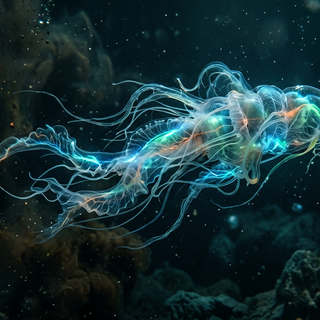
Cryovectris Methanophorus
KNOWN INTEL
CHOSEN HABITAT
Subsurface methane ocean at 3–7 km depth beneath the icy crust. This layer is viable for complex life due to the stability of liquid methane as a solvent under high pressure and cryogenic temperatures (-185°C to -173°C), combined with energy availability from tidal heating and chemical gradients induced by intense geological activity.
BIOLOGY
Cryovectris Methanophorus is a colonial, gelatinous macro-organism adapted to the extreme cryogenic environment of Titan’s subsurface methane oceans, where temperatures range from -185°C to -173°C (mean -179°C). Its cellular chemistry is based on hydrocarbon solvents, utilizing liquid methane (CH₄) as the primary medium for biochemical reactions. Metabolic processes rely on chemosynthesis, harvesting energy from redox reactions between dissolved nitrogen compounds and methane-derived radicals, a direct adaptation to the absence of light at these depths and the availability of atmospheric gases (N2: 95%, CH4: 5%) seeping through the crust. The organism’s structural matrix is composed of flexible, lipid-like polymers that remain pliable at cryogenic temperatures due to integrated antifreeze molecules, preventing solidification in the frigid subsurface ocean environment. The body plan of Cryovectris Methanophorus resembles a sprawling, fractal network of interconnected vesicles, each filled with methane-based fluids that serve as both metabolic reactors and buoyancy regulators. This structure is shaped by the low gravity (0.14g) of Titan, which allows for expansive, low-density forms without significant structural stress, and by the high-pressure environment at 3–7 km depth, which stabilizes liquid methane and necessitates robust vesicle membranes to withstand external forces. The organism’s colonial nature—comprising thousands of semi-autonomous units—evolved as a survival strategy in the resource-scarce subsurface, enabling distributed nutrient absorption across vast areas of the methane ocean floor. Adaptations to the habitat’s extreme cold include quantum-tunneling enzymatic pathways that facilitate chemical reactions at temperatures as low as -185°C, and a remarkably slow metabolic rate, with life cycles spanning centuries, reflecting the low energy flux in this cryogenic niche. The subsurface ocean habitat, insulated by Titan’s thick icy crust, provides a stable thermal and pressure regime compared to the surface, protecting the organism from temperature swings and radiation exposure while maximizing access to dissolved chemical energy sources.
SENSES
Cryovectris Methanophorus perceives its environment through chemical gradient detection and pressure wave sensing, facilitated by specialized vesicles that detect minute changes in methane composition and density fluctuations in the surrounding liquid. These sensory mechanisms allow it to locate nutrient-rich zones and detect geological disturbances caused by Titan’s intense tidal flexing. Communication within the colony occurs via the exchange of chemical signaling molecules—complex hydrocarbon chains—released into the methane medium, which diffuse slowly and create localized “message fields” that synchronize colony behavior over vast distances. This chemical language encodes information about resource availability, colony health, and environmental shifts, enabling coordinated responses across the network.
LOCOMOTION
Movement in Cryovectris Methanophorus is achieved through a combination of buoyancy modulation and peristaltic contractions of its vesicular network. By altering the density of internal methane fluids through controlled chemical reactions, the organism can rise or sink within the subsurface ocean, navigating currents driven by tidal heating. Lateral movement is facilitated by rhythmic contractions of outer vesicles, creating weak propulsive waves that push the colony along the ocean floor or through the liquid medium. The low gravity (0.14g) of Titan minimizes energy costs for such movement, allowing the organism to spread its network over kilometers with minimal effort, while the high-pressure environment ensures structural integrity during these slow, undulating motions.
REPRODUCTION
Cryovectris Methanophorus reproduces through a process of vesicular budding, where individual units within the colony grow to a critical size and detach, forming new sub-colonies that remain chemically linked to the parent network for centuries before achieving independence. It is inherently colonial, with no concept of individuality—each vesicle functions as part of a greater whole, sharing resources and information via chemical conduits. Offspring are not “raised” but are integrated into the colony’s network from the moment of budding, contributing to the collective metabolism and intelligence. Social structure is distributed and egalitarian, with no central hierarchy; decisions emerge from consensus signaled through chemical gradients across the colony. INTELLIGENCE & COGNITION: The intelligence of Cryovectris Methanophorus is distributed across its colonial network, encoded in the dynamic interplay of chemical gradients and pressure oscillations within its vesicles. This emergent cognition operates as a decentralized neural analogue, where each vesicle acts as a node in a vast computational matrix, processing environmental data and coordinating colony-wide responses. Intelligence manifests in sophisticated problem-solving behaviors, such as rerouting nutrient flows to damaged sections of the colony, predicting geological disturbances based on tidal patterns, and modifying the ocean floor through the secretion of stabilizing hydrocarbon films to create favorable microhabitats. Outward expression of intelligence is seen in environmental engineering—constructing intricate, maze-like sediment traps to capture nutrient particles—and in symbolic chemical signaling, where unique molecular patterns serve as “cultural” markers distinguishing one colony from another. This intelligence is consistent with the organism’s biochemistry, as chemical signaling underpins both metabolism and cognition, and the subsurface habitat provides the stable, low-energy environment necessary for such slow, deliberative processing.
DYNAMIC NOTES
Cryovectris Methanophorus is intricately tied to Titan’s environmental parameters, including the equilibrium temperature of -184°C and the surface temperature range of -185°C to -173°C (mean -179°C), which dictate its cryogenic adaptations such as quantum-tunneling biochemistry and slow metabolism. The organism copes with the temperature swing between -185°C and -173°C by modulating internal fluid composition to store thermal energy during warmer periods, using it to sustain minimal metabolic activity during colder extremes. The atmospheric composition (N2: 95%, CH4: 5%) and pressure (1.47 bar) shape its chemistry, providing raw materials for metabolism and maintaining liquid methane stability in the subsurface ocean at 3–7 km depth. The low gravity (0.14g) enables its sprawling, low-density colonial structure, while intense tidal forces from Titan’s moon (mass 0.015 Earth masses at 8.4 Earth radii) drive geological activity that enriches the subsurface with chemical energy via hydrothermal vents and crust fractures, justifying the chosen habitat as a thermodynamically viable niche with stable solvent and energy fluxes. The absence of a significant magnetic field exposes Titan’s surface to stellar radiation from its G-type host star and cosmic rays, but the subsurface habitat shields Cryovectris Methanophorus from this threat, negating the need for radiation-adapted traits or magnetotrophic behaviors. The evolutionary timescale (7/10, ancient biosphere) has allowed for the development of highly specialized adaptations and complex colonial intelligence, driven by competition for scarce resources in the subsurface methane ocean. With only 2% surface coverage by liquid or frozen methane, access to subsurface liquid methane bodies is critical, leading to intense competition among colonies for control of ocean floor territories near vent systems, further accelerating cognitive evolution. Intelligence emerged from the need to navigate and manipulate this resource-scarce, geologically dynamic environment, with the stable pressure and temperature of the subsurface layer accelerating the expression of distributed cognition by providing a predictable niche for chemical signaling and long-term colony growth. Every adaptation—chemical metabolism, vesicular structure, and decentralized intelligence—is directly tied to the pressure, temperature, methane solvent state, and tidal energy fluxes of the subsurface ocean layer.