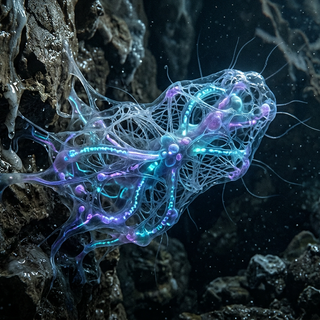
Cryolithospora regolithica
KNOWN INTEL
CHOSEN HABITAT
Subsurface pressurized CO₂ liquid aquifers at 2–4 km depth within regolith. This layer is viable because tidal flexing and geothermal gradients raise local temperatures to -110°C to -90°C while overburden pressure exceeds 30 bar, stabilizing liquid CO₂ against the surface range of -134°C to -88°C.
BIOLOGY
Cellular chemistry relies on liquid CO₂ as solvent with dissolved ammonia traces acting as antifreeze and proton shuttle. Metabolic pathways are chemosynthetic, oxidizing trace methane and hydrogen sulfide vented by tidal fracturing of the crust; enzymes are stabilized by fluorinated proteins that remain flexible at -110°C. Structural materials consist of silica–CO₂ clathrate lattices forming flexible tubular networks that resist crushing at depth while permitting slow flow through regolith pores. The habitat layer enforces a sessile-colonial body plan: individual modules are millimeter-scale vesicles linked by kilometer-scale hyphal strands that permeate the regolith. Daily temperature swings between -134°C and -88°C are buffered by endothermic clathrate phase transitions that absorb heat during warming and release it during cooling, preventing solvent freezing.
SENSES
Magnetoreception via aligned magnetite crystals detects the 2.82 Gauss field fluctuations caused by tidal currents; pressure-wave sensors along hyphae register seismic tremors from the 5.4115-Earth-mass moon. Chemical gradients are read through membrane-bound receptors that map CO₂ density and dissolved reductant plumes. Communication occurs via propagating pH waves and timed releases of volatile fluorocarbons that travel through connected hyphal conduits.
LOCOMOTION
Movement occurs by peristaltic contraction of clathrate tubules that squeeze liquid CO₂ forward, pushing the colonial mass through interconnected regolith pores at rates of centimeters per day; tidal micro-quakes provide occasional bulk displacement.
REPRODUCTION
Reproduction is by fragmentation: hyphal strands detach and nucleate new colonial modules when liquid CO₂ flow increases. The organism is a distributed colonial super-organism with no discrete individuals; resource sharing occurs continuously across the network. INTELLIGENCE & COGNITION: Intelligence is emergent from synchronized chemical oscillators distributed throughout the hyphal network. Problem-solving manifests as selective reinforcement of flow pathways that optimize access to reductant vents; over evolutionary time this produces persistent territorial mapping and seasonal rerouting of the entire colony in response to tidal cycles.
DYNAMIC NOTES
The equilibrium temperature of -177°C and surface range of -134°C to -88°C are offset by 2–4 km of insulating regolith plus tidal heating that maintains the chosen liquid-CO₂ layer. Earth-like atmospheric composition at 1.847 bar supplies trace methane and hydrogen sulfide that diffuse downward to fuel chemosynthesis. Gravity of 0.831g reduces compaction stress on the fragile clathrate tubules. The moderate 2.82 Gauss magnetic field provides adequate radiation shielding from the G-type star at 8.043 AU, allowing the long 7/10 evolutionary timescale to produce distributed colonial intelligence without lethal mutation loads. Surface coverage of 90 % CO₂ ice restricts liquid solvent to these subsurface aquifers, driving intense competition for vent proximity and selecting for network-level cognition that can locate and monopolize geothermal upwellings. Daily thermal cycling between -134°C and -88°C is countered by clathrate buffering and metabolic down-regulation during coldest periods. The ancient biosphere permitted refinement of magnetosensitive and seismic intelligence as the primary adaptations to tidal and magnetic environments.